Behind-the-Meter vs Front-of-the-Meter – What Is the Difference?
The utility meter looks like the least interesting piece of equipment on any site. It does not generate anything, store anything or switch anything. Yet it marks the line where the utility's world ends and the customer's begins, and that line decides who owns the equipment, who regulates it and what a kilowatt-hour is worth. People toss around "behind-the-meter" and "front-of-the-meter" as if everyone already knows the rules. So what is the real difference between behind-the-meter vs front-of-the-meter, and why should a facility owner care?
Behind-the-meter (BTM) equipment sits on the customer's side of the utility meter and serves the customer's own load, while front-of-the-meter (FTM) equipment sits on the utility side and serves the grid. Rooftop solar, a backup generator or a factory's gas plant is behind the meter, because it cuts what the customer buys.
A utility-scale solar farm, a grid battery or a central power plant is in front of the meter, because it sells power to the grid. BTM energy is valued against the retail price the customer would otherwise pay; FTM energy earns wholesale or contract prices. The same technology can sit on either side.
Where Exactly Is the Meter?
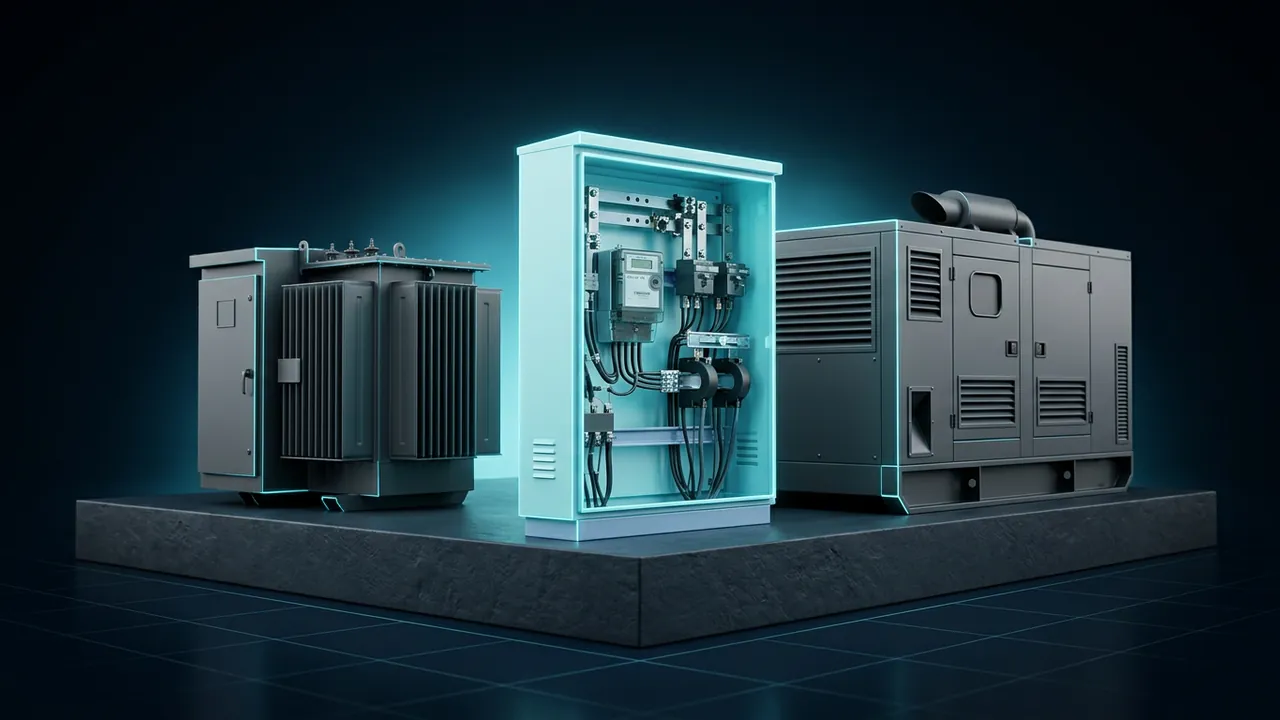
The revenue meter sits at the point of delivery, where the utility hands power to the customer. On a house, that is the round glass meter on the wall. On a large industrial or data center site, it is usually a set of instrument transformers and a meter cabinet at the service entrance or inside a substation, often at medium or high voltage.
Everything upstream of that point, toward the power plants, is front of the meter. Everything downstream, toward the customer's equipment, is behind it.
What Counts as Behind-the-Meter?
Anything that produces, stores or manages power on the customer's side. Enverus defines behind-the-meter generation as electricity produced on the customer's side of the utility meter, listing examples such as on-site gas generators, rooftop solar, fuel cells and batteries, in contrast to centralized utility-scale generation.
Common BTM examples include:
- Standby diesel or gas generators at hospitals and data centers.
- Combined heat and power plants at factories and universities.
- Rooftop or carport solar on commercial buildings.
- Batteries that shave peak demand or provide backup.
- Prime power plants at remote industrial sites.
The customer usually owns or contracts for the equipment and benefits directly from every kilowatt-hour it avoids buying.
What Counts as Front-of-the-Meter?
Equipment that connects to the grid as a supplier. FTM assets include utility-owned power plants, independent wind and solar farms, grid-scale batteries and transmission-connected gas plants. They interconnect as generators, follow the rules of the utility or regional grid operator, and earn money by selling energy, capacity or grid services.
A data center can still buy power from FTM assets, of course. That is what happens every time it pays its utility bill, or when it signs a power purchase agreement with a distant wind farm. The power travels over the grid and through the meter.
Behind-the-Meter vs Front-of-the-Meter, Side by Side
| Question | Behind the meter | Front of the meter |
|---|---|---|
| Who does it serve? | The customer's own load | The grid and all its customers |
| Who usually owns it? | The customer or a contractor | A utility or independent power producer |
| What sets its value? | Avoided retail energy and demand charges, plus resilience | Wholesale prices, capacity payments or contracts |
| Interconnection rules | Utility customer-generation rules, often lighter if non-exporting | Full generator interconnection studies |
| Typical size | Kilowatts to hundreds of megawatts | Megawatts to gigawatts |
| Examples | Backup gensets, CHP, rooftop solar, site batteries | Central plants, wind and solar farms, grid batteries |
Why Is a Kilowatt-Hour Worth More Behind the Meter?
Because it replaces a retail purchase, which includes delivery and other charges, not just the cost of making the energy. Illustrative example, using assumed prices:
- A commercial customer pays an energy rate of $0.09 per kWh plus a demand charge of $15 per kilowatt (kW) of monthly peak.
- A BTM battery cuts the monthly peak by 1,000 kW. Savings: 1,000 × $15 = $15,000 per month from demand charges alone.
- BTM generation that displaces 1,000 kWh of purchases saves about 1,000 × $0.09 = $90.
- The same 1,000 kWh sold in front of the meter at an assumed wholesale price of $0.04 per kWh earns $40.
The BTM value is higher per unit, but it is capped by the customer's own load and rate design. FTM assets can scale far beyond any single customer. Real tariffs vary widely, so the actual numbers depend on your utility.
Can the Same Equipment Be Both?
Sometimes. A battery or solar array behind the meter can export surplus power under net metering or a utility program, which gives it a front-of-the-meter flavor. Large customers with on-site plants sometimes sell excess power when rules allow. The physical location stays behind the meter, but part of the revenue comes from the grid side, and that usually triggers more interconnection review and metering.
Where Does Off-Grid Fit?
Off-grid is behind-the-meter taken to its limit: there is no utility meter at all, because there is no utility connection. Remote oil and gas sites, mines, island communities and some data centers run this way. Every rule about backup, redundancy and fuel supply gets stricter, because nothing else will catch the load. If you are heading that direction, our primer on how to design an off-grid power system walks through the steps.
Which Side Makes Sense for a Data Center?
For most data centers, both, in different roles. The bulk of the energy usually comes from front-of-the-meter plants over the grid, because a strong utility connection is hard to beat on cost and simplicity. Behind the meter, the site keeps standby generators and UPS systems for resilience.
The balance shifts when the grid cannot deliver enough power on time, when the site is remote, or when cheap gas sits nearby. Then a behind-the-meter plant may run every day, with the utility as backup or not present at all. The questions that decide it:
- How soon can the utility serve the full load, and at what cost?
- Is reliable fuel available on site, and can you get air permits for generation?
- Do you have, or can you hire, people to run a power plant around the clock?
- Will the utility let you export, and do you even want to?
The Meter Draws the Line, and the Line Sets the Rules
Behind-the-meter vs front-of-the-meter comes down to which side of the revenue meter the equipment sits on. Behind the meter serves your own load and saves money at retail rates. Front of the meter serves the grid and earns money at wholesale or contract prices. The technology can be identical; the rules, owners and economics are not.
Before choosing, check your utility's tariffs, its rules for customer generation and export, and any state requirements. Those details often decide whether a project pencils out on the customer side or makes more sense as a grid-side asset.