What Is a Microgrid? – Island Mode, Controllers and Uses
A storm knocks out power across a whole county. Streetlights go dark, traffic signals blink out, and most buildings sit silent. But here and there, a hospital, a military base or a university campus keeps humming along as if nothing happened. They are not just running a backup generator. Many of them are running their own small power grid. So what is a microgrid, and how does it keep the lights on when the big grid fails?
A microgrid is a local power system with its own generation, storage and loads inside a defined electrical boundary, which can run connected to the utility grid or disconnect and run on its own in "island mode."
The U.S. Department of Energy's widely used definition describes it as a group of interconnected loads and distributed energy resources that acts as a single controllable entity with respect to the grid and can connect and disconnect from it. A controller coordinates the generators, batteries and solar so supply always matches demand. What separates a microgrid from a pile of backup equipment is that control system.
What Is a Microgrid? Three Tests It Must Pass
Not every building with a generator is a microgrid. Three features set a true microgrid apart.
- A clear electrical boundary. Everyone should be able to point at the one-line diagram and say exactly which loads and sources are inside. That boundary usually ends at a single point where the microgrid meets the utility, called the point of common coupling.
- Local energy sources. Generators, solar panels, fuel cells or batteries inside the boundary that can carry the critical load without the utility.
- Coordinated control. A controller that manages all of those sources together, decides when to island and when to reconnect, and keeps frequency and voltage steady.
A single standby generator with an automatic transfer switch fails the third test. It serves one building and starts only when the utility drops out. A microgrid manages many sources and loads as a system, and it can choose to run independently even when the grid is healthy.
What Is Island Mode in a Microgrid?
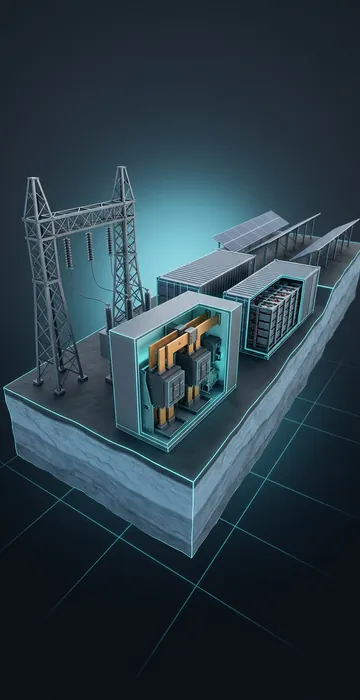
Island mode is when the microgrid disconnects from the utility and runs entirely on its own sources. The switch at the point of common coupling opens, and everything inside the boundary becomes its own small electrical island.
There are two ways to get there. A planned island happens on purpose, for example before a forecast storm or during a period of high grid prices. An unplanned island happens when the utility fails and protective relays open the tie automatically. Planned transitions can be smooth because the controller has time to match the microgrid's output to its load before opening the switch. Unplanned transitions are harder, because the load that was being served partly by the grid suddenly lands on local sources.
Once islanded, the microgrid has to do what the big grid normally does. Something inside the boundary must set the frequency and voltage for everyone else. That is usually a spinning generator or a battery inverter running in "grid-forming" mode. Other sources follow its lead. If no source can hold that reference, the island collapses.
Reconnecting is just as careful. The controller adjusts the microgrid's voltage, frequency and phase angle to match the utility, then closes the switch at the right instant. Close it out of step and the shock can damage equipment, which is why protective relays check synchronization before allowing it.
What Happens During a Grid Outage, Step by Step?
Here is how a typical microgrid with a battery and gas generators rides through an unplanned outage. Exact timing depends on the design, but the sequence is common.
- The utility fails. A fault somewhere upstream drops voltage at the point of common coupling.
- Protection reacts. Relays sense the abnormal voltage or frequency and open the tie switch, often within a fraction of a second, so the microgrid does not try to power the whole neighborhood.
- The battery holds the island. Its inverter, running in grid-forming mode, sets voltage and frequency and picks up the load instantly.
- Low-priority loads drop. The controller sheds non-critical circuits if the local sources cannot cover everything.
- Generators start and sync. Within seconds to minutes, gas units come up to speed, synchronize to the island and take over the bulk of the load, letting the battery recharge.
- Shed loads return. As capacity allows, the controller brings non-critical circuits back in blocks.
- The grid comes back. Once utility power is stable for a set time, the controller matches the island to it and recloses the tie.
Without a battery, step 3 is replaced by a short outage inside the microgrid while generators start, which is why critical loads often also sit behind an uninterruptible power supply (UPS).
How Big Can a Microgrid Be?
Microgrids span an enormous range. At the small end, a remote telecom shelter with a few kilowatts of solar, a battery and a small generator meets the definition. In the middle, a hospital or office campus might run a few megawatts. At the large end, a university, military installation or industrial plant may operate tens of megawatts, and an island utility can be larger still. Size changes the equipment, not the idea: a boundary, local sources and a controller.
What Is Inside a Microgrid?
The parts list varies, but most microgrids include some combination of these:
- Dispatchable generation: natural gas or diesel generators, gas turbines, fuel cells or combined heat and power (CHP) units that can run whenever needed
- Variable generation: solar panels or wind turbines that produce when weather allows
- Energy storage: battery energy storage systems (BESS) that respond in milliseconds and smooth everything else
- Switchgear and protection: breakers, relays and the tie switch at the point of common coupling
- Loads: buildings, process equipment and servers, often split into critical and non-critical groups so the controller can shed the less important ones
- Controls and communication: the brain of the system and the network that connects it to every device
The mix depends on the job. A remote mine might rely on diesel and solar. A university campus might run a gas CHP plant that heats buildings while making power. A telecom site might use solar and batteries with a small generator as backup.
What Does the Microgrid Controller Do?
The controller is what turns a collection of equipment into a microgrid. It decides which generators run, how much each one produces, when to charge or discharge the batteries, when to shed load and when to island or reconnect.
The Institute of Electrical and Electronics Engineers (IEEE) has a standard specifically for this, IEEE 2030.7-2017, which defines the functions a microgrid controller must perform, including managing the transitions between grid-connected and islanded operation. If you want to see what happens inside that box second by second, our guide to the microgrid controller covers it in detail.
Where Are Microgrids Used?
Anywhere an outage is expensive, dangerous or likely. The most common homes for microgrids include:
- Military bases, where critical missions cannot depend on a commercial grid
- Hospitals and emergency services, which need power during exactly the disasters that take the grid down
- University and corporate campuses, often built around a central heating and power plant
- Islands and remote communities, where the microgrid may be the only grid there is
- Mines, oil and gas facilities and other industrial sites far from transmission lines
- Data centers, which are increasingly designed with on-site generation and storage that behaves like a microgrid
- Telecom sites, where solar and batteries can stretch limited fuel supplies
That last point has real numbers behind it. In a 2017 study on resilient renewable energy microgrids, the National Renewable Energy Laboratory (NREL) found that adding solar and a battery to a site backed by a 300 kW diesel generator extended how long it could ride out a grid outage by about 1.8 days. The same report noted that on-site diesel supplies typically last only one to two days.
Microgrid vs Backup Generator: What Is the Difference?
People mix these up constantly, so here is a side-by-side view.
| Feature | Backup generator | Microgrid |
|---|---|---|
| Sources | Usually one type, often diesel | Several, often mixed |
| When it runs | Only during outages and tests | Can run any time, grid-connected or islanded |
| Control | Transfer switch and engine controls | Central controller coordinating everything |
| Grid interaction | Usually none | Can share load, island and reconnect |
| Typical benefit | Survive an outage | Survive outages, cut costs, use local energy |
What Are the Benefits and Challenges of a Microgrid?
The main benefit is resilience. A well-designed microgrid keeps critical loads running through grid outages for as long as its fuel or storage lasts. Many also save money by running efficient on-site generation, using waste heat, or cutting purchases from the utility at expensive times.
The challenges are cost and complexity. A microgrid needs more equipment, more engineering and more careful protection design than a simple backup system. Interconnection rules with the local utility can take time to work out, and operators need training to run the system well. Check with your utility and state regulator early about the rules for parallel operation.
A Small Grid With a Big Job
So, what is a microgrid? It is a small, self-contained power system that can work with the utility or without it, held together by a controller that keeps supply and demand in balance every second. Island mode is its signature trick, and it only works when something inside the boundary can set frequency and voltage for everyone else.
A good first exercise costs nothing: list the loads that truly must stay on, how long they must run without the grid, and which fuel you can count on. Every piece of equipment in the design follows from that list.