How to Size a Battery Energy Storage System – MW vs MWh
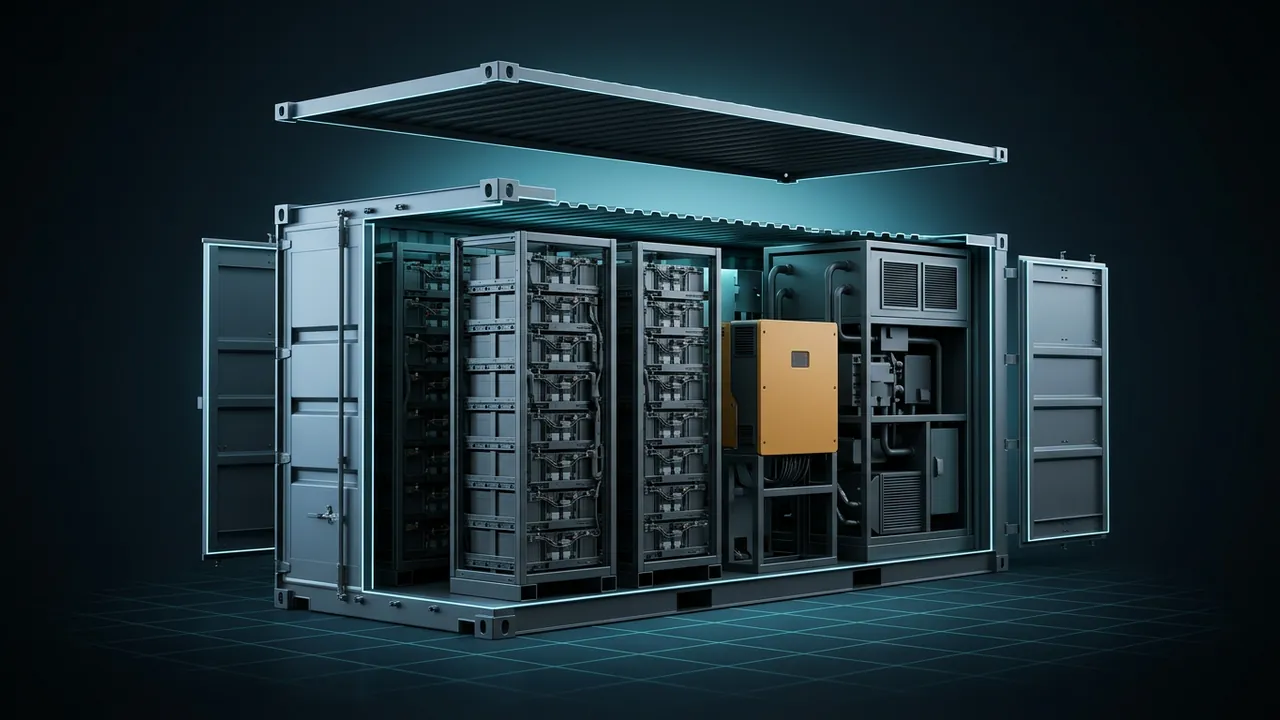
Battery quotes arrive with two numbers, and people mix them up all the time. One is in megawatts. The other is in megawatt-hours. A vendor offering a "10 MW battery" hasn't told you how long it lasts, and a "40 MWh battery" hasn't told you how hard it can push. Order the wrong ratio and you get a system that either can't carry the load or runs out of energy halfway through the job. How do you get BESS sizing right, and what is the real difference between MW and MWh?
BESS sizing, short for battery energy storage system sizing, means choosing two separate numbers: the power rating in MW, which sets how much load the battery can carry at once, and the energy capacity in MWh, which sets how long it can carry that load. Divide MWh by MW and you get the duration in hours, so a 10 MW / 40 MWh system is a four-hour battery.
To size one, start with the job (backup, peak shaving, smoothing or solar shifting), work out the power and energy that job needs, then add margin for inverter losses, the depth of discharge you'll allow and capacity fade over the system's life.
What's the Difference Between MW and MWh?
MW is a rate, and MWh is an amount. A megawatt measures how fast energy flows right now. A megawatt-hour measures how much energy flows over time. One MW sustained for one hour delivers one MWh.
A water tank is a decent picture. The pipe size is MW: how fast water can come out. The tank volume is MWh: how much water is in there. A huge tank with a small pipe empties slowly. A small tank with a big pipe empties fast.
Battery people also use duration (MWh ÷ MW) and C-rate (MW ÷ MWh). A four-hour battery has a C-rate of 0.25. A one-hour battery has a C-rate of 1. High C-rate batteries are built for power; low C-rate batteries are built for energy.
Step 1: What Job Will the Battery Do?
The job sets the shape of the battery, so define it first. Different jobs need very different MW-to-MWh ratios.
| Job | Typical duration | What drives the size |
|---|---|---|
| UPS ride-through | 5 to 15 minutes | Peak load (MW) |
| Load smoothing and generator support | Under 1 hour | Size of load steps (MW) |
| Peak shaving | 1 to 4 hours | Height and length of peaks |
| Backup for outages | 2 to 8 hours or more | Load × hours of coverage |
| Solar shifting | 4 to 14 hours | Evening and overnight load |
Many projects stack jobs. That's fine, but size for the most demanding one and confirm the others fit inside it.
Step 2: How Much Power Does the Load Need?
The power rating has to cover the highest load the battery will carry, plus any short bursts. Pull real interval data if you have it, not nameplate ratings.
Two details catch people. First, inverters are rated in kVA, not just kW, so power factor matters. A 2,000 kW load at a 0.9 power factor needs 2,000 ÷ 0.9 = about 2,222 kVA of inverter capacity. Second, motors draw several times their running current when they start, so an off-grid site with big pumps or compressors needs headroom for those inrush spikes.
Step 3: How Much Energy Does the Job Need?
Energy is load times hours. If the battery must carry 2 MW for 4 hours, the load needs 2 × 4 = 8 MWh delivered at the terminals. That's the starting point, not the answer, because a battery can't deliver its full nameplate energy for its whole life.
Step 4: Add the Margins
Usable energy is always less than nameplate energy. Three margins close the gap. The chart below shows how they stack up for the 2 MW, 4-hour example.
2 MW backup for 4 hours: energy needed at each sizing step
Model: assumed 96% inverter efficiency, 90% allowed depth of discharge and 80% end-of-life capacity; illustrative sizing, not a vendor quote.
View the data
| Battery energy | |
|---|---|
| Delivered to load | 8.0 MWh |
| Plus inverter losses | 8.3 MWh |
| Plus depth of discharge reserve | 9.3 MWh |
| Plus end-of-life margin | 11.6 MWh |
- Inverter and conversion losses: at an assumed 96% efficiency, 8 ÷ 0.96 = about 8.33 MWh must leave the battery.
- Depth of discharge: if you allow the battery to use 90% of its capacity, 8.33 ÷ 0.90 = about 9.26 MWh.
- End-of-life capacity: lithium batteries lose capacity with age and cycling. If the warranty guarantees 80% at end of life, 9.26 ÷ 0.80 = about 11.6 MWh at the start.
So a job that sounds like "8 MWh" needs roughly 11.6 MWh of nameplate capacity on day one. That's 45% more battery. Some owners plan smaller and add modules later, an approach called augmentation, which spreads cost over time.
Don't forget auxiliary loads. Battery containers run heating, ventilation and air conditioning to keep cells in their temperature range, and in hot climates that draw is noticeable. Off-grid systems have to supply it from the battery itself.
How Do Battery Cycles Affect Sizing?
Battery cycles affect sizing because every full charge and discharge wears the cells a little. Warranties usually limit both years and total cycles, so the duty you plan changes how long the battery lasts.
Assume a warranty of 6,000 full cycles and see how the duty changes things:
- One full cycle a day: 6,000 ÷ 365 = about 16 years of cycling
- Two full cycles a day: about 8 years
- Backup only, with a few test cycles a month: cycle life is rarely the limit; calendar aging is
That's why a battery doing peak shaving in the afternoon and solar shifting overnight may need a bigger MWh rating than either job alone suggests. A larger battery cycles more shallowly for the same energy, and shallower cycles generally mean slower wear. Ask vendors for degradation curves at your actual duty, not just a headline cycle count.
A Worked Peak Shaving Example
Peak shaving sizing starts from the load profile. Take a hypothetical facility:
- Facility normally draws 5 MW, but peaks at 6.5 MW for about 3 hours on summer afternoons
- Goal: hold grid demand at 5 MW
- Power needed: 6.5 − 5 = 1.5 MW
- Energy needed: peaks aren't flat, so average the excess; say the average is 1.0 MW over 3 hours, so 3 MWh
- With the same margins (96%, 90%, 80%): 3 ÷ 0.96 ÷ 0.90 ÷ 0.80 = about 4.3 MWh nameplate
- Result: roughly a 1.5 MW / 4.3 MWh system, close to a three-hour battery
The risk in peak shaving is the day the peak runs longer than expected. If the battery empties at hour two and demand charges are based on the single highest interval, one bad afternoon can wipe out a month of savings. Size with a buffer or pair the battery with load control.
How Do You Size a Battery for Off-Grid Use?
Off-grid sizing adds days of autonomy: how many days the battery must carry the load with little or no charging. Solar off-grid designers have used this method for decades. The Louisiana Department of Natural Resources stand-alone PV sizing worksheet walks through it, combining daily load, design-month sun hours, days of autonomy and depth of discharge.
The formula is daily load × days of autonomy ÷ depth of discharge ÷ efficiency. A 100 kWh-per-day remote site with three days of autonomy, 80% depth of discharge and 95% efficiency needs 100 × 3 ÷ 0.8 ÷ 0.95 = about 395 kWh. That's why off-grid batteries get big fast, and why most remote systems keep a generator for long stretches of bad weather.
Even modest storage helps a lot. An NREL study of resilient renewable microgrids found that adding 845 kW of solar and a 155 kW / 172 kWh battery to a 300 kW diesel-backed site extended its resilience by about 1.8 days, mostly by stretching the fuel.
What Mistakes Happen in BESS Sizing?
The same mistakes show up again and again:
- Sizing from nameplate MWh instead of usable, end-of-life MWh.
- Matching MWh but forgetting the inverter's kVA limit.
- Using monthly bills instead of 15-minute interval data for peak shaving.
- Ignoring temperature, which affects both capacity and aging.
- Assuming one cycle a day when the actual duty is two or three.
- Expecting a battery to cover multi-day outages it was never sized for.
When Is a Battery the Wrong Tool?
A battery is the wrong tool when the job is measured in days or weeks rather than hours. Energy storage costs scale with MWh, so long durations get expensive quickly, and the battery sits partly idle most of the time.
For continuous power, especially at remote sites, a firm source makes more sense: gas generators, a grid connection or, for the future, a microreactor designed to run for years without refueling. Batteries then do what they're best at: fast response, smoothing and short-term backup.
BESS Sizing in Three Questions
Good BESS sizing comes down to three questions. How many MW does the job need at its peak? How many MWh does it need from start to finish? And how much margin covers losses, depth of discharge and aging?
Answer those with real load data, and the MW and MWh numbers fall out naturally. Then check the inverter kVA, the cooling load and the warranty terms before you sign. A battery sized this way will still do its job in year ten, not just on commissioning day.