How Much Does It Cost to Power a Data Center? – $/MWh and Bills
A 10 MW data center that runs flat out all year uses 87,600 megawatt-hours of electricity for its servers alone. Add cooling and electrical losses, and the number climbs past 100,000 MWh. At those volumes, a few dollars per megawatt-hour moves the annual bill by hundreds of thousands of dollars. For many operators, power is the biggest operating expense once the building is up. How much does it cost to power a data center, and what actually sets the bill?
Data center electricity cost equals the IT load times the PUE times the hours it runs times the all-in price per megawatt-hour. For example, 1 MW of IT at a PUE of 1.5 and $70 per MWh comes to about $920,000 a year. That all-in price is set by more than energy: demand charges, transmission and capacity costs, riders and taxes all land on a large customer's bill. Big sites often pay lower industrial or transmission-level rates, and a steady load spreads fixed demand charges over more megawatt-hours.
How Do You Calculate Data Center Electricity Cost?
You calculate it with four numbers: IT load, PUE, hours and price. Power usage effectiveness (PUE) is total facility energy divided by IT energy, so it captures the cooling, lighting and electrical losses on top of the servers.
Here is the formula: annual cost = IT load (MW) × PUE × 8,760 hours × average utilization × $/MWh.
A worked example with labelled inputs:
- IT load: 5 MW of installed capacity.
- Average utilization: 80%, so the servers draw an average of 4 MW.
- PUE: 1.4, so the facility draws 4 × 1.4 = 5.6 MW on average.
- Annual energy: 5.6 MW × 8,760 hours = 49,056 MWh.
- All-in price: $75 per MWh (7.5 cents per kWh).
- Annual cost: 49,056 × $75 = about $3.68 million.
Notice the utilization line. A site rarely runs at 100% of its installed IT capacity. Using nameplate numbers without a utilization factor is a common way to overstate the bill, and a common way to oversize a power supply.
How Much Does PUE Change the Bill?
PUE changes the bill in direct proportion. Every 0.1 of PUE adds 10% of the IT energy on top. On a large site, that difference is easily worth millions of dollars a year.
The chart below models a 10 MW IT load running at full utilization all year, priced at $70 per MWh, at different PUE values.
Full utilization, 8,760 hours, $70 per MWh
Model: 10 MW IT x PUE x 8,760 h x $70/MWh; illustrative inputs, not market data
View the data
| Annual cost ($ millions) | |
|---|---|
| PUE 1.2 | $7.4M |
| PUE 1.4 | $8.6M |
| PUE 1.6 | $9.8M |
| PUE 1.8 | $11.0M |
| PUE 2.0 | $12.3M |
Going from a PUE of 2.0 to 1.4 saves about $3.7 million a year in this model, which is enough to pay for a lot of cooling upgrades. The Green Grid's comprehensive examination of the PUE metric explains how to measure it consistently, which matters if you are comparing sites or vendor claims. For the basics of the ratio, see our guide to power usage effectiveness.
Try your own numbers in the calculator below. Enter your IT load, PUE and price per MWh to see facility load, yearly energy and annual cost.
What Is Actually on a Large Data Center Power Bill?
A large customer's bill has several parts, and the energy charge is only one of them. The exact structure depends on the utility tariff or supply contract, but most include some version of these:
| Charge | Billed on | What it pays for |
|---|---|---|
| Energy charge | $ per kWh or MWh used | Fuel and generation |
| Demand charge | $ per kW of peak demand per month | Generation, wires and capacity sized for your peak |
| Transmission and capacity charges | Peak demand or coincident peak | The grid's high-voltage system and reserve capacity |
| Riders and fuel adjustments | Usually per kWh | Fuel cost swings, programs and special recovery |
| Customer and facilities charges | Fixed monthly | Meters, substations and dedicated equipment |
| Taxes and fees | Percent of bill or per kWh | State and local requirements |
In deregulated markets such as much of Texas, the energy might come from a retail supplier while the wires charges come from the local utility. In regulated states, one utility bills it all, often under a large power or industrial tariff with its own rules.
Why Does Load Factor Matter So Much?
Load factor matters because demand charges are fixed for the month, no matter how many hours you run. Load factor is average demand divided by peak demand. Data centers usually run steady, which gives them high load factors and a lower blended price per MWh.
Here is a labelled example. Say a site peaks at 12 MW and its tariff charges $15 per kW-month for demand.
- Monthly demand charge: 12,000 kW × $15 = $180,000.
- At 90% load factor, it uses 12 × 0.9 × 730 hours = 7,884 MWh a month. The demand charge adds $180,000 ÷ 7,884 = about $23 per MWh.
- At 50% load factor, it uses 4,380 MWh. The same demand charge adds about $41 per MWh.
That is why a steady data center can pay a lower average rate than a factory with the same peak. It is also why a single spike, such as a cooling plant test at the wrong moment, can set the demand charge for the whole month.
What Drives the Price per Megawatt-Hour?
The price depends mainly on where you are, how you buy and at what voltage you connect. The U.S. Energy Information Administration's Electricity Monthly Update tracks average retail prices by sector, and industrial customers consistently pay well below residential and commercial customers, partly because they take power at higher voltage and use it steadily.
The main drivers:
- Region. Prices vary widely between states and grid regions.
- Fuel prices. Natural gas plants often set the market price, so gas price swings flow through to power prices.
- Service voltage. Taking power at transmission voltage, with your own substation, avoids distribution charges.
- Contract type. Fixed-price supply deals, index pricing and power purchase agreements spread risk in different ways.
- Peak timing. Some grids charge transmission costs based on demand during a few system peak hours each year, so cutting load in those hours saves real money.
How Do Large Data Centers Buy Power?
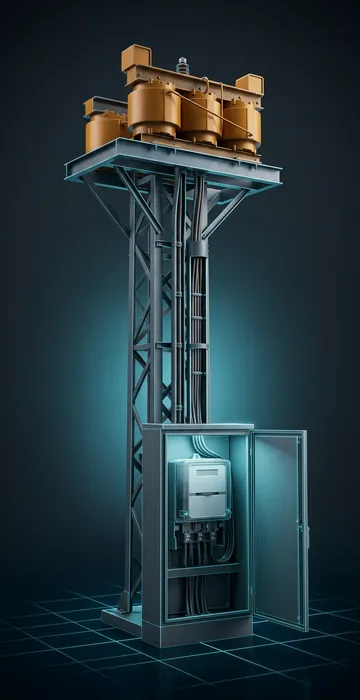
Large data centers buy power in one of a handful of ways, and the choice shapes both the price and the risk. Small sites simply take the utility's standard commercial or industrial rate. Bigger ones negotiate.
- Standard tariff. The utility's published large power rate, with its demand charges and riders.
- Special contract. A negotiated agreement for a very large load, often with minimum bills, longer terms and dedicated facilities.
- Retail choice. In competitive states, a supplier sells the energy at a fixed or index price while the utility delivers it.
- Power purchase agreement. A long-term deal with a specific generator, sometimes financial rather than physical.
- On-site generation. Engines, turbines, fuel cells or solar owned by the site or a third party.
A useful rule of thumb for comparing offers: on 1 MW of IT load at a PUE of 1.5, running all year, every $10 per MWh is worth 13,140 MWh × $10 = $131,400 a year. Multiply by your megawatts, and a few dollars at the negotiating table becomes real money.
Is On-Site Generation Cheaper Than Grid Power?
Sometimes, and the fuel math is the starting point. A gas generator's fuel cost per MWh equals its heat rate times the gas price. Say an engine plant runs at 9,000 Btu per kWh and gas costs $3 per MMBtu (million Btu). Fuel then costs 9,000 × $3 ÷ 1,000 = $27 per MWh.
That is only fuel. Add maintenance, staff, the capital cost of the engines or turbines, redundancy and financing, and the all-in cost can land well above the fuel number. On-site power wins when grid power is expensive, slow to arrive or unavailable, and when the gas supply is cheap and reliable. When you take a project to lenders, those assumptions belong front and center in your energy project investor deck, with the heat rate, fuel price and capital cost each spelled out.
How Can a Data Center Cut Its Electricity Cost?
The biggest levers are lower PUE, better utilization, smart contracts and peak management. In rough order of payback:
- Fix airflow with containment and blanking panels, then raise supply temperatures.
- Add economizer hours so compressors run less.
- Retire or consolidate idle servers, which draw power without doing useful work.
- Negotiate the tariff or supply contract, including voltage level and demand ratchets.
- Manage load during system peaks, using storage or on-site generation where allowed.
Data Center Electricity Cost Comes Down to Four Numbers
Most people who guess at a power bill get the formula right and the price wrong. The rate on the tariff sheet is not your rate; your blended rate, after demand, transmission and capacity charges, is.
Start by pulling 12 months of bills and calculating your real blended $/MWh and PUE. Then model what a 0.1 drop in PUE, a better contract or a change in service voltage would save. On a multi-megawatt site, those numbers usually justify the time it takes to find them.