How Much Water Does a Data Center Use? – Gallons per MW
Water has become the question at almost every public hearing for a new data center. Neighbors want to know if the building will drain their wells. Developers want to know how much to plan for. The answer surprises both groups, because two data centers of the same size can differ by a factor of a hundred. So how much water does a data center use, and how many gallons per megawatt should you plan for?
Data center water usage for a site cooled by evaporative towers runs roughly 10,000 to 12,000 gallons a day for each megawatt of IT load. A site cooled by dry coolers or closed liquid loops can use close to zero. The first figure comes from the 1.9 liters per kWh average water usage effectiveness cited by the Environmental and Energy Study Institute. On top of that is indirect water, used by the power plants that make the electricity, which can match or exceed on-site use.
Where Does a Data Center's Water Actually Go?
Almost all of it goes to cooling, and most of that leaves as water vapor. Drinking fountains and restrooms barely register. The big users are:
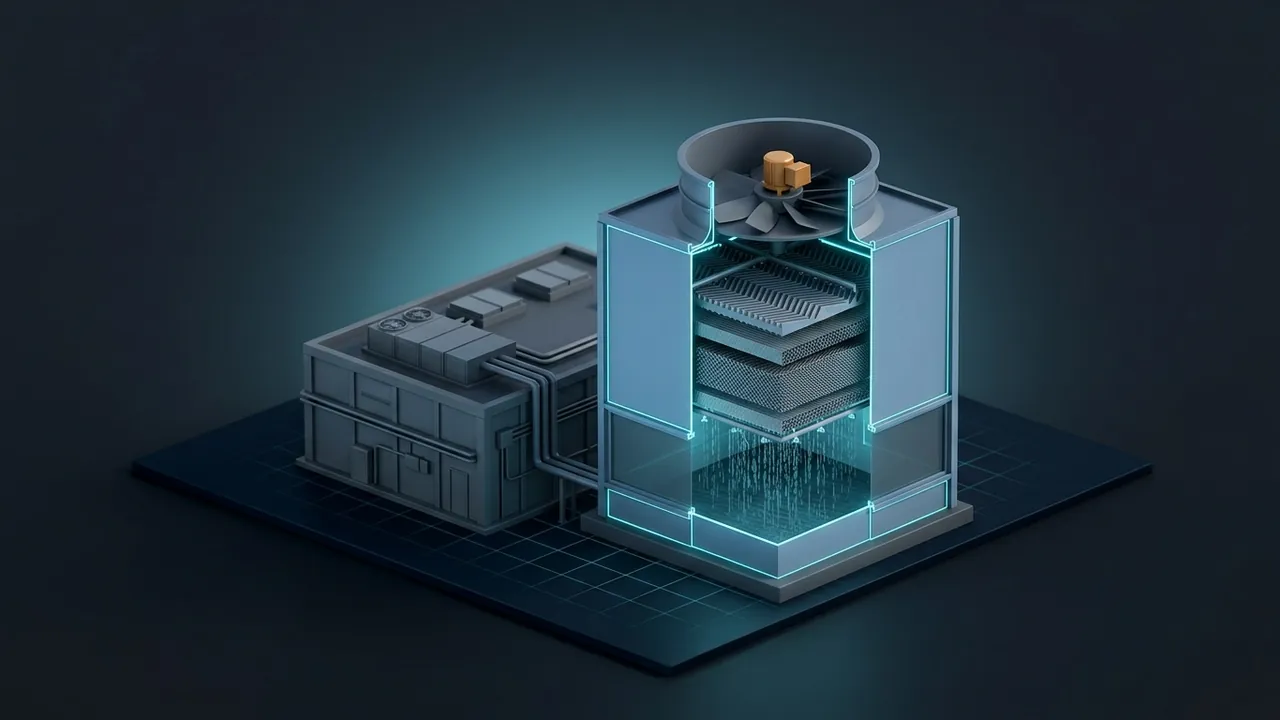
- Evaporation in cooling towers. Warm water from the chillers trickles over fill media while fans pull air through. A small share evaporates, and that evaporation carries away heat.
- Blowdown. As water evaporates, minerals concentrate in what is left. Operators drain some water, called blowdown, and replace it with fresh makeup water to keep scale and corrosion in check.
- Evaporative and adiabatic air cooling. Some sites cool incoming air by passing it over wet pads or through a fine mist.
- Humidification, in some climates, to keep the air from getting too dry.
The Environmental and Energy Study Institute (EESI) notes in its overview of data centers and water consumption that about 80% of the water a typical data center withdraws evaporates, and that large facilities can use up to 5 million gallons a day. That evaporated water does not go back to the river or aquifer, which is why consumption, not just withdrawal, is the number to watch.
How Many Gallons per MW Does a Data Center Use?
For an evaporatively cooled site, about 10,000 to 12,000 gallons per day per megawatt of IT load is a reasonable planning figure, though real sites range widely. The math uses water usage effectiveness (WUE), which divides annual site water in liters by IT energy in kilowatt-hours (kWh).
Here is the worked example for 1 MW of IT running flat out, using EESI's 1.9 L/kWh average:
- Daily IT energy: 1,000 kW × 24 hours = 24,000 kWh
- Daily water: 24,000 kWh × 1.9 L/kWh = 45,600 liters
- In gallons: 45,600 ÷ 3.785 ≈ 12,050 gallons per day
- Per year: 12,050 × 365 ≈ 4.4 million gallons
Scale that to a 50 MW campus and you get roughly 600,000 gallons a day. A site that runs at a WUE of 0.5 instead would use about a quarter of that. A dry-cooled site might use only what the bathrooms need.
Does the Physics Back That Up?
It does. Evaporating one kilogram (about one liter) of water absorbs roughly 2,400 kilojoules at cooling tower temperatures. One kWh is 3,600 kilojoules. So rejecting 1 kWh of heat purely by evaporation takes about 3,600 ÷ 2,400 = 1.5 liters. Add blowdown, which at four cycles of concentration adds about a third more, and you land near 2.0 liters per kWh on the hottest days. Free cooling hours in winter pull the annual average down. That is how a figure near 1.9 comes about.
How Does That Compare With Homes?
The U.S. Environmental Protection Agency's WaterSense program uses about 300 gallons a day as the indoor and outdoor use of an average American family at home. By that yardstick, 1 MW of evaporatively cooled IT at 12,050 gallons a day uses about as much as 40 households. A 50 MW campus at the same WUE is in the range of 2,000 households. A dry-cooled campus of the same size might use as much as a handful.
That comparison helps at a community meeting, but use it carefully. Homes return much of their water to the sewer system, while a cooling tower sends most of its water into the sky. Per gallon, evaporative cooling consumes more of what it withdraws.
How Does Cooling Choice Change Water Use?
The cooling design sets the range, and the weather decides where in that range you land each day. The chart below models daily on-site water for a 10 MW IT load at several WUE levels, from a dry-cooled site to the EESI average.
Gallons per day at different water usage effectiveness (WUE) levels, full load
Model: 10,000 kW × 24 h × WUE (L/kWh) ÷ 3.785. The 1.9 L/kWh average is cited by EESI (2025).
View the data
| Gallons per day | |
|---|---|
| WUE 0 (dry) | 0 gal |
| WUE 0.2 | 12,682 gal |
| WUE 0.5 | 31,704 gal |
| WUE 1.0 | 63,408 gal |
| WUE 1.9 (EESI average) | 120,476 gal |
As a rough guide, here is how common approaches compare.
| Heat rejection approach | On-site water use | Energy trade-off |
|---|---|---|
| Open cooling towers with chillers | High | Very energy efficient |
| Direct evaporative air cooling | Moderate to high in hot, dry weather | Low energy |
| Adiabatic or hybrid dry coolers | Low, wet only on hot days | Moderate |
| Air-cooled chillers or dry coolers | Near zero | Higher energy on hot days |
| Closed liquid loops to dry coolers | Near zero | Often low, thanks to warm water |
You can estimate your own site's daily water with the calculator below. Plug in your IT load, a WUE and how heavily the site is used.
Why Does Water Use Swing With the Seasons?
Because evaporation only earns its keep when the air is warm. In winter, many sites switch to free cooling, where cold outdoor air or cold tower water does the job with little or no evaporation. In summer, towers and evaporative pads run hard, and water use can be several times the winter rate.
Humidity matters too. Evaporation works best in dry air, which is why evaporative cooling is popular in the desert Southwest. The irony is that dry places are exactly where water is scarcest. A site in a humid climate evaporates less effectively and leans more on chillers, so it uses more power and somewhat less water.
For planning, the annual average tells you your yearly bill and permit totals. The peak summer day tells you how big your supply line, well field or storage tank must be. Ask for both.
Does Water Quality Affect How Much a Site Uses?
Yes, quite a bit. Hard water full of calcium and magnesium forms scale in a cooling tower as it concentrates, so the operator has to bleed off more blowdown and add more makeup water. Soft, clean water can be cycled many more times before it needs replacing.
The math is straightforward. Blowdown equals evaporation divided by the cycles of concentration minus one. At 3 cycles, blowdown is half of evaporation. At 6 cycles, it is one fifth. Good water treatment, sometimes including softening or filtration, can cut total makeup water noticeably without changing the cooling design at all.
What Is the Difference Between Direct and Indirect Water Use?
Direct water is what the data center uses on its own property, mostly for cooling. Indirect water is what the power plants feeding it use to make electricity. Steam plants, whether coal, nuclear or gas combined cycle, often cool their condensers with water, and much of that evaporates too.
EESI puts indirect water at roughly 1.2 gallons per kWh of electricity. Using that figure, 1 MW of IT at a power usage effectiveness (PUE) of 1.3 draws 31,200 kWh a day from the grid, which implies about 37,000 gallons of indirect water daily. That is three times the direct number in our example above. A site that boasts zero cooling water but buys power from water-cooled thermal plants has not made its water footprint disappear. It has moved it.
What About On-Site Gas Generation?
This is where off-grid and behind-the-meter sites get interesting. Reciprocating gas engines cool themselves with closed radiator loops, like a truck engine, and use very little water. Simple-cycle gas turbines without inlet evaporative cooling or water injection also use little. A combined cycle plant with a wet cooling tower, on the other hand, can use a lot. So the type of on-site generation matters as much as the cooling choice when you add up the full picture.
Does Using Less Water Mean Using More Power?
Usually, yes, at least on hot days. Evaporation is the cheapest way to dump heat in energy terms, so when you stop evaporating, fans and compressors work harder. A dry-cooled site in a hot climate will see its PUE climb on summer afternoons.
The trade-off is smaller than it used to be. Warmer server inlet temperatures and liquid cooling let dry coolers handle far more of the year without help. Our guide to waterless cooling covers how dry coolers, adiabatic units and closed loops keep that energy penalty in check. And if your power comes from water-cooled plants, burning a little more electricity can erase some of the water you saved on site, which is another reason to look at both numbers together.
How Is Data Center Water Use Measured and Reported?
The standard metric is WUE, developed by The Green Grid. The Green Grid's water usage effectiveness white paper defines it as annual site water use in liters divided by annual IT energy in kWh. Our guide to water usage effectiveness walks through how to calculate it and where it can mislead.
Not every operator reports WUE, and those that do often report fleet averages that hide big differences between cool and hot locations. If you are evaluating a specific project, ask for the expected water use at that site, in gallons per day, for an average day and the peak summer day.
How Do Sites in Dry Country Plan for Water?
In places like West Texas and western Oklahoma, water can be the hardest resource to secure, even when land and gas are plentiful. Smart sites plan for it early.
- Design for low water from the start with dry or hybrid coolers and higher operating temperatures.
- Look at non-potable sources such as treated municipal wastewater or brackish groundwater, which need treatment but do not compete with drinking supplies.
- Raise cycles of concentration with good water treatment so less goes down the drain as blowdown.
- Talk to the local water authority early. Groundwater and surface water rules vary by state and district, so check with counsel and your state regulator before you assume a supply.
Data Center Water Usage Comes Down to How You Reject Heat
The single design decision that sets your water number is whether the site evaporates water to reject heat. Every kilowatt-hour dumped that way costs about one and a half liters before blowdown, and there is no clever trick around that physics.
So settle one question before anything else: is water or power the scarcer resource at your site? Design the cooling around that answer. Count indirect water from your power source as well. Data center water usage is now one of the first questions any community asks, and having a clear, honest number ready is one of the best ways to keep a project moving.