How Does Evaporative Cooling Work in Data Centers? – Water vs Energy

Step out of a swimming pool on a dry, breezy day and you shiver, even in summer. The water on your skin is evaporating, and evaporation pulls heat out of whatever it touches. Evaporative cooling data center designs use that same trick at industrial scale, and it is one of the cheapest ways to reject heat on the planet. The catch is that the water you evaporate is gone. How does evaporative cooling work in a data center, and is the water worth the energy it saves?
Evaporative cooling in a data center uses the heat absorbed when water evaporates to cool air or water, which takes far less electricity than running compressors. Whether the water is worth it depends on which is scarcer at your site, because every pound evaporated carries away roughly 1,000 Btu and the bill runs to thousands of gallons per megawatt per day. Direct systems pass outside air through wet pads. Indirect systems keep that air separate behind a heat exchanger. Cooling towers do the same job for chilled water plants.
How Does Evaporative Cooling Work?
Evaporative cooling works because water needs a lot of energy to change from liquid to vapor. That energy, called the latent heat of vaporization, comes from the air and the remaining water. Both get cooler.
The limit is the wet-bulb temperature. That is the lowest temperature air can reach by evaporating water into it, and it depends on how dry the air is. In a desert, a 100°F afternoon might have a wet-bulb near 65°F to 70°F, which leaves a big gap to work with. In a humid coastal city, the wet-bulb sits much closer to the dry-bulb, and evaporation has less to give.
That is why evaporative systems shine in places like West Texas, Arizona and the Mountain West, and struggle on muggy Gulf Coast afternoons.
Direct vs Indirect Evaporative Cooling
The difference is whether outdoor air touches the servers. In direct evaporative cooling, fans pull outside air through wetted pads and push it straight into the cold aisle. In indirect evaporative cooling, the wet side and the data hall side are separated by a heat exchanger, so only heat crosses over, not air or moisture.
Each has a place:
- Direct systems are simple and very efficient, but they add humidity and bring outdoor dust, smoke and pollutants closer to the IT gear, so filtration and humidity control matter.
- Indirect systems keep the data hall sealed from outside air, which protects equipment in dusty or polluted areas, at the cost of larger units and a little less cooling effect.
- Many indirect units include a compressor stage, a "trim" coil that kicks in only on the worst days.
Here is how close direct cooling can get, with labelled example numbers. Say outdoor air is 100°F dry-bulb with a 70°F wet-bulb, and the media has 85% saturation effectiveness. The supply air temperature is 100 − 0.85 × (100 − 70) = 100 − 25.5 = 74.5°F. That is inside the recommended range for server inlets, without a compressor turning.
What About Cooling Towers?
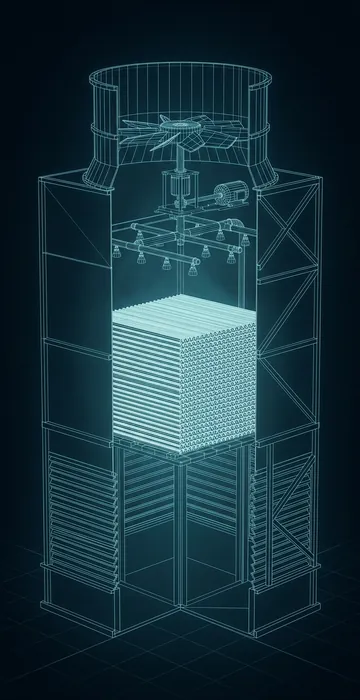
Cooling towers are the most common form of evaporative cooling in large data centers, even though the servers never see them. A chilled water plant makes cold water for the data hall cooling units. The chillers move that heat into a condenser water loop. The towers then spray the condenser water over fill media while fans pull air through, and a small fraction evaporates and cools the rest.
Towers let chillers run with cooler condenser water than an air-cooled condenser could manage on a hot day. Lower condenser temperatures mean less compressor work. On cool days, a plate heat exchanger can let the towers cool the chilled water directly, and the chillers can shut off entirely. Engineers call that water-side economizing.
Inside the data hall, those chilled water loops usually feed air handlers rather than refrigerant units, which is the heart of the CRAC vs CRAH question.
How Much Water Does Evaporative Cooling Use?
A rough answer is about 400 gallons evaporated for every megawatt-hour of heat rejected purely by evaporation, plus extra water flushed out to control minerals. You can work it out from basic physics.
- 1 MWh of heat = 3,412,000 Btu.
- Each pound of water evaporated absorbs roughly 1,000 Btu, so 3,412,000 ÷ 1,000 = 3,412 pounds.
- Water weighs about 8.34 pounds per gallon: 3,412 ÷ 8.34 = about 409 gallons per MWh.
Now scale it with a labelled example. Say the towers reject 1.15 MW around the clock (1 MW of IT heat plus the chiller compressor energy, which also ends up as heat). That is 27.6 MWh per day, or about 11,300 gallons evaporated.
Evaporation leaves minerals behind, so towers bleed off some water, called blowdown, and replace it with fresh makeup water. Operators describe this as cycles of concentration. At 4 cycles, makeup water equals evaporation × 4 ÷ 3, or about 15,000 gallons per day. Running at 6 cycles drops it to about 13,500 gallons. The U.S. Department of Energy's Federal Energy Management Program (FEMP) points to higher cycles of concentration and more economizer hours as the main levers for cutting cooling water.
Real sites use less than that worst case because towers do not run flat out all year, and many hours are covered by economizers. For the bigger picture across a whole facility, see our guide to data center water usage.
Water vs Energy: Which Matters More?
It depends on what is scarce where you are building. Evaporative cooling can cut cooling electricity sharply compared with air-cooled chillers, especially in dry climates. But in a basin where water rights are tight or the aquifer is falling, the gallons may be the harder thing to get.
There is also a hidden water cost on the energy side. Many thermal power plants evaporate water in their own cooling systems, so every kilowatt-hour a data center avoids can save some water upstream. A site that switches to dry cooling and burns more electricity does not always come out ahead on total water. It depends on how the local grid makes its power, or how the on-site plant is cooled.
From the operations side, my advice is simple: decide the water budget first, early in site selection, then design the cooling around it. Retrofitting a water plan after the permits are issued is painful.
What Are Adiabatic and Hybrid Coolers?
Adiabatic coolers are dry coolers with wetted pads or misting in front of the coils. Most of the year they run dry, like a big radiator. When the outside air gets too hot, water wets the pads, pre-cooling the air before it hits the coils.
Vendors make big claims for this design. A 2017 Data Center Dynamics piece on adiabatic cooling cited vendor figures of dry operation up to 85% of the year and up to 90% less water than cooling towers. Treat those as best cases. The real split depends on your climate and how warm your cooling loop can run.
What Does It Take to Run Evaporative Systems Well?
It takes water treatment, maintenance discipline and a plan for bad days. Cooling towers can grow bacteria, including Legionella, so they need a water management program with regular testing, biocide control and cleaning. ASHRAE Standard 188 lays out that kind of risk management for building water systems.
Scale and corrosion are the other enemies. Hard water leaves deposits on fill and heat exchangers, which cuts efficiency over time. Pads in direct and adiabatic systems clog with minerals and dust and need replacing on a schedule.
And plan for water interruptions. A main break or a drought restriction should not take the cooling plant down. Many sites keep on-site storage tanks sized for a day or more of makeup water.
Evaporative Cooling in a Data Center: Cheap Cooling, Paid for in Water
Keep one number in your pocket: about 400 gallons per megawatt-hour of heat rejected by evaporation, plus blowdown. That is the price of the compressor energy you save, and it is a good deal in dry country only if the water is really there.
Your next step is to compare the two budgets side by side for your site: the water you can reliably get and the power you can reliably buy or make. Run the numbers for a typical summer day and a worst-case heat wave. The answer often lands on a hybrid system that saves water most of the year and spends it only when the heat demands it.