Why Are Data Centers Turning to Natural Gas? – Speed, Firm Power, Trade-Offs
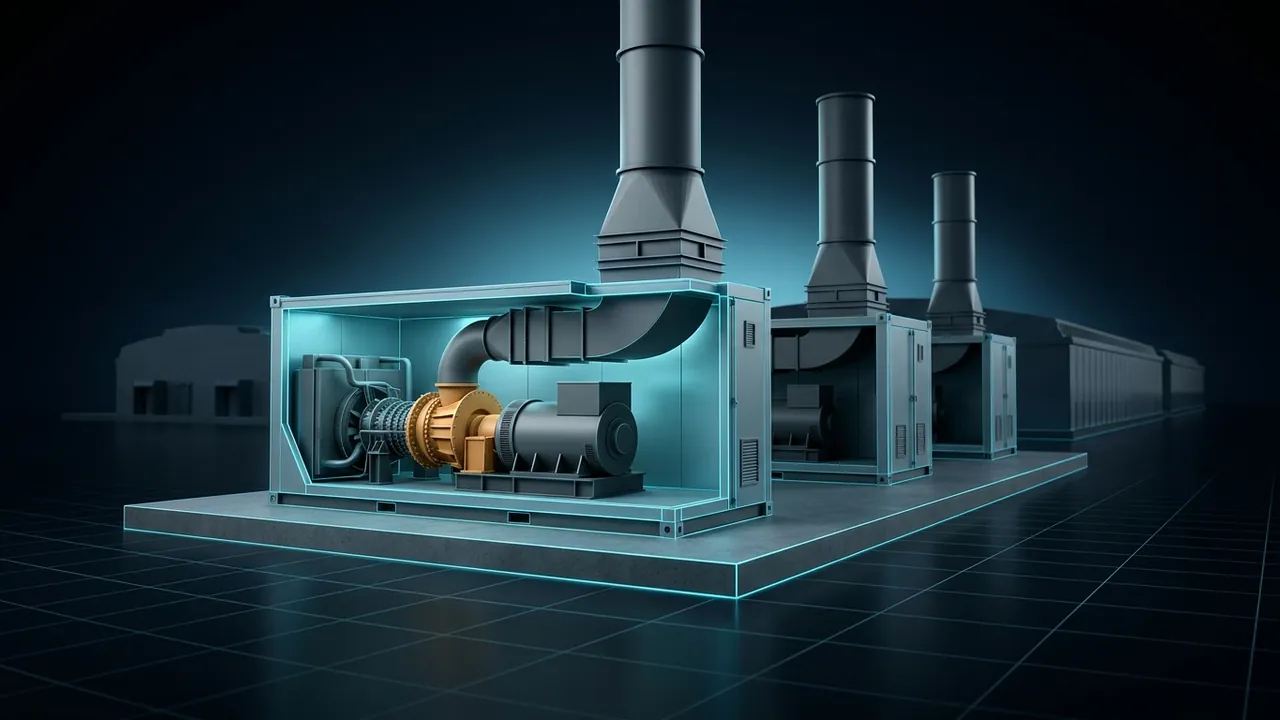
For most of the internet's history, a data center developer's power plan fit in one sentence: call the utility. That still works in plenty of places. But on site maps for the biggest new campuses, a different line now gets circled in red, and it is often a gas pipeline rather than a transmission line. The natural gas data center has gone from oddity to common plan. Why are data centers turning to natural gas, and what do they give up to do it?
Data centers are turning to natural gas because it can deliver large amounts of firm, around-the-clock power on the developer's schedule instead of the grid's. Grid connections for very large loads can take years, while on-site gas engines and turbines can often be running sooner, and gas plants produce steady output in any weather, which suits a load that never sleeps.
Gas is also abundant and relatively cheap in the US, especially near production basins. The trade-offs are real: carbon dioxide and nitrogen oxide emissions, air permits, fuel price risk, the cost of building in redundancy, and long waits and rising prices for turbines.
What Changed for Data Center Power?
Demand grew faster than the grid could add capacity. For years, efficiency gains in servers and cooling kept data center electricity use roughly flat even as computing grew. That stopped holding as GPU-heavy AI clusters, with racks drawing many times what older servers did, joined the conventional cloud buildout.
The chart below shows the scale. According to the U.S. Department of Energy's summary of the Lawrence Berkeley National Laboratory data center energy report, US data centers used about 58 TWh in 2014 and about 176 TWh in 2023, roughly 4.4% of the nation's electricity. The same report projects 325 to 580 TWh by 2028, a range that reflects real uncertainty about how fast the buildout continues.
Estimated annual consumption, with 2028 low and high scenarios
Lawrence Berkeley National Laboratory, 2024 United States Data Center Energy Usage Report (summarized by U.S. DOE, Dec 2024)
View the data
| Electricity use | |
|---|---|
| 2014 | 58 TWh |
| 2023 | 176 TWh |
| 2028 low | 325 TWh |
| 2028 high | 580 TWh |
A jump from 176 to even the low case of 325 TWh means adding demand equal to many large power plants in five years. Utilities, grid operators and equipment makers were not built to move that fast, and that gap is where natural gas comes in.
Speed to Power: Why the Grid Is Too Slow
The single biggest reason a natural gas data center gets built is time. A developer with land, fiber, a tenant and financing can lose that tenant if power arrives years late. "Speed to power" has become the phrase of the buildout because power, not buildings or servers, is usually the longest pole in the tent.
Grid delays come from several directions at once:
- Interconnection studies for large loads and new generation take years in many regions.
- New transmission lines and substations need permits, land and long-lead equipment.
- Transformers and high-voltage breakers have had long delivery times.
- Utilities must plan generation to serve the new load, and that generation has its own queue.
Enverus, an energy analytics firm, wrote in its 2026 analysis of why data centers are looking to natural gas for behind-the-meter power that projects in grid queues were averaging more than 2,100 days from queue entry to commercial operation, and that only about 10% of queued capacity actually gets built. When the grid answer is "maybe, in six years," a gas plant the developer controls starts to look less like a luxury and more like the only way the project happens.
Why Natural Gas Instead of Just Solar and Batteries?
Natural gas wins on firmness and footprint. A data center runs close to flat, 24 hours a day, all year. A gas plant can match that profile directly. Solar produces only when the sun is up, so an off-grid solar plant needs enough batteries to carry the load through every night and every cloudy stretch.
Here is a simple illustration of why that matters. Say a campus needs a steady 100 MW. Overnight, from sunset to sunrise, is roughly 12 hours in spring or fall. Carrying 100 MW through that period takes 100 MW × 12 h = 1,200 MWh of battery storage, before any allowance for losses, cloudy days or winter. That is a very large battery for one night, and the solar field would also have to be several times larger than 100 MW to run the load by day while recharging it.
Solar, wind and storage still play big roles in many projects, often alongside gas. But when a developer needs hundreds of megawatts of firm power on a fixed date, gas is usually the fuel that can carry the base load. Other firm options, such as nuclear and geothermal, are attractive on carbon but slower or more site-limited for the near term.
How Do Natural Gas Data Centers Get Their Power?
Most natural gas data center projects follow one of four patterns:
- Bridge power: on-site gas generation runs the campus until the utility connection arrives, then shifts to backup, peaking or demand response duty, or moves to another site.
- Permanent behind-the-meter: the gas plant is the main power source for the life of the campus, with or without a grid tie.
- Grid-plus-onsite hybrid: the campus takes some grid power and makes the rest on site, which can shorten the grid wait because the request is smaller.
- Energy park: a power plant, often gas plus batteries and sometimes solar, built alongside one or more large loads on a shared campus.
The equipment choices are familiar to anyone in the gas power business. Reciprocating engine gensets come in blocks of a few megawatts each and handle load changes well. Aeroderivative gas turbines, built from jet engine designs, come in roughly 20 to 100 MW sizes and start quickly. Large frame turbines and combined-cycle plants are the most efficient at hundreds of megawatts but have the longest lead times. Some operators also use natural gas fuel cells.
Redundancy Costs Extra Megawatts
An islanded campus cannot borrow from the grid when a unit trips, so it must carry spare units. If a 200 MW load runs on 20 MW turbines, it needs 10 running units plus at least one spare (N+1), and many designs carry two (N+2) so maintenance and a failure can overlap. Twelve installed units for ten units of load means the plant is 20% bigger than the load, and that capital shows up in the price of every MWh.
How Much Gas Does a Gas-Powered Data Center Use?
A lot, but it is easy to estimate. Enverus put a 1 GW data center at roughly 140 million cubic feet of gas per day (MMcf/d) in the analysis linked above. We can check the order of magnitude with simple math.
Example: a 1,000 MW plant running all day makes 1,000 MW × 24 h = 24,000 MWh, which is 24 million kWh. At a heat rate of 6,000 Btu per kWh (an optimistic figure that only the most efficient combined-cycle plants approach), fuel use is 24,000,000 × 6,000 = 144 billion Btu, or 144,000 MMBtu (million British thermal units). At about 1,036 Btu per cubic foot, that is roughly 139 MMcf/d. A less efficient simple-cycle plant at 9,000 Btu/kWh would need about 50% more gas, roughly 210 MMcf/d. In other words, the Enverus figure only works for best-in-class efficiency or a plant averaging below full output. Most on-site engine and turbine plants running flat out would land closer to 170 to 250 MMcf/d per gigawatt, so plan pipeline capacity on your own heat rate.
For a full breakdown by campus size, with a calculator, see our guide to data center natural gas consumption. The short version: a large gas-powered campus burns as much gas as a utility-scale power plant, because that is what it is, so pipeline capacity and firm supply contracts matter as much as the generators.
What Are the Trade-Offs of a Natural Gas Data Center?
Gas solves the speed problem but brings its own list. None of these are deal-killers on their own, but each one has to be planned for.
Emissions and Permits
Burning natural gas emits carbon dioxide, about 117 pounds per MMBtu of fuel. At 7,000 Btu/kWh, that works out to 7 MMBtu × 117 lb ≈ 820 pounds of CO2 per MWh. That collides with the clean-energy goals many tech companies have announced. Gas engines and turbines also emit nitrogen oxides (NOx), which usually require emissions controls and an air permit. Large plants can trigger major-source permitting, which takes time and public review. Rules differ by state, so permitting needs early attention from specialists and counsel.
Equipment Lead Times and Cost
Because so many projects chose gas at once, turbines got scarce. Industry analysts have reported multi-year waits for new turbines and sharply higher prices, which pushes some developers toward reciprocating engines, mobile turbines, refurbished units or factory slot reservations. We cover that squeeze in detail in our guide to gas turbine lead times.
Fuel Price and Supply Risk
Grid power bundles fuel risk into the utility's rates. On-site gas puts it on your books. Gas prices can spike during cold snaps when heating demand and power demand peak together. Interruptible pipeline service is cheaper but can be cut, so a campus that must never go dark needs firm transportation, on-site backup fuel, or both.
Community and Long-Term Fit
Neighbors notice engines and turbines, especially noise, exhaust stacks and truck traffic during construction. A plant sized for one tenant can also become a stranded asset if that tenant leaves or the grid connection later makes the plant redundant. Smart developers plan a second life for the generation, such as selling into the grid or serving as backup.
Is Gas a Bridge or a Permanent Answer?
It can be either, and many projects do not know which on day one. A plant built as a bridge may run for years longer than planned if the grid connection slips. A plant built as permanent may end up as backup once a utility line arrives. The smart move is to design for both possibilities from the start.
In practice that means a few choices made early:
- Leave room in the substation and switchgear for a future utility tie, even if none is planned.
- Choose generator ratings and controls that can run in parallel with the grid as well as islanded.
- Write gas supply and air permit terms that allow both high-hour operation and lower-hour backup duty.
- Consider skid-mounted or trailer-mounted units for the bridge phase so they can move to the next site.
My view: treat every on-site gas plant as a long-term asset with an exit plan, not a temporary fix. Temporary has a way of becoming permanent in this business.
Where Do Natural Gas Data Centers Make the Most Sense?
They make the most sense where gas is plentiful, pipelines have room, land is available and permitting is predictable. That points to producing regions such as West Texas, Oklahoma, Louisiana and the Appalachian basin, where gas is close by and sometimes cheap because pipelines out of the region are full.
Being near production also opens options that a city site lacks: direct supply deals with producers, shorter laterals, and in some cases gas that would otherwise be flared. The flip side is distance from users and sometimes from fiber, water and skilled workers. Every site is a trade.
The Natural Gas Data Center Buys Time, Not a Free Lunch
Data centers are turning to natural gas because it delivers firm power fast, on a schedule the developer controls, at a time when the grid cannot keep up with demand. That is the core of the answer, and it explains why a gas line now shows up on so many site plans.
The price of that speed is emissions, permits, fuel risk, extra units for redundancy and a scramble for equipment. For many projects the trade is worth it, at least as a bridge. Before committing, put the grid's realistic in-service date next to the date you need power. If the gap is a year, gas may be a stopgap. If it is five years, you are probably building a permanent plant, and the pipeline contract, air permit and spare units should be planned that way.