Why Is the Permian Basin Attracting Data Centers? – Gas, Land, Limits
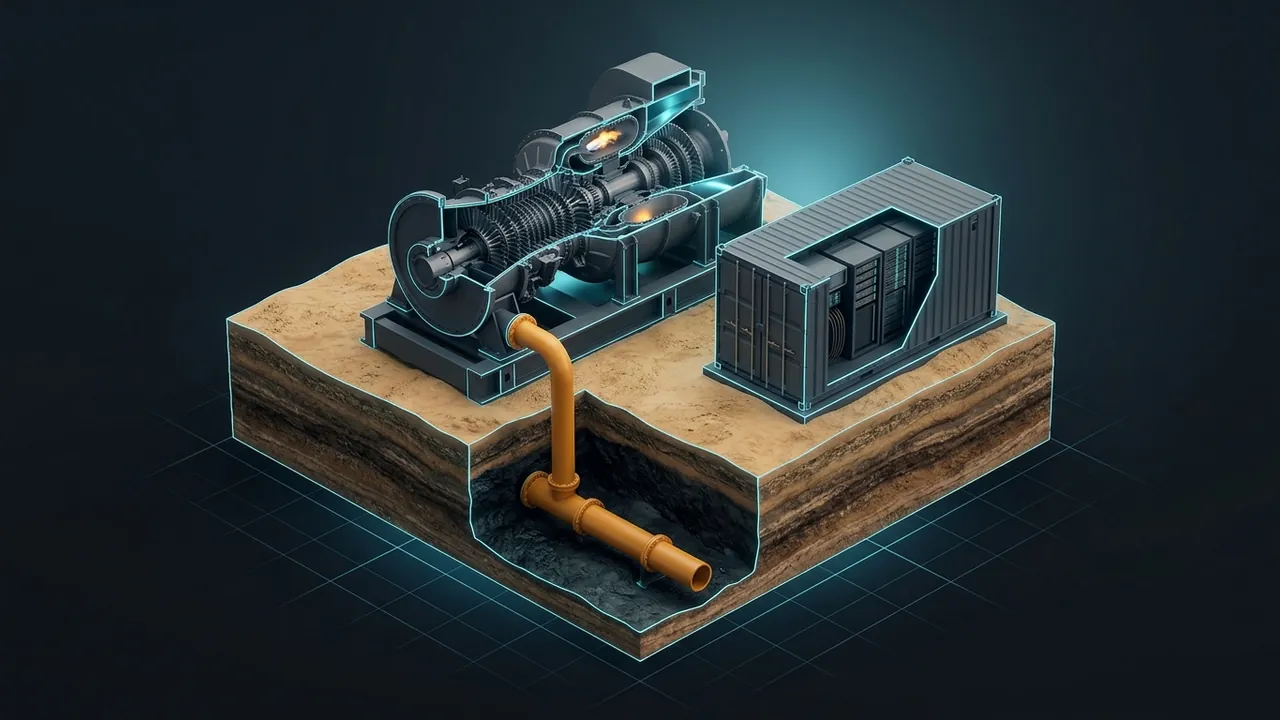
Drive west out of Midland at night and the horizon is dotted with lights: drilling rigs, compressor stations, the occasional flare. For decades that view meant oil. Lately it has started showing up in a different kind of pitch deck, the kind about megawatts and server halls. Why is the Permian Basin attracting data centers, and what limits come with all that gas and open land?
Permian Basin data centers are drawing interest because the region is the country's second-largest and fastest-growing major gas producer, often with some of the lowest local prices in the country, on cheap, wide-open land inside the Texas power market. The U.S. Energy Information Administration (EIA) says Permian output reached 27.7 billion cubic feet per day (Bcf/d) in 2025, about 23% of the nation's marketed gas. Pipeline bottlenecks can push local prices down hard. For a developer who needs hundreds of megawatts quickly, on-site gas generation fed by Permian gas can look faster than waiting for a grid connection. Water, the grid and labor are the catch.
How Much Gas Does the Permian Basin Produce?
A lot, and it keeps growing. According to the EIA's report on record 2025 U.S. gas production, the Permian rose 11% to 27.7 Bcf/d, making up about 23% of the country's 118.5 Bcf/d of marketed output. Only Appalachia, at 36.6 Bcf/d, produced more.
To put that in data center terms, imagine a 1,000 MW campus running on gas at a heat rate of 8,000 British thermal units per kilowatt-hour (Btu/kWh):
- Fuel per hour: 1,000,000 kW × 8,000 Btu/kWh = 8,000 million Btu (MMBtu).
- Fuel per day: 8,000 × 24 = 192,000 MMBtu.
- Volume at about 1,037 Btu per cubic foot: 192,000 ÷ 1.037 ≈ 185 million cubic feet per day (MMcf/d), or about 0.19 Bcf/d.
So even a gigawatt-scale campus would burn well under 1% of current Permian output. Gas volume is not the bottleneck. Getting that gas to the right spot, at the right quality, on firm terms is where the work lies.
Why Are Permian Gas Prices So Low?
Most Permian gas is associated gas, meaning it comes out of oil wells as a byproduct. Producers drill for oil, and the gas follows. When oil prices are good, drilling continues even if gas prices are poor, because the oil pays the bills.
That means gas supply can grow faster than the pipelines leaving the basin. When takeaway capacity fills up, or a major line goes down for maintenance, gas backs up and the local price at the Waha hub can drop far below the national Henry Hub benchmark. At times it has dropped below zero, with producers paying to have gas taken away.
For a power-hungry buyer sitting inside the basin, that discount is the attraction. Buying gas on the "wrong" side of a pipeline bottleneck can mean paying much less than a plant on the Gulf Coast. New pipelines change the math over time, though. Lines like Matterhorn Express, which began service in late 2024, add takeaway capacity and tend to narrow the discount, at least until production catches up again.
What Else Makes the Permian Attractive?
Gas is the headline, but several other factors line up.
- Land: vast tracts of ranchland, often available in large parcels, with fewer neighbors to object than near a city.
- Midstream know-how: gathering systems, processing plants, compressor stations and crews who build and run them every day.
- Market access: most of the basin sits inside ERCOT, the Texas grid operator, which gives projects a path to sell surplus power or buy backup.
- Permitting climate: Texas has a long track record of approving energy infrastructure, and the oilfield is used to heavy industry.
- Existing fiber routes: long-haul fiber runs along the major highway corridors across West Texas.
For workloads that care more about power and cost than about being a few milliseconds from a big city, like large training clusters, the distance from population centers is less of a problem than it would be for a cloud region serving consumers.
What Kinds of Projects Are Showing Up?
The buildout of large AI training and cloud campuses since 2023 has changed who is looking at West Texas. Rather than one standard model, a few deal patterns keep repeating. Some developers buy or lease big ranch parcels and plan gigawatt-scale campuses with on-site gas generation from day one. Some partner with producers or midstream companies, pairing a long-term gas supply with land near existing pipelines. Bitcoin miners already operating in West Texas, with power contracts and substations in place, have looked at converting or expanding sites for high-performance computing.
Announcements are not the same as energized megawatts, though. Many plans depend on turbine deliveries, financing and tenants that are still being lined up, so treat headline numbers as intentions until steel is in the ground.
How Would a Permian Data Center Get Its Power?
There are three broad paths, and many projects plan to use more than one.
| Approach | How it works | Main challenge |
|---|---|---|
| Grid connection | Interconnect to ERCOT through a local utility | Long study queues and a congested West Texas grid |
| Behind-the-meter gas | Turbines or engines on site, fed by a lateral from nearby pipelines | Equipment lead times, gas quality and air permits |
| Hybrid | On-site generation plus a grid tie, sometimes with batteries | More complex contracts and protection design |
The grid path is crowded. Utility Dive reported that ERCOT's large load queue jumped almost 300%, to roughly 233 gigawatts of requests, with data centers making up more than 70%. That backlog is one reason behind-the-meter gas keeps coming up in Permian plans: it lets a project start running while the grid connection works its way through the process.
New Texas Rules for Large Loads
Texas changed the rules for big new loads in 2025. Senate Bill 6 set new requirements for loads of 75 MW or more, including study fees, disclosure of on-site backup generation and, for newer connections, equipment that lets the grid operator curtail them in emergencies. Anyone planning a Permian campus should read up on Texas Senate Bill 6 and work with counsel on how it applies, since rules are still being implemented.
What Are the Biggest Limits in the Permian?
This is the part the glossy announcements tend to skip. Anyone who has worked out there knows the basin has some hard edges.
Water
West Texas is dry. Evaporative cooling, the cheapest way to reject heat in a hot climate, uses a lot of water, and fresh groundwater is limited and already spoken for by farms, towns and oilfield operations. Most serious Permian designs lean toward closed-loop liquid cooling and dry coolers that use little or no water, which costs more power on the hottest afternoons. The oilfield produces huge volumes of salty produced water, and treating it for industrial use is an active area of work, but it is not yet a simple off-the-shelf cooling supply.
Heat and Dust
Summer highs often climb past 100°F, which cuts gas turbine output and makes cooling harder. Dust storms clog air filters on both the generators and the data halls. None of this is a deal breaker, but it adds equipment and maintenance that a mild-climate site would not need.
Gas Quality
Raw Permian gas is often rich in heavier hydrocarbons, and parts of the basin produce sour gas with hydrogen sulfide. Gas bought from a processing plant's residue line is usually close to pipeline quality. Gas tapped closer to the wellhead may need conditioning before it is fit for turbines.
The Grid and Transmission
Oilfield electrification has already pushed West Texas power demand up sharply, and the regional grid was not built for it. Texas regulators have approved plans for major new high-voltage transmission into the Permian, including ERCOT's first 765 kV lines, but those take years to build. Until then, a large new load may find the grid can serve only part of it, or none of it, for a while.
People and Housing
Boom times in the oilfield already strain housing, hotels, roads and the skilled labor pool. Electricians, linemen, controls techs and pipefitters are in demand. A large construction project competes with drilling and midstream work for the same crews, and when oil prices are high, that competition gets fierce.
Is Cheap Permian Gas a Safe Bet for Decades?
It is a good bet, but not a guaranteed one. Several things could change the picture over the life of a data center:
- More pipelines out of the basin would narrow the local discount.
- Lower oil prices would slow drilling and, with it, associated gas growth.
- Wells decline quickly, so steady supply depends on continuous drilling across the basin.
- Changing rules on flaring and emissions could affect how and where gas is handled.
Smart buyers do not build a 20-year plan on a spot price. They sign supply agreements with clear pricing, firm transport on a lateral sized for future growth and some kind of backup. The discount is a bonus. The reliable supply is the real asset.
How Does the Permian Compare With Other Gas Regions?
The Permian is not the only place where gas, land and power meet. The Haynesville in Louisiana and East Texas, Appalachia's Marcellus and Utica, and the Anadarko Basin in Oklahoma all have big gas supplies and their own pros and cons. Oklahoma, for example, sits in a different grid region, the Southwest Power Pool, with its own large-load process and a long history of hosting large data centers. If you are comparing sites, it is worth reading about Oklahoma data centers next to the Permian case.
The Permian's edge is scale and price. Its weak spots are water, climate and an overloaded grid. Some other regions trade a bit of gas price advantage for better water or a less congested grid.
Permian Basin Data Centers: Plenty of Gas, Fewer Easy Answers
Why is the Permian Basin attracting data centers? Because it has an enormous and growing gas supply, frequently at a discount, sitting under cheap land in a state that builds energy projects fast. For developers frustrated by grid queues, generating power on site from Permian gas is a real option.
The limits are just as real. Plan for little or no water use, heat and dust, gas that may need conditioning, a grid that will take years to catch up and crews that are already busy. If you are looking at a Permian site, start with gas supply and water, model your power plan for the hottest week of the year, and talk early with ERCOT, your utility and the midstream companies nearby. A campus that works in Virginia will not survive a West Texas August unchanged, so design for the basin you are actually in.