What Does a Microgrid Controller Do? – Keeping Power Stable
Take a small power plant with four gas generators, a battery bank, a field of solar panels and a few buildings full of equipment. Each machine has its own local controls, and each one is perfectly happy doing its own thing. That is the problem. Left alone, they would fight over load, ignore the clouds rolling over the solar field and have no idea what to do when the utility drops out. Somebody has to be the referee. What does a microgrid controller actually do to keep that power stable?
A microgrid controller is the central control system that coordinates every generator, battery, solar inverter and load in a microgrid so that supply matches demand at every moment. It decides which units run and how hard, holds frequency and voltage within limits, sheds low-priority loads when capacity falls short, and manages the switch between grid-connected and islanded operation, including resynchronizing safely when the utility returns. It also sequences restarts after a blackout and records everything for operators. Without it, a microgrid is just a collection of equipment.
What Does a Microgrid Controller Do?
Its jobs fall into a handful of groups. The Institute of Electrical and Electronics Engineers (IEEE) standard for microgrid controllers, IEEE 2030.7-2017, focuses on two core functions, dispatch and transitions, and most real controllers add the rest:
- Dispatch: choose which sources run and set each one's output
- Transitions: island from the utility, run islanded, and reconnect
- Stability: keep frequency and voltage within tolerance
- Load management: shed and restore loads by priority
- Black start: rebuild the system from zero after a total outage
- Monitoring: alarm, trend and log every device for operators
How Does a Microgrid Controller Keep Frequency and Voltage Stable?
Through layers of control working at different speeds. Think of it as reflexes, adjustments and planning.
Primary Control: The Reflexes
The fastest layer lives in each generator governor and inverter, not in the central controller. The usual method is droop. With droop, a generator lowers its frequency slightly as its load rises. That simple rule lets several units share load without talking to each other.
Here is the math with example settings. A 60 hertz (Hz) system with 5% droop means frequency changes by 5% of 60 Hz, or 3 Hz, as a unit goes from no load to full load.
If the no-load setpoint is 61.5 Hz, the unit runs at 60 Hz when half loaded and 58.5 Hz when fully loaded. Two identical units with identical settings always land at the same frequency, so they split the load evenly. Units with different sizes but the same percent droop share in proportion to their ratings.
Secondary Control: The Adjustments
Droop works, but it leaves frequency sitting off 60 Hz whenever load changes. The central controller fixes that over a few seconds by nudging every unit's setpoint up or down together until frequency returns to nominal. It does the same for voltage, adjusting generator excitation and inverter reactive power.
Tertiary Control: The Planning
Over minutes and hours, the controller looks at the bigger picture. Which units are the most efficient at this load? Is the battery charged enough for the evening? Is solar output about to drop? Should it buy from the utility now or run its own generation? This is where economics and fuel use get optimized.
How Does Load Shedding Work?
When a source trips and the remaining capacity cannot carry the load, the controller must drop loads fast, before falling frequency trips the remaining generators too.
An illustrative example: an islanded microgrid runs three 2 MW generators carrying 5 MW of load. One generator trips. Now there is 4 MW of capacity against 5 MW of load, a 1 MW shortfall. If nothing happens, the two survivors slow down, frequency falls, and under-frequency protection trips them within seconds.
The controller instead opens breakers on 1 MW or more of non-critical loads, such as office heating or a lower-priority process line, within a fraction of a second. Frequency recovers, and those loads come back once a battery or another unit picks up the slack.
That is why load priorities must be decided before commissioning. Arguing about which circuits are critical during an outage is too late.
How Does the Controller Manage Solar and Batteries?
Solar and batteries add flexibility, and they also add new ways for things to go wrong. The controller handles a few recurring situations.
- Cloud ramps. When a cloud crosses a solar field, output can fall sharply in under a minute. The controller uses the battery to cover the dip so generators are not slammed with a sudden load step.
- Too much sun. In island mode, if solar output exceeds what the load and battery can absorb, the controller must curtail the inverters. There is no utility to take the surplus.
- Minimum generator load. Engines and turbines have minimum loading limits set by their manufacturers. On a sunny afternoon, the controller may shut down a unit rather than run several lightly loaded ones.
- Battery state of charge. The controller keeps a reserve in the battery for the next trip or cloud, rather than draining it to save a little fuel.
Getting these rules right is where much of the real engineering time goes. The settings that work in spring can misbehave in July, so good integrators review them after the first full season of operation.
How Does the Controller Handle Islanding and Reconnection?
For a planned island, the controller first ramps local generation until the flow through the utility tie is close to zero, then opens the tie breaker. Because almost nothing changes at the moment of separation, the transition is smooth.
For an unplanned island, protective relays open the tie when they see the utility fail. The controller then has to catch the system: confirm a grid-forming source is holding voltage and frequency, shed load if needed and start more units.
Reconnection is the delicate part. The controller adjusts the island's voltage, frequency and phase angle to match the utility. A synchronizing check relay permits the breaker to close only when the two sides line up within tight limits. Closing out of phase sends a heavy jolt through generator shafts and windings, so this check is never skipped.
What Hardware Is a Microgrid Controller?
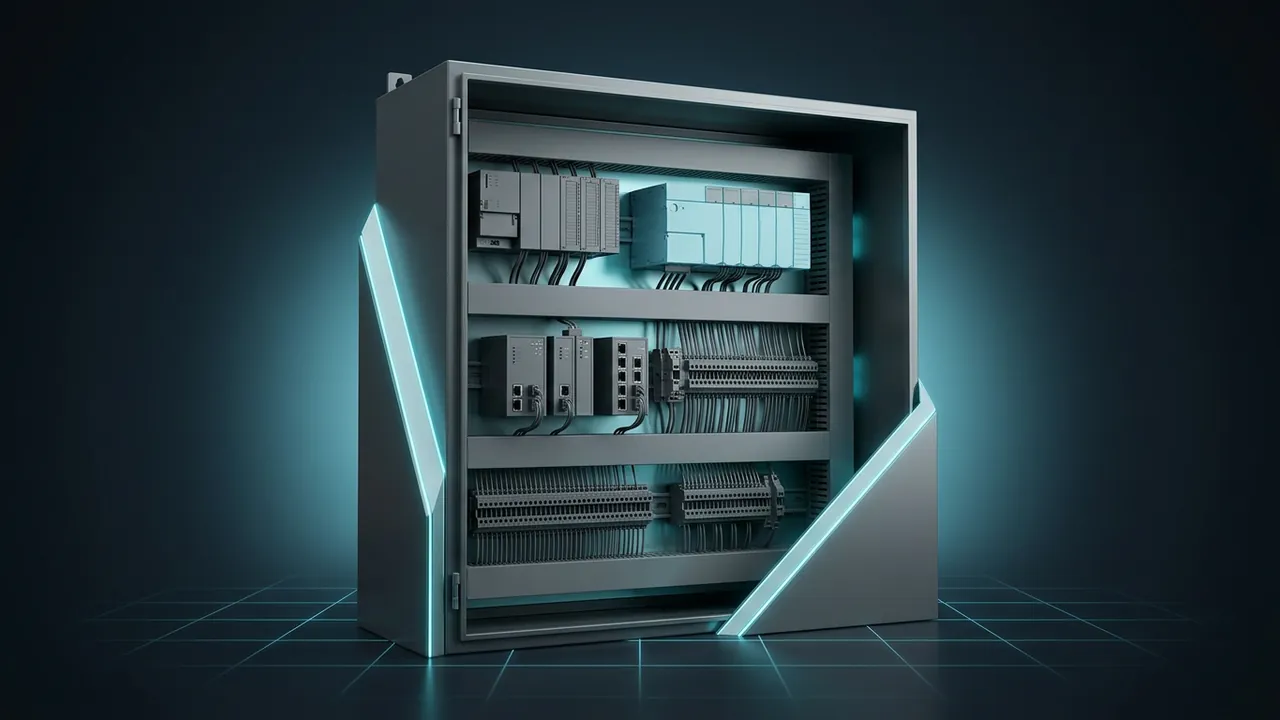
Usually less exotic than people expect. Most microgrid controllers run on industrial hardware: programmable logic controllers (PLCs), hardened industrial computers or specialized protection-and-control devices, installed in a cabinet in the switchgear room.
They talk to field devices over industrial protocols such as Modbus, Distributed Network Protocol 3 (DNP3) and IEC 61850, the International Electrotechnical Commission's standard for substation communications. Operators watch the system through a supervisory control and data acquisition (SCADA) screen. The fastest protection still lives in relays and local controls, so the system stays safe even if the network has a hiccup.
What Happens If the Controller Itself Fails?
A good design makes sure a controller failure is an inconvenience, not a blackout. Local governors and voltage regulators keep running on droop, protective relays still trip faults, and the plant holds its current state while operators take manual control.
For critical sites, controllers are often duplicated, with a hot standby ready to take over automatically. Deciding how much duplication is enough is the same question engineers ask about generators, and our guide to N+1 vs 2N redundancy explains the trade-offs. Communication networks get the same treatment, with redundant paths so one cut cable does not blind the controller.
How Do You Choose a Microgrid Controller?
Ask vendors and integrators pointed questions:
- Which of your sources and protocols does it already support, and what needs custom work?
- How fast can it shed load after a unit trip, measured from trip to breaker open?
- How are planned and unplanned islanding tested before go-live?
- What happens if the controller or its network fails?
- Who maintains the logic, and how are changes managed and documented?
- What cybersecurity measures protect it, and how are remote connections controlled?
Insist on factory testing with a simulated version of your actual system, followed by real-world tests during commissioning. Load shedding and islanding should be proven on site, not taken on faith.
The Quiet Referee Behind Stable Power
A microgrid controller keeps power stable by coordinating every source and load as one system. Droop in each machine handles the first instant, the controller restores frequency and voltage over seconds, and planning logic optimizes fuel and cost over hours. On top of that, it sheds load, islands, reconnects and restarts the plant when needed.
When you specify one, spend less time on dashboards and more on the hard moments: unit trips, unplanned islanding and resynchronization. A controller that handles those well will make everything else look easy.