How Long Can Data Center Backup Generators Run? – Fuel and Storage

Most of the time, a data center's generators do nothing at all. They sit warm, fueled and silent, starting only for tests. Then a storm takes out the utility for a day, or three, and the only question anyone cares about is how much diesel is left in the tanks. How long can data center backup generators actually run, and what decides that number?
A data center backup generator can run as long as it has fuel, and most large facilities store enough diesel on site for roughly 24 to 48 hours at full load, with some designs going longer. Beyond that, runtime depends on refueling: contracts with fuel suppliers, access for tanker trucks and enough fuel available in the region during a widespread emergency.
The engines themselves can run for days or weeks with routine checks, though standby-rated units are designed for limited annual hours. Codes such as NFPA 110 classify systems by how many hours they run at rated load without refueling.
How Long Can a Data Center Backup Generator Run?
Mechanically, a long time. A well-maintained diesel engine can run continuously for days, needing only checks of oil, coolant and filters along the way. The practical limit is fuel.
Published examples help. Microsoft's datacenter fuel safety fact sheet says its sites store diesel for up to 48 hours of generator runtime, in one double-walled, leak-detected tank per generator. The Uptime Institute's Tier standard, a common design reference, sets a floor of 12 hours of on-site fuel. Many operators land between those, at 24 to 48 hours, then rely on refueling for anything longer.
The generators feed the building through transfer and paralleling equipment. If the gear between the engines and the load is unfamiliar, our explainer on what switchgear is covers it.
How Much Fuel Does a Generator Burn?
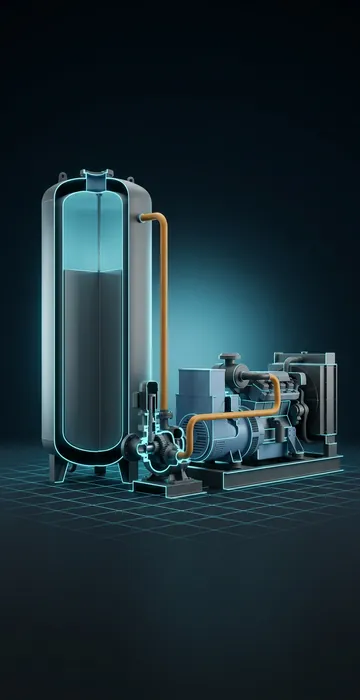
A large diesel generator burns roughly 0.07 gallons per kilowatt-hour (kWh) at heavy load, or about 14 kWh per gallon. That figure is approximate; the real number comes from each unit's spec sheet and varies with load.
Worked example for one 2,500 kilowatt (kW) generator:
- Assume the unit runs at 75% load: 2,500 × 0.75 = 1,875 kW.
- Fuel burn: 1,875 kWh per hour × 0.07 gallons per kWh ≈ 131 gallons per hour.
- For 48 hours: 131 × 48 ≈ 6,300 gallons.
- Tanks cannot be drained to the last drop, so add margin for unusable volume, say 10%: about 6,900 gallons per generator.
Now scale it. A facility with 13 such generators carrying a 24 MW load needs about 24,000 kWh per hour × 0.07 ≈ 1,700 gallons per hour across the site, or over 80,000 gallons for 48 hours. Figure the load you actually expect, though: generators sized with spares will share the load, so each runs below full output.
Turning It Around: Runtime From a Tank
If you already know the tank size, flip the formula: runtime in hours = usable gallons ÷ (load in kW × gallons per kWh). Illustrative example: a generator with 6,000 usable gallons, carrying 1,500 kW, at 0.07 gallons per kWh, runs about 6,000 ÷ (1,500 × 0.07) = 6,000 ÷ 105 ≈ 57 hours. Lighter load stretches the runtime, though fuel burn per kWh gets a little worse at low load, so the gain is not quite proportional.
A quick sanity check: diesel holds about 138,000 British thermal units (Btu) per gallon, and 1 kWh equals 3,412 Btu. At 14 kWh per gallon, the generator turns about 14 × 3,412 ÷ 138,000 ≈ 35% of the fuel's energy into electricity, a reasonable figure for a large diesel engine.
How Much Fuel Do Data Centers Store?
It depends on the reliability target, local codes, available space and how much the owner trusts the fuel supply chain. A helpful reference is NFPA 110, the standard for emergency and standby power systems. As Consulting-Specifying Engineer explains, NFPA 110 sorts systems by Type (how fast power is restored, such as Type 10 for 10 seconds), Class (hours of operation at rated load without refueling) and Level (how critical the loads are). Class 48, for example, means 48 hours.
Typical ranges in practice:
- 12 hours: a floor for many critical designs.
- 24 hours: common for enterprise and colocation sites with strong refueling contracts.
- 48 hours: common at large facilities and in places where storms can cut off roads.
- 72 hours or more: sites with a remote location, weak fuel logistics or stricter owner requirements.
Where Is the Fuel Kept?
Usually in one of three places. Sub-base or "belly" tanks sit directly under each generator, double-walled with leak detection, and are the most common choice for containerized units. Day tanks sit beside the engine and are fed from larger bulk tanks. Bulk storage tanks, above or below ground, serve several generators through a fuel pumping and piping system.
Each has trade-offs. Belly tanks keep every generator independent, so one fuel problem affects only one unit. Bulk tanks store more fuel in less space but add pumps, piping and controls that must themselves be redundant. Environmental rules for spill prevention and leak detection apply to all of them, so check with your state regulator.
What Happens When the Tanks Run Low?
The plan is to never get there. Operators sign fuel delivery contracts, often with more than one supplier, that promise priority delivery during emergencies. A full-size tanker truck carries several thousand gallons, so a large site in a long outage may need multiple deliveries a day.
The weak point is the regional event. A hurricane or ice storm that knocks out the utility may also close roads, shut fuel terminals and send every hospital, cell tower and water plant to the same suppliers. Good plans assume deliveries will be slower than promised and keep enough fuel on site to bridge the gap.
Does Stored Diesel Go Bad?
Yes, slowly. Diesel absorbs water, grows microbes at the fuel and water boundary, and oxidizes into gums and sediment over time. Ultra-low sulfur diesel and biodiesel blends can be less stable in long storage than older fuels. Bad fuel clogs filters, which is exactly what you do not want on hour six of an outage.
Operators protect stored fuel by sampling and testing it on a schedule, draining water from tank bottoms, running fuel polishing systems that filter and recirculate it, and rotating stock where they can.
Can the Engines Themselves Run for Days?
Yes, with attention. Long outages turn standby generators into prime movers for a while, and crews need to treat them that way. During an extended run, technicians typically check oil level, coolant, belts, air filters and fuel filters on a schedule, watch exhaust temperatures, and log every alarm. Spare filters on the shelf matter, because fuel stirred up from the bottom of a tank can clog them.
Manufacturers' standby ratings assume limited annual hours, and an outage of a week can eat a large share of that in one go. Nothing breaks when the hour counter passes a number, but the engine is due for inspections sooner. Sites that expect long outages sometimes buy units with prime ratings for exactly that reason.
What About Natural Gas Backup Generators?
Gas units avoid on-site fuel storage, so runtime is unlimited as long as the pipeline delivers. The catch is that the fuel supply is no longer under your control. A pipeline problem or a cold-weather supply squeeze can take away fuel just when power is needed most. Gas engines also tend to accept large load steps less readily than diesels. Some sites split the difference with dual-fuel engines or keep a smaller diesel reserve.
How Often Are Generators Tested?
Regularly, but not much in total hours. Monthly runs and periodic load bank tests are common, and federal rules for emergency engines generally cap non-emergency operation for maintenance and testing at 100 hours a year. Microsoft's fact sheet says its generators run less than three hours a year in testing. Low test hours save fuel and emissions, but operators watch for "wet stacking," the buildup of unburned fuel when diesels run lightly loaded, and use load banks to keep tests meaningful.
Your Data Center Backup Generator Runs on Logistics
A data center backup generator can run as long as fuel keeps arriving. On-site storage of 24 to 48 hours is common, set by codes such as NFPA 110 classes, reliability targets and owner policy. Past that point, the real limit is the fuel supply chain during a regional emergency.
To check your own site, calculate fuel burn at the load you expect, compare it with usable tank volume, then read your fuel contracts with a skeptical eye. Test the fuel, not just the engines. The best generator in the world stops when the tank runs dry.