On-Site Power Generation Options – Gas, Solar, Fuel Cells, Storage
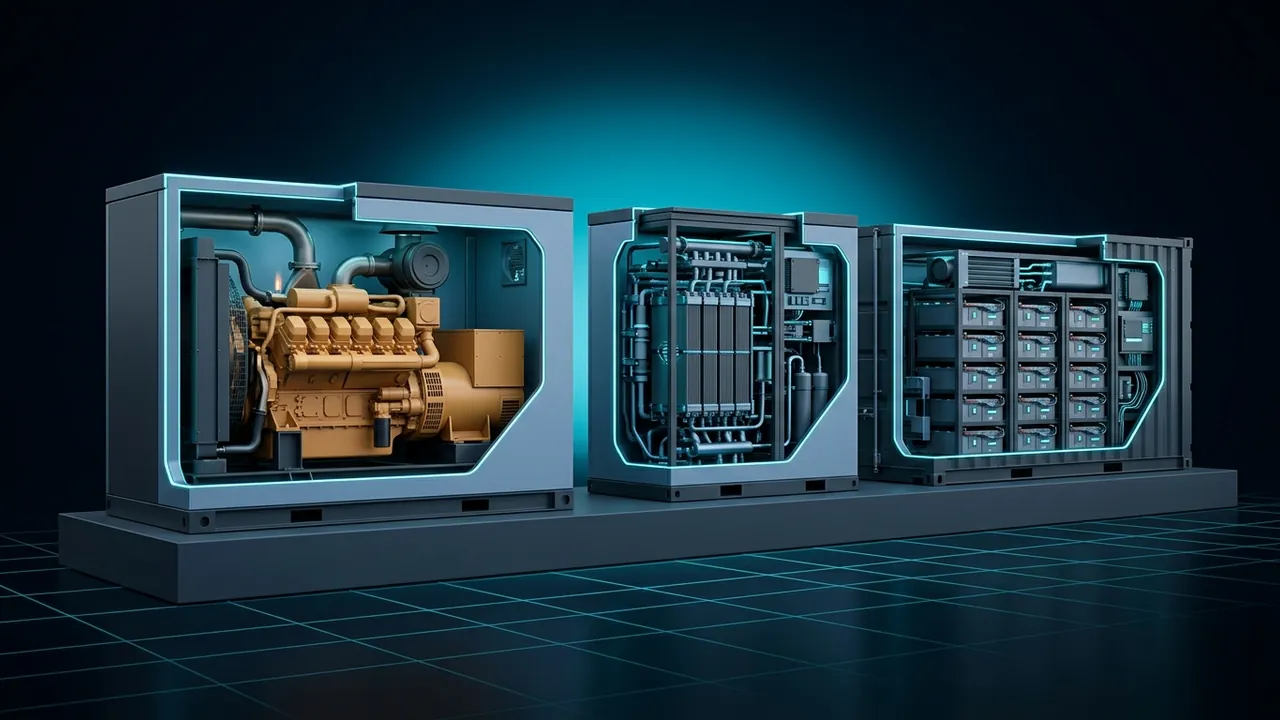
Ask five engineers how to power a remote facility and you might get five answers, all defensible. One loves gas engines. One swears by turbines. Someone mentions fuel cells, someone else wants solar and batteries, and the old-timer in the corner points out that diesel has never let him down. They are all partly right, because each machine fits a different job. So which on-site power generation options make sense, and how do you choose between them?
The main on-site power generation options are natural gas reciprocating engines, gas turbines, fuel cells, solar panels and battery storage, with diesel generators still the default for emergency backup. Gas engines and turbines are the workhorses for large, around-the-clock loads because they run on a fuel that can be piped in continuously.
Fuel cells offer quiet, efficient, low-emission power at a higher cost per kilowatt. Solar provides cheap daytime energy but needs storage or another source for nights and cloudy weather. Batteries do not make energy at all; they move it in time and respond in milliseconds. Most serious sites combine two or more.
What Are the Main On-Site Power Generation Options?
It helps to sort them by what they do best rather than by technology. Some make bulk energy around the clock. Some respond fast. Some exist mainly to cover emergencies.
- Bulk energy, 24 hours a day: gas reciprocating engines, gas turbines, fuel cells
- Low-cost energy when the sun is up: solar photovoltaic (PV) arrays
- Speed and smoothing: battery energy storage systems (BESS)
- Emergency backup: diesel generators, sometimes gas or dual-fuel units
The rest of this article takes them one at a time, then puts them side by side.
Natural Gas Reciprocating Engines
A reciprocating engine is a piston engine, the same basic idea as a car engine, scaled up and built to run for tens of thousands of hours on natural gas. Each one turns a generator, and together they make a genset.
The U.S. Environmental Protection Agency's Catalog of CHP Technologies lists reciprocating engines from about 5 kW up to 10 MW per unit, with electrical efficiency of roughly 27% to 41% on a higher heating value basis and availability of 96% to 98%. Larger sites line up many units in parallel.
Why engineers like them:
- Good efficiency, even at part load
- Modular, so losing one unit costs only a slice of capacity
- Quick starts, often within minutes
- Waste heat from the jacket water and exhaust can be recovered for heating or cooling
The downsides are more moving parts to maintain, noise, and emissions controls for nitrogen oxides (NOx). Natural gas engines also accept sudden load steps less gracefully than diesel engines, which matters for loads that jump around.
Gas Turbines
A gas turbine compresses air, burns fuel in it and spins a turbine with the hot exhaust. It is a close cousin of a jet engine, and some models, called aeroderivatives, are literally adapted from aircraft engines.
The same EPA catalog gives gas turbines a range of about 0.5 to 300 MW per unit, electrical efficiency of roughly 24% to 36% in simple cycle and availability around 93% to 96%. They deliver a lot of power from a small footprint and have fewer moving parts than a field of engines.
Turbines get much more attractive when their hot exhaust is put to work. In combined heat and power (CHP), the exhaust makes steam or hot water for a nearby process. In combined cycle, it feeds a steam turbine that makes more electricity. Both raise overall efficiency a lot, at the cost of more complexity.
Watch for heat derating. Turbines lose noticeable output on hot days because warm air is less dense. If your peak load comes on summer afternoons, size for that, not for a cool spring morning.
How Much Fuel Does Each Gas Option Burn?
Efficiency sounds abstract until you turn it into fuel. The conversion is simple: one kilowatt-hour equals 3,412 British thermal units (Btu), so heat rate in Btu/kWh = 3,412 ÷ efficiency.
Compare two example machines, both making a steady 1 MW for a full day:
- Gas engine at 38% efficiency: 3,412 ÷ 0.38 ≈ 8,980 Btu/kWh. Daily fuel = 1,000 kW × 24 h × 8,980 ≈ 215.5 million Btu (MMBtu).
- Small simple-cycle turbine at 30% efficiency: 3,412 ÷ 0.30 ≈ 11,370 Btu/kWh. Daily fuel = 1,000 × 24 × 11,370 ≈ 272.9 MMBtu.
That is about 57 MMBtu more per megawatt every day, or roughly 27% more gas for the turbine in this example. Over a year and many megawatts, that gap pays for a lot of maintenance. It is also why recovering a turbine's exhaust heat, through CHP or combined cycle, changes the comparison so much. Use the efficiency basis on your actual data sheets (higher or lower heating value), because mixing the two can skew the answer by about 10%.
Are Fuel Cells Worth the Higher Cost?
A fuel cell makes electricity from a chemical reaction instead of combustion. Most stationary fuel cells in commercial use run on natural gas, which is reformed into hydrogen inside the system. Because nothing burns, NOx emissions are very low and the units are quiet.
Solid oxide fuel cells (SOFC) are among the most efficient types. The U.S. Department of Energy's SOFC research program has set a goal of efficiency above 60%. The main trade-offs are higher upfront cost per kilowatt, sensitivity to fuel quality, and slower response to rapid load changes, which is why fuel cells are often paired with batteries.
Can Solar Power Carry an On-Site Load?
Solar PV has no fuel cost and very little maintenance. Its limitation is simple physics: it only produces when the sun shines, and it peaks around midday.
Consider what that means for a steady load, using illustrative numbers. Suppose a site needs a constant 1 MW, which is 24 MWh per day. If the location averages 5 peak sun hours, a 1 MW array produces roughly 5 MWh on an average day, before losses.
To make 24 MWh, you would need about 24 ÷ 5 = 4.8 MW of panels, plus extra for losses, plus enough storage to carry the load for the roughly 18 to 19 hours when the array is weak or dark. And that is an average day, not the cloudiest week of winter.
That is why solar shines as a fuel saver alongside gas or diesel, and why fully solar-powered sites tend to be small, like remote monitoring stations and telecom shelters.
Battery Storage: Not Generation, but Essential
A battery stores energy made by something else. It cannot run a site for long on its own, but it does things no engine can. A lithium-ion BESS responds in milliseconds, covers the seconds after a generator trips, absorbs load spikes, soaks up excess solar and can provide the starting power to restart a plant from zero.
Battery systems are sized by both power (MW) and energy (MWh). A 10 MW, 20 MWh system can deliver 10 MW for about two hours. For most on-site power plants, the power rating matters more than the energy rating, because the battery's job is speed, not endurance.
Diesel Generators: Still the Backup Standard
Diesel gensets remain the default emergency backup for hospitals, data centers and industrial plants. Diesel can be stored on site in tanks, so the backup does not depend on a pipeline staying up. Diesel engines also start fast and accept large load steps well.
The catch is that most diesel standby units are rated and permitted for limited annual hours. They are a safety net, not a primary power source, and emissions rules generally keep them that way.
What About Wind, Microturbines and Other Options?
A few more machines show up on site plans, usually in supporting roles.
- Microturbines are small gas turbines in the tens to hundreds of kilowatts. They are common at oil and gas sites and small CHP plants because they tolerate varied gas and need little maintenance, though they are less efficient than engines.
- Wind turbines can cut fuel use at windy remote sites, but output is even less predictable than solar, and tall towers bring permitting and maintenance challenges.
- Small hydro works beautifully where a site happens to have falling water, which is rare.
- Small nuclear reactors for on-site use remain in development and licensing, so they are a planning topic rather than an option you can order for a near-term project.
How Do On-Site Power Generation Options Compare?
The table below gives the big picture. Numbers are typical ranges, and specific models vary.
| Option | Typical unit size | Runs 24/7? | Response speed | Best role |
|---|---|---|---|---|
| Gas reciprocating engine | Up to about 10 MW | Yes | Fast | Modular prime power, CHP |
| Gas turbine | About 0.5 to 300 MW | Yes | Moderate | Large prime power, CHP, combined cycle |
| Fuel cell | Modules, often 100s of kW | Yes | Slow alone | Quiet, clean baseload |
| Solar PV | Any size | No | Weather-driven | Fuel saver, small remote loads |
| Battery storage | Sized by MW and MWh | No | Milliseconds | Smoothing, ride-through, black start |
| Diesel genset | Up to a few MW | Limited hours | Fast | Emergency backup |
How Do You Choose the Right Mix?
Start with four questions, in this order:
- What fuel can you actually get, reliably, at the site? Pipeline gas changes everything.
- How big is the load, and does it run around the clock or follow a daily pattern?
- How fast does the load change, and how much interruption can it tolerate?
- What will the air permit, the neighbors and the budget allow?
The answers usually point to a combination. A common pattern for a large site is gas engines or turbines for bulk energy, a battery for speed and a diesel or dual-fuel unit in case the pipeline fails. Add solar where land is cheap and daytime fuel savings matter.
Once you have several sources and a controller tying them together, you have built a microgrid, and our guide to what a microgrid is explains how those pieces work as one system. If you are stuck between the two gas options, our comparison of gas turbine vs reciprocating engine plants goes further.
Pick the Fuel First, Then the Machine
The best on-site power generation options are the ones that match your fuel, your load and your tolerance for interruption. Gas engines and turbines carry big loads around the clock, fuel cells trade cost for quiet efficiency, solar saves fuel when the sun cooperates, batteries buy speed, and diesel waits for the bad day.
No single machine does it all, and that is fine. Settle the fuel question first, then size the bulk generation, then add the fast and backup pieces around it. That order saves a lot of redesign.