What Is Switchgear? – Types for Data Centers and On-Site Plants

Every power system needs a way to turn things on, turn things off and, most importantly, shut things down fast when something goes wrong. In a house, that job belongs to the breaker panel in the garage. In a data center or a power plant, the same job is done by rows of steel cabinets that can weigh several tons per section and interrupt fault currents large enough to vaporize copper. Those cabinets are switchgear. What is switchgear, exactly, and which types matter for data centers and on-site power plants?
Switchgear is an assembly of circuit breakers, switches, fuses, protective relays, metering and busbars, housed in metal enclosures, that controls, protects and isolates electrical equipment. It lets operators connect and disconnect circuits, and it automatically trips a breaker when it detects a fault such as a short circuit, limiting damage and keeping the rest of the system running.
Switchgear is grouped by voltage: low voltage up to 1,000 volts, medium voltage from about 1 kilovolt (kV) to the mid-30s of kV, and high voltage above that. Data centers use it from the utility service down to the 480-volt gear feeding UPS and cooling systems, and on-site plants use it to synchronize and protect each generator.
What Is Switchgear Made Of?
Open a switchgear lineup (after a qualified electrician has made it safe) and you will find the same basic parts. Schneider Electric's switchgear explainer describes them as breakers, protective relays, busbars and instrument transformers, working together to connect, control and protect circuits.
- Circuit breakers: the muscle. They carry normal current and interrupt fault current on command.
- Protective relays: the brains. They watch current and voltage and decide when a breaker must trip.
- Instrument transformers: current transformers (CTs) and voltage transformers (VTs) scale high currents and voltages down to levels relays and meters can read.
- Busbars: thick copper or aluminum bars that carry power between sections.
- Disconnect switches and grounding switches: provide a visible, lockable break for maintenance.
- Metering and controls: meters, indicating lights and communication links to the building or plant control system.
How Does Switchgear Protect a Power System?
By detecting trouble and isolating it in a fraction of a second. Suppose a cable fails and shorts to ground. The fault current may jump to many times normal. CTs feed that current to a relay, the relay recognizes the pattern, and it signals the breaker to open. A medium-voltage vacuum breaker typically clears the fault within a few cycles, and on a 60 hertz (Hz) system each cycle is about 17 milliseconds.
The art is selectivity. Relays are set so the breaker closest to the fault trips first, and upstream breakers wait a little longer as backup. When coordination is done right, a fault on one feeder drops only that feeder. When it is done wrong, a small fault can black out a whole building. Engineers set these timings in a protective device coordination study.
What Are the Main Types of Switchgear?
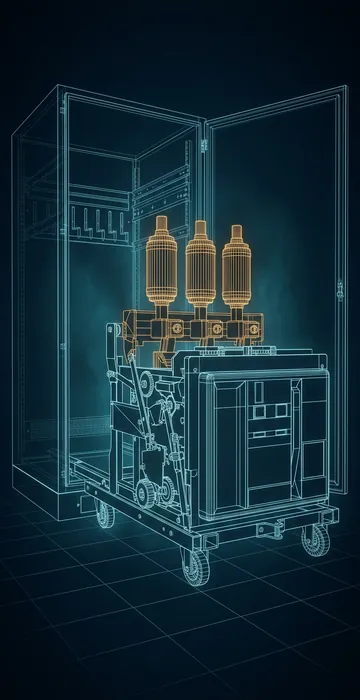
Switchgear is sorted in a few overlapping ways. Voltage class comes first, then construction and insulation.
By Voltage
- Low voltage (up to 1,000 volts): in North American data centers, mostly 480-volt gear feeding UPS systems, mechanical loads and distribution.
- Medium voltage (about 1 to 38 kV): the backbone of campus distribution and generator buses, often at 4.16, 13.8 or 34.5 kV.
- High voltage (above about 69 kV): utility and owner substations that tie into the transmission grid.
By Construction
In North America, medium-voltage switchgear is commonly metal-clad, built to the IEEE C37.20.2 standard. Each breaker sits in its own grounded metal compartment and can be racked out on rails, separate from the bus and cable compartments. Metal-enclosed switchgear is a simpler design, often using load-interrupter switches and fuses instead of breakers. Arc-resistant switchgear is tested to channel the blast of an internal arc away from the front of the gear, protecting people standing nearby.
By Insulation
Air-insulated switchgear uses air spacing between live parts, which makes it larger but easy to inspect. Gas-insulated switchgear seals the live parts in a tank of insulating gas, traditionally sulfur hexafluoride (SF6), and fits in a much smaller footprint. SF6 is a very potent greenhouse gas, so leaks are monitored closely, and manufacturers have been developing alternatives.
How Is Switchgear Rated?
Four ratings do most of the work: voltage class, continuous current, interrupting rating and short-time withstand. Continuous current is what the bus and breakers carry all day, such as 1,200, 2,000 or 3,000 amps for medium-voltage gear and up to 4,000 amps or more for 480-volt gear. Interrupting rating, in thousands of amps (kA), is the largest fault the breaker can safely clear. Short-time withstand is how long the gear can carry a fault while a downstream breaker clears it.
Interrupting rating is where people get caught out. Worked example for a 2,500 kilovolt-ampere (kVA) transformer feeding 480-volt switchgear, with a typical impedance of 5.75%:
- Full-load current: 2,500,000 ÷ (1.732 × 480) ≈ 3,007 amps.
- Maximum fault current, assuming a very strong utility source: 3,007 ÷ 0.0575 ≈ 52,300 amps, or about 52 kA.
- Large motors and generators on the bus add more fault current, so the gear might need a 65 kA rating.
Gear with too low an interrupting rating can fail violently during a fault, which is why the short-circuit study comes before the equipment order.
Switchgear vs Switchboard vs Panelboard
People use these words loosely, but in North America they mean different things. The table sums up the usual distinctions for low-voltage equipment.
| Equipment | Typical use | Breakers | Key traits |
|---|---|---|---|
| Low-voltage switchgear | Main service and critical distribution | Drawout power circuit breakers | Compartmentalized, rated to withstand faults long enough for upstream breakers to coordinate |
| Switchboard | Service entrance and distribution in commercial buildings | Often molded or insulated case breakers | More compact and cheaper, less compartmentalized |
| Panelboard | Branch circuits for lighting and small loads | Small plug-in or bolt-on breakers | Wall-mounted, lowest cost |
How Do Data Centers Use Switchgear?
At nearly every step from the utility to the server. A typical large facility has:
- Service entrance or substation switchgear where utility power arrives.
- Medium-voltage distribution switchgear feeding buildings and unit substations. Our guide to medium voltage distribution covers those layouts.
- Generator paralleling switchgear that synchronizes generators and shares load among them.
- Low-voltage switchgear in each unit substation, often arranged as main-tie-main so either transformer can carry the load.
- UPS input, output and bypass switchboards.
Transfer between utility and generator happens either in the switchgear itself, with motorized breakers and logic, or in a dedicated automatic transfer switch. Large facilities often use breaker-based transfer schemes in switchgear, while smaller sites and individual mechanical loads use transfer switches.
What Does Switchgear Do at an On-Site Power Plant?
It turns individual generators into one plant. Each generator gets its own breaker, with protection for faults inside the machine and on the bus. Synchronizing equipment matches each unit's voltage, frequency and phase angle before its breaker closes. Feeder breakers carry power out to the loads, and if the plant ties to the utility, an interconnection breaker with utility-required relays forms the boundary. Plant switchgear also hosts the load-shedding logic that drops less critical loads when generation runs short.
How Is Switchgear Maintained?
On a schedule, by qualified electrical workers following arc flash safety rules. Typical tasks include infrared scans to find hot connections, breaker inspection and timing tests, relay testing, cleaning and torque checks, and insulation testing. NFPA 70B is the common reference for electrical maintenance programs, and NFPA 70E covers the safe work practices around energized equipment. Never open live switchgear without training and proper protective equipment. The energy behind those doors is not forgiving.
Switchgear Is the System's Reflexes
What is switchgear? It is the assembly of breakers, relays, bus and instrument transformers that lets a power system switch, protect and isolate its equipment, at low, medium and high voltage. In data centers it sits at the service entrance, on the medium-voltage backbone, behind every generator and on the 480-volt side. In on-site plants it synchronizes generators and guards the boundary with the grid.
When you plan a project, treat switchgear as a design decision, not a commodity. Its layout, ratings and protection settings decide how far a fault spreads and whether you can maintain the system without a shutdown.