What Is a Behind-the-Meter Data Center? – How It Works
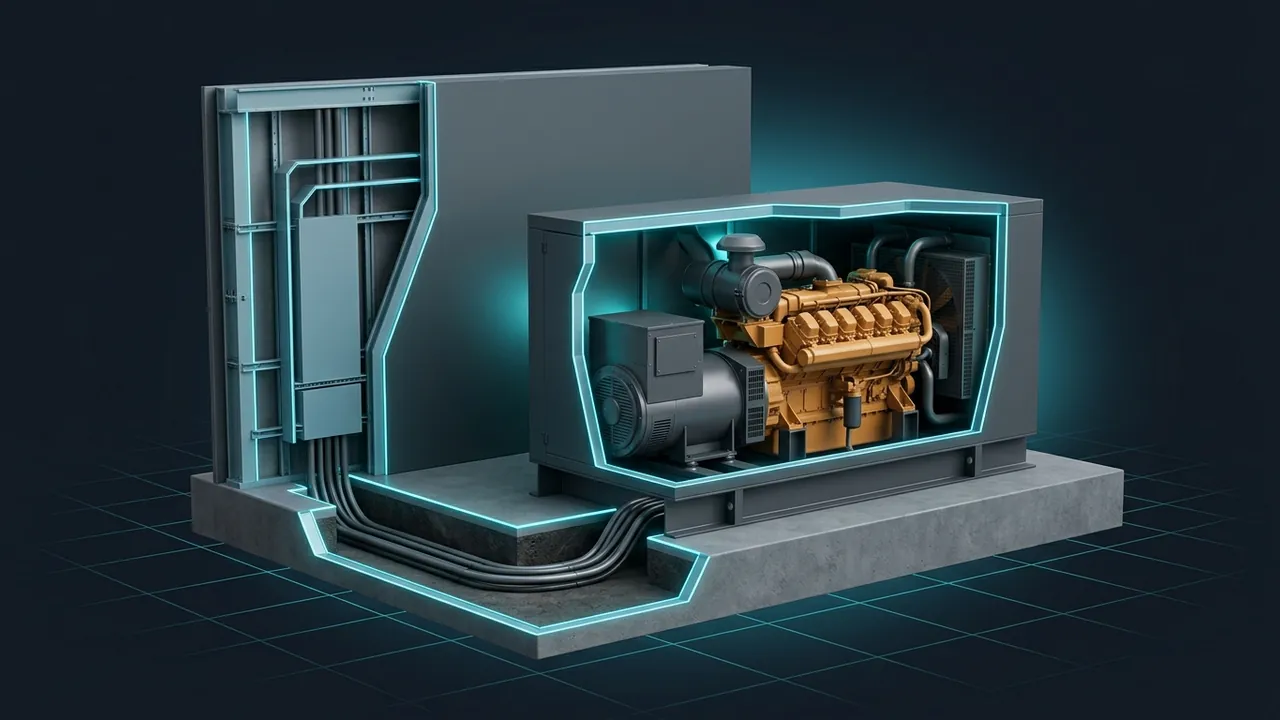
Most data centers buy their electricity the ordinary way: the utility builds a substation, runs a line, sets a revenue meter and sends a bill every month. That model works until the utility says the line will take five or more years. Then developers start asking a different question. What if the power plant sat on our side of the meter? What is a behind-the-meter data center, and how does it work?
A behind-the-meter data center is a data center whose main power comes from generation on the customer's side of the utility meter, usually on the same site, instead of from the grid. The plant is usually natural gas engines or turbines, sometimes with batteries, solar or fuel cells.
Some sites run fully islanded with no utility connection at all, while others stay tied to the grid and use it as backup or for part of the load. Developers choose it mainly for speed, since a gas plant can often be built faster than a new transmission connection. The price is that the owner now runs a power plant.
What Does "Behind the Meter" Actually Mean?
"Behind the meter" (BTM) describes where generation sits relative to the utility's revenue meter. Anything on the customer side of that meter is behind it. Anything on the utility side, feeding the wider grid, is "in front of" it.
Enverus puts it simply in its glossary entry on behind-the-meter generation: electricity produced on the customer's side of the meter, such as on-site gas generators, rooftop solar, fuel cells or batteries, as opposed to big centralized plants. A homeowner with rooftop panels is behind the meter. So is a hospital with a cogeneration plant. A data center campus with forty gas engines lined up next to the data halls is the same idea at a much larger scale.
Here is the detail people miss. Almost every serious data center already has generation behind the meter, in the form of diesel standby generators. Those only run during outages and tests. When people say "behind-the-meter data center" today, they usually mean something bigger: on-site generation that runs every hour of the year as the primary source of power, not just the emergency spare.
Why Are Developers Building Behind-the-Meter Data Centers Now?
The short answer is time. Demand for data center power has grown much faster than the grid's ability to connect new large loads, and every month without power is a month a finished building earns nothing.
The demand side is well documented. A Lawrence Berkeley National Laboratory report released by the U.S. Department of Energy in December 2024 estimated that U.S. data centers used about 58 terawatt-hours (TWh) in 2014 and about 176 TWh in 2023, roughly 4.4% of U.S. electricity. Its scenarios put 2028 use somewhere between 325 and 580 TWh. The chart below shows those figures.
Estimated annual use, with low and high scenarios for 2028
- Projected or scenario value
Lawrence Berkeley National Laboratory, 2024 United States Data Center Energy Usage Report (released by U.S. DOE, December 2024)
View the data
| Electricity use | |
|---|---|
| 2014 | 58 TWh |
| 2023 | 176 TWh |
| 2028 (low scenario) | 325 TWh |
| 2028 (high scenario) | 580 TWh |
The supply side is the bottleneck. A large campus needs new transmission lines, substations and studies, and utilities have to make sure a few hundred megawatts of new load will not hurt reliability for everyone else. Caterpillar's 2025 white paper on bridge power cites utility waits of three to seven years in some markets. Even generation projects wait: Berkeley Lab's queue research has found median times from interconnection request to commercial operation of more than four years.
Put those together and the math is blunt. If the building can be finished in 18 to 24 months but the utility connection takes five years, the owner can either sit on a very expensive empty shell or build power on site. That gap is the whole business case for most behind-the-meter projects.
How Does a Behind-the-Meter Data Center Work?
Electrically, a behind-the-meter data center works much like any other data center. The difference is what sits at the top of the one-line diagram. Instead of a utility substation, the source is an on-site plant.
Follow the power from fuel to server:
- Fuel arrives. Usually natural gas through a pipeline lateral and a meter and regulation skid. Sites without a pipeline sometimes use trucked compressed natural gas (CNG) or liquefied natural gas (LNG) for a while.
- Generators make power. Reciprocating engine gensets (typically a few megawatts each) or gas turbines (from a few megawatts to well over 50 MW each) convert fuel to electricity, often at medium voltage.
- Switchgear collects and protects. Medium-voltage switchgear ties the generators to a common bus, synchronizes them and isolates faults.
- Transformers step down. Unit substations bring the voltage down to the levels the building uses.
- The uninterruptible power supply (UPS) bridges gaps. Batteries or flywheels carry the IT load for seconds to minutes if a generator trips, while the controls rebalance.
- The racks consume it. Nearly every watt that reaches the servers comes back out as heat, so cooling is part of the electrical load too.
Above all of this sits a plant control system, often a microgrid controller, that decides how many units run, shares load between them and keeps frequency and voltage steady. On the grid, a huge interconnected system does that job for you. Behind the meter, your own controls and your own spinning machines are the grid.
What Are the Main Behind-the-Meter Configurations?
There is no single design. Most projects fall into one of four patterns, and some move from one to another over their life.
Fully Islanded
No utility tie at all. The on-site plant carries 100% of the load, all the time, with enough spare units to cover failures and maintenance. This is the hardest version to engineer, since nothing outside the fence can help when something goes wrong. We cover it in detail in our guide to what it takes to run an off-grid data center.
Grid-Parallel (Hybrid)
The site has a utility connection and on-site generation, and both run at the same time. The generation might cover the base load while the grid covers peaks, or the grid might be the backup for the plant. This needs an interconnection agreement, protective relaying to keep the plant from backfeeding the utility unexpectedly, and a clear decision about whether the site will ever export power.
Bridge to Grid
On-site generation powers the campus until the permanent utility connection arrives, then shifts to backup or leaves. Mobile turbines and rented engine fleets are common here because the owner may not want them forever.
Grid Primary With On-Site Backup
The traditional data center: utility power normally, diesel or gas standby generators for outages. It is technically behind the meter, but it is not what most people mean by the term.
| Configuration | Utility tie? | Who carries the load normally | Biggest design challenge |
|---|---|---|---|
| Fully islanded | No | On-site plant, always | Redundancy, load steps, black start |
| Grid-parallel | Yes | Shared between plant and grid | Protection and interconnection terms |
| Bridge to grid | Later | On-site plant until the grid arrives | Planning the hand-off |
| Grid primary, on-site backup | Yes | Utility | Generator testing and fuel storage |
What Equipment Powers a Behind-the-Meter Site?
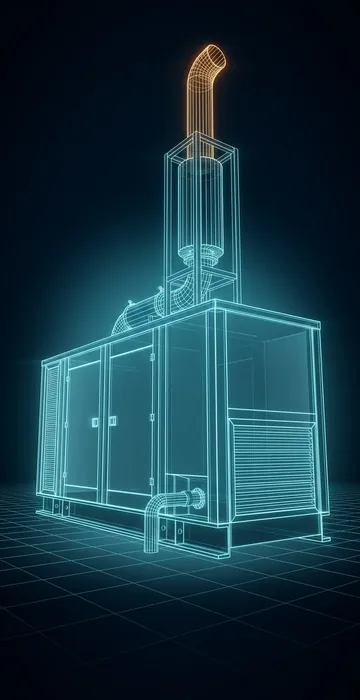
Most behind-the-meter data centers run on natural gas, because gas is the fuel that can deliver hundreds of megawatts around the clock from a modest footprint. Within gas, there are two main families of machines, and the choice shapes the whole plant.
Reciprocating engines are big cousins of the engine in a pickup truck, built to run on natural gas for years at a time. Units of a few megawatts each are common, and a site might line up dozens of them. They start quickly, handle partial load gracefully and lose only a small slice of capacity when one unit trips.
Gas turbines are jet-engine relatives. Aeroderivative models in the tens of megawatts start in minutes and pack a lot of power into a small space, while larger industrial frames are bigger and slower to deliver. Fewer, larger units mean fewer things to maintain, but each trip is a bigger bite out of the plant.
Around the gas machines, other equipment fills specific roles:
- Battery energy storage systems (BESS) absorb sudden load changes, cover the seconds after a generator trips and can help restart the plant from zero.
- Fuel cells turn gas into power electrochemically, quietly and with very low nitrogen oxide (NOx) emissions, at a higher cost per kilowatt.
- Solar arrays can trim daytime fuel burn where land is cheap, though they cannot carry a 24-hour load alone without very large storage.
- Diesel generators often stay on as emergency backup, since diesel can be stored on site in tanks when gas delivery fails.
In practice the strongest designs mix them. A common pattern is engines or turbines for energy, batteries for speed, and some stored fuel in case the gas supply is interrupted.
How Much Gas Does a Behind-the-Meter Data Center Burn?
A lot, and it is worth doing the arithmetic before anyone signs a gas contract. The key number is heat rate, the fuel energy needed per kilowatt-hour of electricity, measured in British thermal units per kilowatt-hour (Btu/kWh). Lower is better.
Take an example site that needs 100 MW at the fence, running on engines with a heat rate of 8,500 Btu/kWh:
- Power in kilowatts: 100 MW = 100,000 kW
- Fuel per hour: 100,000 kW × 8,500 Btu/kWh = 850,000,000 Btu, or 850 million Btu (MMBtu) per hour
- Fuel per day: 850 MMBtu × 24 = 20,400 MMBtu per day
- Gas volume: at about 1,036 Btu per cubic foot, that is 20,400 ÷ 1.036 ≈ 19,700 thousand cubic feet (Mcf) per day, or about 19.7 million cubic feet per day (MMcf/d)
Scale that up and the numbers get big fast. The same math for a 1 gigawatt (GW) campus at full load gives about 197 MMcf/d. Real campuses usually average below their peak, and a more efficient plant burns less, so a real 1 GW site's average burn usually comes in somewhat below that full-load figure, but the order of magnitude does not change. Either way, this is pipeline-scale demand, not something a single gas well supports. Firm transportation, gas quality and backup fuel all become questions for the power design, not afterthoughts.
What Are the Trade-Offs of Going Behind the Meter?
Speed is the prize. Everything below is the bill for it.
- Redundancy costs money. The grid gives you thousands of generators in the background. On site, you have to buy your own spares. A site needing 28 running units might install 30 or more so that one can be in maintenance while another trips.
- Fuel becomes a single point of failure. If the pipeline goes down, the whole campus goes down unless there is backup fuel or a grid tie. Many designs add dual-fuel capability or on-site storage for that reason.
- Air permits are real work. A plant this size can easily be a major source under the Clean Air Act, which means emissions controls, modeling and a permit timeline that has to fit the schedule.
- Efficiency is lower than the best utility plants. Simple-cycle engines and turbines burn more gas per kWh than a large combined-cycle plant. Some projects add waste-heat recovery to close part of that gap.
- Load behavior matters. Large, sudden swings in data center demand are hard on a small isolated plant. Batteries and careful generator selection help.
- Neighbors notice. Engines and turbines make noise and visible exhaust plumes, which comes up at every community meeting.
Rules are also shifting. Texas Senate Bill 6, signed in June 2025, added new requirements for large loads in ERCOT (the Electric Reliability Council of Texas), including disclosure of backup generation. Other states and grid operators are writing their own. Anyone planning a site should check the current rules with counsel and the state regulator early.
How Is Behind the Meter Different From Front of the Meter?
Front-of-the-meter generation sells power into the grid. A utility plant or an independent power producer feeds the transmission system, gets paid through a wholesale market or a contract, and the power reaches customers through the wires. Behind-the-meter generation serves the load right next to it first, and exporting is optional or not allowed at all.
The practical difference is who carries the risk. Front of the meter, the grid absorbs a plant trip without anyone noticing. Behind the meter, a trip lands directly on your load. If you want the full comparison, our article on behind-the-meter vs front-of-the-meter walks through it.
Where the Meter Sits Decides Who Keeps the Lights On
The takeaway: going behind the meter swaps a long utility wait for a power plant you have to fuel, staff and maintain. That is a good trade when the grid date is years away and gas is close by, and a poor one when neither is true.
That choice moves the hard problems inside the fence: fuel supply, redundancy, permits, load swings and long-term cost. None of them are unsolvable, and engine and turbine plants have run industrial sites reliably for decades.
If you are weighing a site, start with three numbers: the real facility load in megawatts, the firm gas you can contract for, and the date the utility will actually deliver. Those three answers usually tell you which configuration fits.