What Is Bridge Power for Data Centers? – Running Until the Grid Arrives
The building is done. The chillers are commissioned, the racks are going in, and the tenant wants to start next quarter. The utility, meanwhile, says the new substation is three years out. Nobody wants to pay for a finished data center that sits dark that long, so the developer starts sketching a bridge power data center plan, and a different kind of power shows up on trailers. What is bridge power for data centers, and how does it get a site running before the grid arrives?
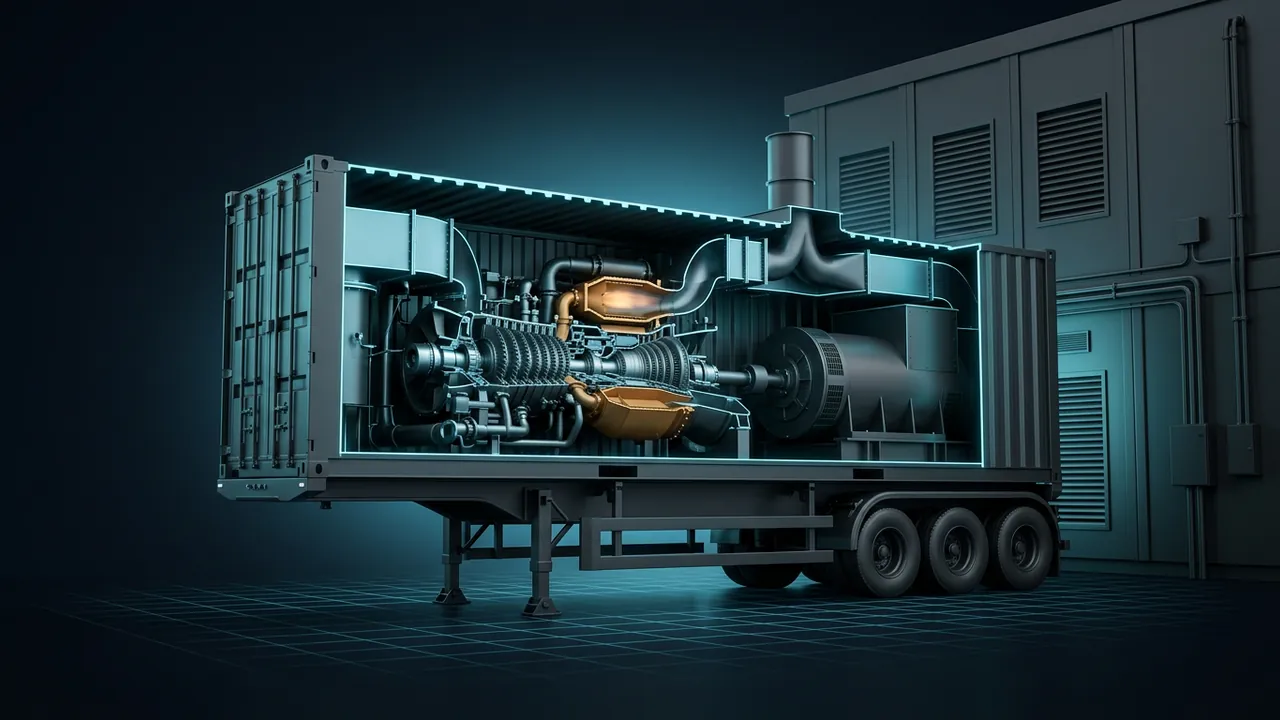
Bridge power is temporary on-site generation that runs a data center from the day the building is ready until the permanent utility connection is energized. It is usually mobile gas turbines, containerized reciprocating engine gensets or a mix, often backed by batteries, and fueled by pipeline gas or trucked gas.
Bridge setups can last from a few months to several years. When the grid finally arrives, the equipment is removed, kept as backup or folded into a hybrid plant. A bridge power data center trades higher fuel and rental costs for earlier revenue, and for many projects that trade pays off.
Why Do Data Centers Need Bridge Power?
Because the grid and the building run on different clocks. A data center shell can often be built in 18 to 24 months. A new high-voltage connection for hundreds of megawatts can take far longer once studies, transmission upgrades and long-lead equipment are added. Caterpillar's 2025 white paper on bridge power solutions for data centers cites utility waits of three to seven years in some markets.
The cost of waiting is easy to underestimate. Try an illustrative case. Say a finished campus represents $500 million of invested capital, and the owner's cost of capital is 8% per year. That is $500,000,000 × 0.08 = $40 million per year, or about $3.3 million every month, before a single tenant pays rent. Against that, a bridge plant that costs more per megawatt-hour than utility power can still look cheap.
Tenants care too. A company that needs compute capacity now will choose the site that can energize first, and bridge power is often what makes "first" possible.
What Equipment Does a Bridge Power Data Center Use?
The best bridge equipment shares three traits: it ships quickly, sets up quickly and can leave quickly. Three families dominate.
Mobile Gas Turbines
Aeroderivative turbines mounted on trailers are the heavy hitters. GE Vernova describes its TM2500 as a mobile unit on a three-trailer system rated up to about 34 MW, and its data center FAQ names these units for bridge power. Solar Turbines offers single-trailer mobile packages in the 5 to 16 MW range. Turbines pack a lot of power into a small pad, start in minutes and need less maintenance labor per megawatt than a field of small engines.
Containerized Reciprocating Engines
Gas engine gensets in shipping-container-style enclosures, typically one to a few megawatts each, can be lined up in rows and added as load grows. They are generally more efficient than small turbines, handle part load well, and losing one unit is a small hit to capacity. The trade-off is more units to maintain and more noise sources to manage.
Battery Energy Storage
A battery energy storage system (BESS) rarely provides bridge energy on its own, but it is increasingly part of the package. It handles fast load swings, gives engines time to respond when a unit trips and can help black start the plant. When the grid arrives, the batteries often stay.
| Option | Typical unit size | Strengths | Watch-outs |
|---|---|---|---|
| Mobile gas turbine | About 5 to 35 MW | High power per pad, fast start | Lower efficiency, loses output in heat |
| Containerized gas engine | About 1 to 5 MW | Efficient, modular, good part-load | Many units, noise, maintenance labor |
| Battery system | Sized by MW and MWh | Millisecond response, stays useful later | Not a long-duration energy source |
Is Bridge Power the Same as Backup Generators?
No, and the difference matters for equipment choice. Standby generators sit idle almost all year and run only during outages and tests. They are usually diesel, rated for limited annual hours, and sized to carry the load for hours or days.
Bridge power runs every hour, as the primary source. That means prime or continuous ratings, not standby ratings, plus fuel supply sized for nonstop operation and maintenance planned around run hours. A diesel standby fleet cannot simply be switched on and left running for a year; its ratings, its air permit and its fuel tanks were not built for that job.
Where Does Bridge Power Get Its Fuel?
Ideally from a pipeline. A lateral from a nearby gas line gives steady supply at the lowest cost. Where no pipeline exists yet, operators truck in compressed natural gas (CNG) or liquefied natural gas (LNG), which Caterpillar's white paper also discusses. Trucked gas works for smaller loads or short periods, but the truck count climbs quickly at large scale, so most big bridge plants plan around a pipeline from the start.
Some equipment can also run on diesel. That flexibility is valuable as a fallback, though air permits often limit how many hours a unit can burn it.
How Long Does Bridge Power Last?
As long as the gap. Short bridges of months often use rented reciprocating gensets, which are easy to bring in and take away. Bridges measured in years tend to favor turbines and batteries, which Caterpillar's paper also suggests, because maintenance and fuel efficiency matter more over long run times.
The honest answer is that bridges often last longer than planned. Utility in-service dates slip. Transformers arrive late. A smart contract assumes the bridge may need to stretch and prices the extension up front.
How Is Bridge Power Contracted?
There are a few common models, and the right one depends on how long the bridge will last and what happens to the equipment afterward:
- Rental: the owner rents units by the month and operates them, or pays the rental company to operate them
- Energy as a service: a third party owns and runs the plant and sells power to the data center, usually priced per kWh, with a capacity charge per kW-month
- Purchase: the owner buys the equipment, runs it as bridge power, then keeps it as backup or for a hybrid plant
Every model needs clear terms on fuel cost pass-through, availability guarantees, who pays when a unit trips, and what happens if the grid date moves. Have counsel review the agreement; these contracts carry real money and real risk.
How Do You Plan a Bridge Power Project?
Work backward from the date the first racks need power, and treat the bridge plant as a real power project rather than a rental order. A practical sequence looks like this:
- Pin down the load ramp. How many megawatts are needed on day one, at six months and at a year? Bridge plants are easiest to finance when they grow with the tenant.
- Confirm fuel early. Talk to the pipeline operator about a lateral and firm service before choosing equipment, since fuel delivery often sets the schedule.
- Start the air permit immediately. In many states this is the longest task on the list.
- Reserve equipment. Mobile turbines and large gensets are in demand, and fleets get booked months ahead.
- Design the electrical tie-in for both phases. Plan where the bridge plant connects now and where the utility substation connects later.
- Write the exit plan. Decide whether the equipment leaves, stays as backup or runs in parallel, and put that in the contract.
Projects that skip the first two steps tend to find out late that the gas cannot get there in time, which is an expensive way to learn the order of operations.
What Are the Risks of Bridge Power?
Speed brings its own problems. The common ones:
- Air permits: temporary does not mean exempt. Turbines and engines still need permits, and some permit types limit hours or require emissions controls.
- Load swings: large compute jobs can ramp power up and down quickly, and a small bridge plant feels every swing. The causes and fixes for AI training power fluctuations matter a lot here.
- Reliability: a bridge plant still needs spare units and a black start plan, since the grid is not there to catch a trip.
- Heat derating: turbines lose output on hot days, exactly when cooling load is highest.
- Community: temporary turbines are still loud and visible, and neighbors judge the project by them.
What Happens When the Grid Arrives?
The hand-off is a planned project of its own. The utility connection is energized, protection is tested, and the load is moved onto the grid, usually in stages. Then the bridge plant takes one of three paths.
- It leaves. Rented turbines and engines go back to the fleet for the next project.
- It becomes backup. Owned units stay on site and replace or supplement standby diesel.
- It keeps running in parallel. The plant covers part of the load alongside the grid, which requires an interconnection agreement and protective relaying to run safely in parallel.
Design for the hand-off from the start. Switchgear layout, protection settings and space for the permanent substation are much cheaper to plan on day one than to retrofit under load.
A Bridge Is Only as Good as the Far Bank
Bridge power is really a bet on a date. The turbines, engines and batteries are the easy part; the risky part is the utility's promise at the other end.
So ask the utility for its schedule in writing, assume it will slip, and build the extension cost into the plan. A bridge that lands on solid ground pays for itself; one that never reaches the far bank becomes a permanent power plant you did not design for.