Can a Data Center Use Grid Power and On-Site Power Together?
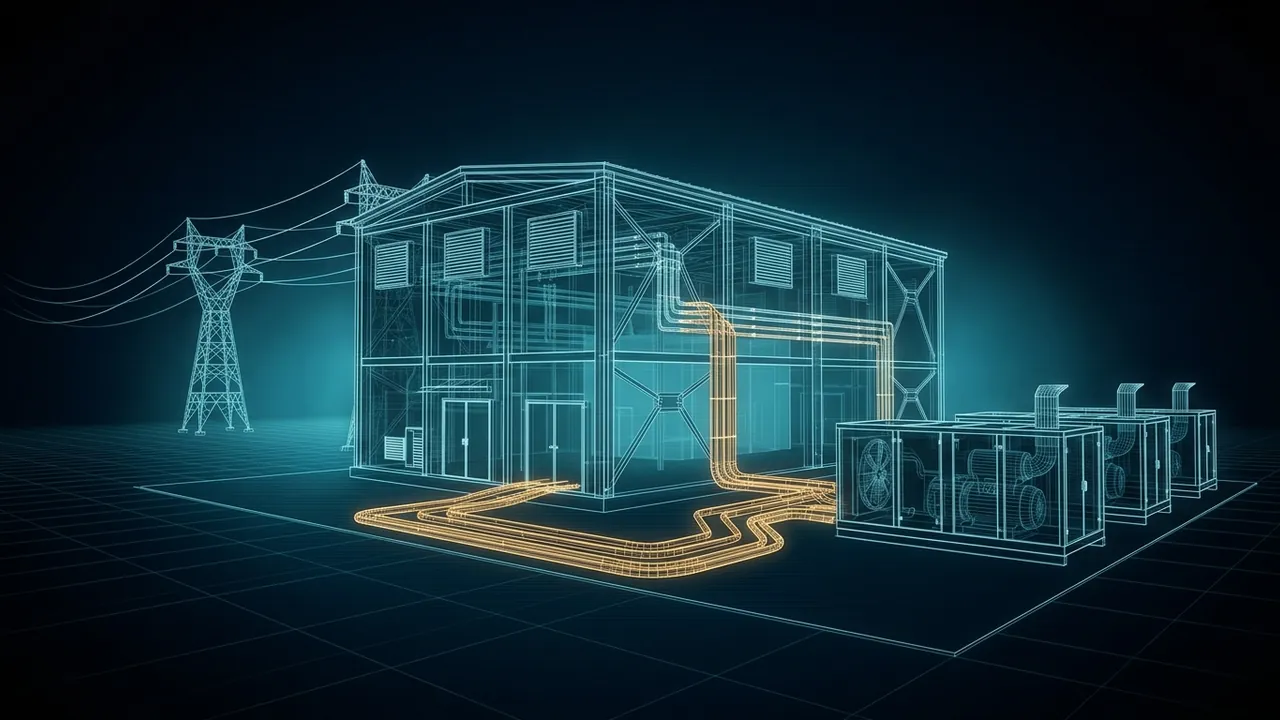
The old arrangement was simple. The utility supplied power, and diesel generators waited in the yard for the day it failed. Now developers want on-site generation running daily, a utility tie for backup or extra capacity, and sometimes a way to export. Grid-connected on-site generation is old news at factories and campuses, but it comes with rules that surprise people. Can a data center really run on grid power and on-site power at the same time, and what does it take to do it safely?
Yes, a data center can use grid power and on-site power together, as many industrial plants, hospitals and campuses already do. The main setups are grid primary with on-site standby, on-site primary with the grid as backup or top-up, and on-site bridge power that later hands off to the utility.
Running both at once (in parallel) requires a utility interconnection agreement, synchronizing equipment and protective relays that separate the site from the grid within fractions of a second when something goes wrong. Most data center projects choose a non-export design, which never pushes power back onto the utility system and keeps the approval process simpler.
What Are the Ways to Combine Grid and On-Site Power?
There are four patterns worth knowing, and a single campus may move through more than one over its life.
| Setup | Normal source | Role of the other source | Runs in parallel? |
|---|---|---|---|
| Grid primary, on-site standby | Utility | Generators start only in an outage | Usually no, or only briefly during a closed transition |
| On-site primary, grid backup | On-site plant | Utility covers maintenance and unit trips | Often yes |
| Shared load | Both, every day | Each covers part of the load | Yes, continuously |
| Bridge, then grid | On-site plant until the utility connection is ready | Plant becomes backup or is removed | Depends on the final design |
The first is the classic data center. The others are where things get interesting, because the site and the utility are now electrically joined while both are producing power.
How Does Grid-Connected On-Site Generation Run in Parallel?
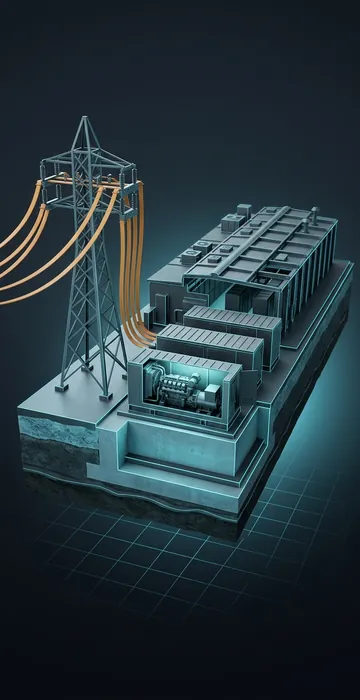
It runs locked in step with the grid. Before a generator breaker can close onto a live utility bus, the generator must match the grid's voltage, frequency and phase angle. A synchronizer nudges the engine or turbine speed and the voltage regulator until the two waveforms line up, and a sync-check relay blocks the breaker unless they do. Close out of phase and you get a violent torque shock to the machine and a large current surge.
Once paralleled, the grid sets the frequency. It is far stronger than any on-site plant, so the generators cannot speed it up or slow it down. Instead, the controls decide how much power each unit makes. A typical approach is base loading, where the on-site units hold a set output and the utility supplies whatever is left. Another is import control, where the plant follows the load so the utility supply stays near a target.
If the site separates from the grid, the controls must switch modes instantly. Now the on-site units have to hold frequency and voltage themselves, and every load change lands on them. A site that wants to keep running through that separation needs enough spinning capacity, fast controls and often a battery to absorb the step.
What Protection Does the Utility Require?
The utility's first concern is that your generators never harm its system or its crews. A lineman working on a line he believes is dead does not want your plant back-feeding it. So the interconnection agreement will specify protective relays at the point of interconnection, commonly including:
- Under and over voltage, and under and over frequency, to separate the site when the grid is abnormal.
- Reverse power or directional power, to detect power flowing toward the utility when it should not.
- Directional overcurrent, so the site's generators do not keep feeding a fault on the utility side.
- Anti-islanding protection, and sometimes a direct transfer trip signal from the utility substation.
- Sync-check, so nothing closes out of step.
On distribution systems, these requirements often follow the IEEE 1547 standard for distributed energy resources, adjusted by each utility's own rules. At transmission voltage, the utility and the regional grid operator set the requirements. The generators also add fault current, so the utility may require studies to confirm its breakers can still interrupt a fault safely.
What Does a Hybrid One-Line Diagram Look Like?
Simplified, a hybrid site has three main pieces of switchgear. Picture them from left to right on a one-line diagram:
- The utility service, ending at a point of interconnection breaker. This is where the utility's required relays live, and it is the breaker that opens to separate the site.
- A generator paralleling bus, usually at medium voltage, where the on-site engines or turbines synchronize with each other and share load.
- The site distribution bus, which feeds the unit substations, UPS systems and cooling plant. A tie breaker joins it to the generator bus.
With both main breakers closed, the site runs in parallel. Open the utility breaker and the site is islanded on its own plant. Open the generator tie and it is a plain utility customer. Batteries, if present, usually connect to the generator bus or the site bus, where they can steady frequency the moment the site islands.
Export or Non-Export: Which Is Easier?
Non-export is usually easier. In a non-export design, the site always imports at least a small amount from the grid, and a reverse power or minimum import relay trips the generator breaker if flow ever reverses. Because the plant never sells into the grid, the interconnection is often reviewed as a load with on-site generation rather than as a new power plant.
Export changes the picture. A site that wants to sell power generally enters the generator interconnection process, faces wholesale market rules and needs more studies. That can make sense for a large energy campus, but it adds time. The rules differ by utility, state and grid region, so check with the utility and with counsel before committing to either path.
Many large projects now pair load and generation on one campus by design. Our guide to the energy park data center model covers how developers plan those sites. The economics of making versus buying power belong in a different conversation, covered in self-generation vs utility power.
What Happens When the Grid Has a Disturbance?
This is where data centers have surprised grid operators. Data center electrical systems are designed to protect the IT load first, so when grid voltage dips, UPS and transfer systems may move the load to batteries and generators on their own. One site doing that is no problem. Many doing it at once is.
The North American Electric Reliability Corporation (NERC) documented exactly this. In its incident review of simultaneous voltage-sensitive load reductions, NERC described a July 10, 2024 fault on a 230 kV line that caused about 1,500 megawatts (MW) of data center load to transfer to backup power. The grid suddenly lost that much demand, which pushes frequency and voltage the wrong way.
For a site with grid-connected on-site generation, the lesson is that the protection and transfer settings are not just a private design choice. Ride-through settings, how fast the site separates and how it reconnects all affect the wider grid. Expect utilities to ask for those settings and to test them during commissioning.
Are the Rules for Hybrid Sites Changing?
Yes, and quickly. Large loads paired with their own generation do not fit neatly into rules written for either a load or a power plant. In October 2025, the U.S. Department of Energy directed the Federal Energy Regulatory Commission (FERC) to take up large load interconnection. As Vinson & Elkins summarized, the directive covered loads over 20 MW and hybrid facilities that combine load and generation.
Regional grid operators and states have been writing their own processes too. Because these rules keep moving, treat any summary, including this one, as a starting point and confirm the current requirements with your utility, grid operator and counsel.
Two Sources, One Set of Rules to Respect
Grid-connected on-site generation works, and it has for decades at factories and campuses. The physics is straightforward: synchronize, let the grid hold frequency, control your output, and separate cleanly when the grid misbehaves. The hard parts are the interconnection agreement, the protection scheme and the decision about export.
In practice, that means calling the utility before the design is set, deciding export versus non-export before you size anything, and writing down exactly how the site should behave during a grid fault. Settle those early and the rest of the engineering gets much easier.