CRAC vs CRAH – What Is the Difference in Data Center Cooling?

One letter apart, and people mix them up constantly. Facility staff say "CRAC unit" for anything big and beige at the end of a row. Vendors use both terms on the same brochure. But the two machines work differently, cost differently and fail differently. CRAC vs CRAH: what is the difference, and which one belongs in your data center?
The difference between a CRAC and a CRAH comes down to where the cooling is made: a CRAC (computer room air conditioner) has its own refrigerant compressor inside, while a CRAH (computer room air handler) has no compressor and cools air with chilled water from a central plant. CRACs suit smaller rooms and sites without a chiller plant. CRAHs usually win at larger scale, because a central chiller plant runs more efficiently and can use free cooling for more of the year.
What Is a CRAC Unit?
A CRAC unit is a packaged air conditioner built for computer rooms. It contains a compressor, an evaporator coil, an expansion device and fans. Refrigerant absorbs heat from the room air at the coil, the compressor raises its pressure and temperature, and the heat leaves the building through a condenser.
That condenser can be:
- An outdoor air-cooled condenser, the most common setup, connected by refrigerant piping.
- A water or glycol loop that carries heat to a dry cooler or cooling tower outside.
- A unit with an extra "free cooling" coil that uses cold glycol in winter so the compressor can rest.
The industry also calls these direct expansion (DX) units. Each CRAC is its own self-contained cooling system, which is handy. If one fails, the others keep going.
What Is a CRAH Unit?
A CRAH unit is an air handler that cools room air using chilled water. It has fans, filters, a chilled water coil and a control valve that opens or closes to match the heat load. There is no compressor inside.
The cold comes from somewhere else, usually a chiller plant with pumps, piping and often cooling towers. Chilled water flows into the CRAH coil anywhere from the mid-40s °F in older designs to the 60s in newer, warmer-running ones, picks up heat from the room, and returns warmer to the plant.
Because the CRAH is simpler, it is quieter and easier to maintain at the unit. The complexity has moved to the central plant, which needs its own redundancy and its own maintenance team.
Which Is More Efficient, CRAC or CRAH?
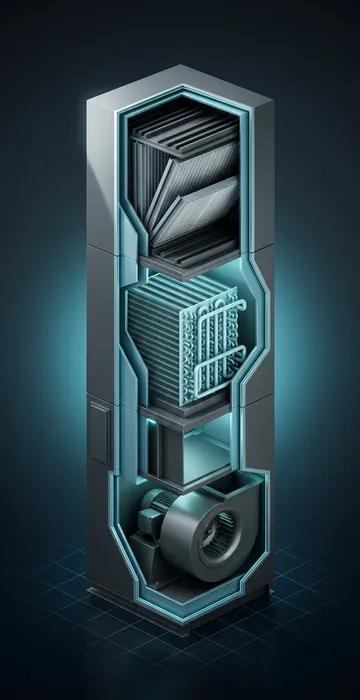
CRAH systems are usually more efficient at medium and large scale. A central plant with large water-cooled chillers typically uses less energy per ton of cooling than many small compressors spread across the floor. And a chilled water plant can use water-side economizers, cooling the water with outdoor air or towers alone during cool weather.
TechTarget's explainer on CRAC vs CRAH unit differences sums up the common rule of thumb: CRAC units suit loads up to roughly 200 kW, and CRAH systems make more sense above that. Treat that as a starting point. Climate, existing infrastructure and growth plans can move the line either way.
Efficiency matters beyond the utility bill. On an island or off-grid site, every kilowatt of cooling has to be generated on site. For a solar powered data center, cooling power means more panels, more batteries and more land, so the cooling choice shows up in the capital budget, not just the operating budget.
CRAC vs CRAH Side by Side
| Feature | CRAC | CRAH |
|---|---|---|
| Cooling source | Built-in compressor and refrigerant | Chilled water from a central plant |
| Heat leaves through | Condenser (air, water or glycol) | The chiller plant and its heat rejection |
| Typical fit | Small and mid-size rooms, edge sites | Larger data halls and campuses |
| Free cooling | Optional, with an economizer coil | Natural fit with water-side economizers |
| Failure impact | One unit at a time | A plant fault can affect many units |
| Up-front cost | Lower for small sites | Higher, because of the plant |
How Much Air Does a Cooling Unit Need to Move?
Whichever you choose, the unit has to move enough air to carry the heat. The sensible heat formula for air in US units is: CFM = Btu/hr ÷ (1.08 × ΔT in °F). The 1.08 comes from air density and specific heat at standard conditions.
A worked example with labelled inputs:
- IT load in one zone: 100 kW.
- Convert: 100 × 3,412 = 341,200 Btu/hr.
- Temperature rise across the servers: 20°F.
- Airflow: 341,200 ÷ (1.08 × 20) = about 15,800 CFM.
In cooling tons, 341,200 ÷ 12,000 = about 28 tons. With N+1 redundancy and units rated, say, 10 tons of sensible cooling each, three units cover the 28 tons, and one spare brings the total to four. If the temperature rise falls to 10°F because hot exhaust is mixing with supply air, airflow doubles. That is why containment and blanking panels pay off with either technology.
Which Should You Choose?
Choose a CRAC system when the room is small, there is no chilled water available, or you need units that stand alone. Server rooms in office buildings, telecom huts, modular data centers and remote sites usually land here.
Choose a CRAH system when the load is large, you are building or already own a chiller plant, or you want long economizer hours. Most large multi-megawatt facilities use chilled water with CRAHs or similar air handlers.
A few practical questions help settle it:
- How many kilowatts today, and how many in five years?
- Is water available, and do you want cooling towers on site?
- Who will maintain a central plant, and at what hour?
- How much refrigerant piping can the building layout handle?
What Breaks, and What Does Failure Look Like?
CRAC failures are usually local: a compressor trips on high head pressure on a hot afternoon, a refrigerant leak drains a circuit, or a condenser fan quits. The room warms in one area, and the neighboring units pick up some of the slack.
CRAH failures are often upstream. A chiller trips, a pump fails or a control valve sticks. Because many CRAHs share one plant, a plant problem can hit the whole floor at once. That is why chilled water plants use redundant chillers and pumps, and why some sites add chilled water storage to ride through a restart.
Both types need clean filters, healthy fan motors and calibrated sensors. Skipping filter changes is the quiet way to lose capacity on either one.
CRAC vs CRAH: Compressor in the Room or Plant Down the Hall
Once you see that the CRAC vs CRAH choice is really about where you make cold, the decision gets easier. Small, scattered or remote loads favor the self-contained compressor. Big, growing loads favor the central plant.
Start with your load, its growth and your water situation, then work out the airflow with the 1.08 formula and add redundancy. If you are past a couple hundred kilowatts and planning to grow, price out a chilled water plant before you buy one more DX unit.