Can Solar Power a Data Center? – Panels, Land and Storage Math
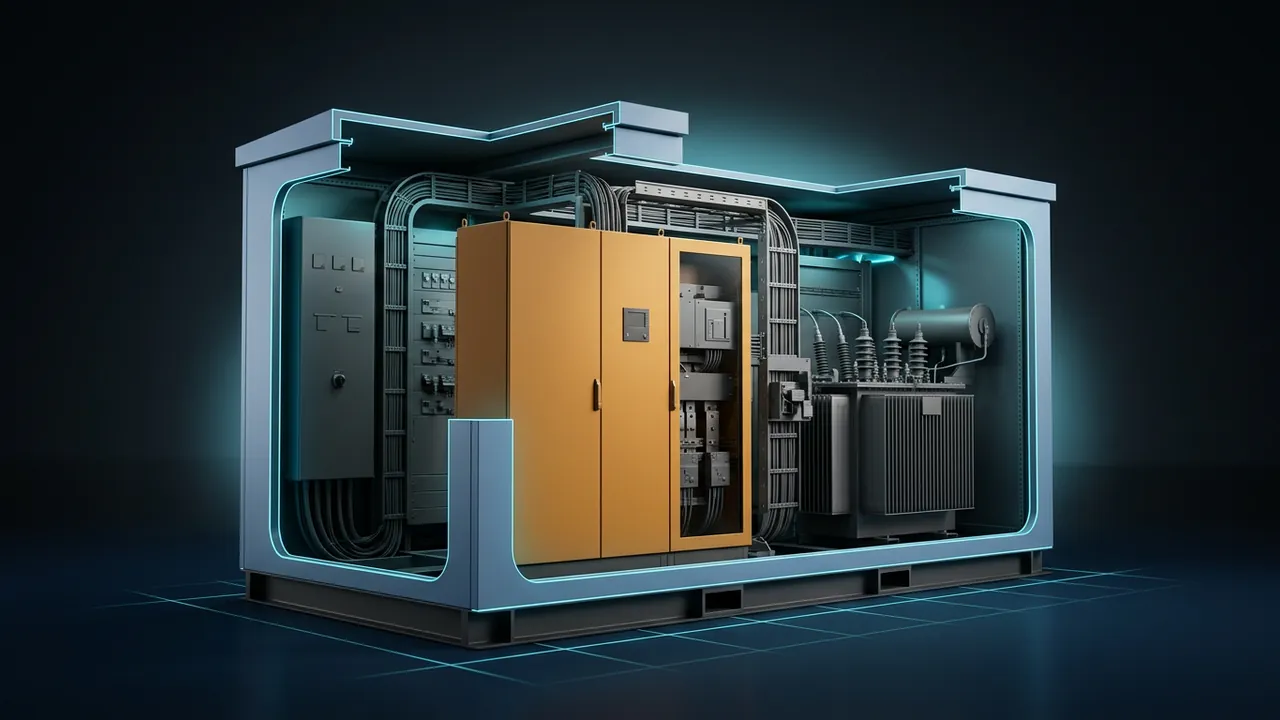
The pitch for a solar powered data center sounds great. Sunshine is free, panels keep getting cheaper and servers run on electricity, so why not build next to a big solar farm and skip the utility? Then you notice the data center runs at night, through cloudy weeks and in December, and the sun doesn't. The real question is how much land, storage and backup it takes to cover a load that never sleeps. Can solar power a data center by itself, and what does the math look like?
Solar can supply a large share of a data center's energy, but a solar powered data center almost always needs large battery storage plus a firm backup source, such as the grid or gas generators, to stay online around the clock. The load runs 24 hours a day, while panels produce only in daylight.
Covering a steady 20 MW load with solar on an annual basis takes roughly 90 MW of solar capacity, around 700 acres of land and hundreds of MWh of batteries just to get through each night. Several cloudy days in a row are where firm backup earns its keep.
Why Is Solar Hard to Match With a Data Center Load?
Solar is hard to match with a data center because the two have opposite shapes. A data center's load is flat: the same megawatts at 3 a.m. as at noon. A solar array produces nothing at night, ramps up in the morning, peaks around midday and fades by evening.
Solar output also swings with the seasons and the weather. A clear June day might produce two or three times as much as a cloudy December day. Data centers, meanwhile, often use slightly more power in summer for cooling but never drop to zero.
The chart below shows a modeled clear-day profile for a solar array sized for a 20 MW data center. The gap between the curve and the flat load line is the whole design problem.
Clear spring day, 90 MWac single-axis tracking array
- Solar output
- Data center load
Model: assumed 90 MWac single-axis tracking array on a clear spring day in the southern Plains; illustrative shape, not measured data.
View the data
| Solar output | Data center load | |
|---|---|---|
| 12am | 0 MW | 20 MW |
| 2am | 0 MW | 20 MW |
| 4am | 0 MW | 20 MW |
| 6am | 8 MW | 20 MW |
| 8am | 55 MW | 20 MW |
| 10am | 82 MW | 20 MW |
| 12pm | 88 MW | 20 MW |
| 2pm | 85 MW | 20 MW |
| 4pm | 60 MW | 20 MW |
| 6pm | 10 MW | 20 MW |
| 8pm | 0 MW | 20 MW |
| 10pm | 0 MW | 20 MW |
From about 7 p.m. to 7 a.m., the array covers nothing. During the middle of the day, it produces four times what the data center needs. That surplus has to be stored, sold or wasted.
How Many Solar Panels and Acres Does a Data Center Need?

A steady 20 MW data center needs roughly 90 MW of solar, close to 300,000 panels and about 700 acres to match its yearly energy use. Here's the step-by-step math, with every assumption labelled.
Step 1: Yearly Energy Use
- Facility load: 20 MW, running 8,760 hours a year
- Yearly energy: 20 × 8,760 = 175,200 MWh
Step 2: Solar Output per MW
- Assumed capacity factor: 25% for a single-axis tracking array in a sunny southern location (AC basis)
- Yearly output per MW of AC capacity: 8,760 × 0.25 = 2,190 MWh
Step 3: Account for Storage Losses
- Assume 40% of the load is served directly during daylight and 60% comes from batteries
- Assumed battery round-trip efficiency: 85%
- Solar energy needed: (0.40 + 0.60 ÷ 0.85) × 175,200 = about 193,800 MWh
- Solar capacity: 193,800 ÷ 2,190 = about 88.5 MWac, rounded to 90 MWac
Step 4: Panel Count
- Assumed DC-to-AC ratio: 1.3, so the DC array is 90 × 1.3 = 117 MWdc
- Assumed panel rating: 400 watts
- Panels: 117,000,000 ÷ 400 = about 292,500 panels
Step 5: Land
The National Renewable Energy Laboratory's study of land-use requirements for solar power plants found a capacity-weighted average of about 7.9 total acres per MWac for large photovoltaic plants. At that rate, 90 MWac × 7.9 = about 711 acres, a bit over one square mile.
For comparison, the data center building itself might sit on a few dozen acres. The solar field would be many times larger than the facility it serves.
How Much Battery Storage Would It Need?
To ride through a typical night, the site needs roughly 300 MWh or more of usable battery capacity, able to deliver at least 20 MW.
- Hours without useful solar on a typical night: about 13
- Energy needed: 20 MW × 13 hours = 260 MWh delivered
- Add margin for winter nights, battery aging and reserve: plan for 320 MWh or more
That's a big battery, and it covers only one ordinary night. Winter nights run longer, and the array may not fully recharge the battery on a short, hazy winter day. The BESS sizing article explains how to separate the MW rating (how fast the battery delivers) from the MWh rating (how long it lasts), which is exactly the trade-off here.
What Happens on Cloudy Days?
Cloudy days are where an all-solar plan breaks down. If a storm system parks over the site for three days and output drops to a fraction of normal, the battery drains after the first night and nothing refills it.
Covering three days of a 20 MW load would take 20 × 72 = 1,440 MWh of storage, more than four times the nightly battery. That battery would sit mostly unused the rest of the year, which makes it very expensive per MWh delivered. This is why nearly every serious design adds a firm source:
- A grid connection that supplies power when solar and batteries fall short
- On-site natural gas engines or turbines that start when the battery runs low
- Diesel generators, which work for rare emergencies but not for frequent use
Why Not Just Build More Solar?
Building more solar helps in winter, but it doesn't fix nights or multi-day storms, and it creates a lot of wasted energy in summer. If you sized the array for the cloudiest December week, it would produce far more than the site could use for most of the year.
Off-grid designers call this the oversizing trap. Each extra MW of panels adds less useful energy than the one before, because more and more of its output shows up when the battery is already full. At some point, a few hours of generator runtime a year costs much less than another few hundred acres of panels.
How Do Tracking and Location Change the Numbers?
Tracking and location change the numbers a lot, because they change the capacity factor. The example above assumed 25%, which fits a single-axis tracking array in a sunny southern location. A fixed-tilt array, or one farther north, might average closer to 18% or 20%.
Here's the same 193,800 MWh target at a 20% capacity factor:
- Yearly output per MWac: 8,760 × 0.20 = 1,752 MWh
- Solar capacity: 193,800 ÷ 1,752 = about 111 MWac
- Land at 7.9 acres per MWac: about 877 acres
That's about 23% more capacity and land for the same data center. Site selection for a solar heavy design starts with the sun, not the land price.
Can Solar Help Even if It Can't Do It All?
Solar can help a lot even when it covers only part of the load, mainly by saving fuel. Pair a modest array with on-site gas generation and every MWh from the panels is a MWh the engines don't have to make.
Run a hypothetical case:
- Solar array: 40 MWac at a 25% capacity factor
- Yearly output: 40 × 2,190 = 87,600 MWh
- Assumed gas engine heat rate: 8,500 Btu/kWh, or 8.5 MMBtu per MWh
- Gas avoided: 87,600 × 8.5 = about 744,600 MMBtu a year
- At an assumed $3.00/MMBtu: about $2.2 million a year in fuel savings
The engines still have to be sized for the full load, because they must carry the site at night. So the savings come from fuel and wear, not from smaller generators. That makes this a fuel-price hedge more than a capital saver, which is worth knowing before you pitch it to investors.
What Does a Realistic Solar Powered Data Center Look Like?
A realistic solar powered data center is a hybrid. Solar supplies cheap daytime energy and charges batteries. Batteries carry the load through the evening and smooth fast changes. A firm source, grid or gas, covers the rest.
In that setup, solar might supply anywhere from a third to most of the site's yearly energy, depending on how much storage the owner is willing to buy. The last slice of solar coverage is always the most expensive, so many designs stop well short of 100%.
The sizing work is worth doing with real data. NREL's free PVWatts calculator estimates hourly solar output for any location, which is a good starting point before hiring a design firm.
Where Does Solar Work Best for Data Centers?
Solar works best for data centers in places with strong sun year-round, cheap flat land and room for a large array next to the facility. West Texas, New Mexico, Arizona and parts of Oklahoma fit that description better than cloudier northern regions.
It also works better for loads that can flex. A bitcoin mining operation or a batch computing job that can pause at night is a much easier match for solar than a facility that must stay online every second. The rule of thumb I'd use: the more flexible the load, the more solar makes sense on its own.
The Solar Powered Data Center Math Points to a Hybrid
So, can solar power a data center? Yes, but not alone. For a steady 20 MW load, plan on roughly 90 MW of panels, around 700 acres, a few hundred MWh of batteries for each night, and a firm backup for long stretches of bad weather.
The smart approach is to treat a solar powered data center as a hybrid system from day one. Model the site's hourly solar output, size storage for the nights you can afford to cover, and pick a backup source you can count on. Then decide how much solar coverage is worth paying for, rather than chasing 100% at any price.