Dust, Sand and Data Centers – Filtration for Harsh Sites
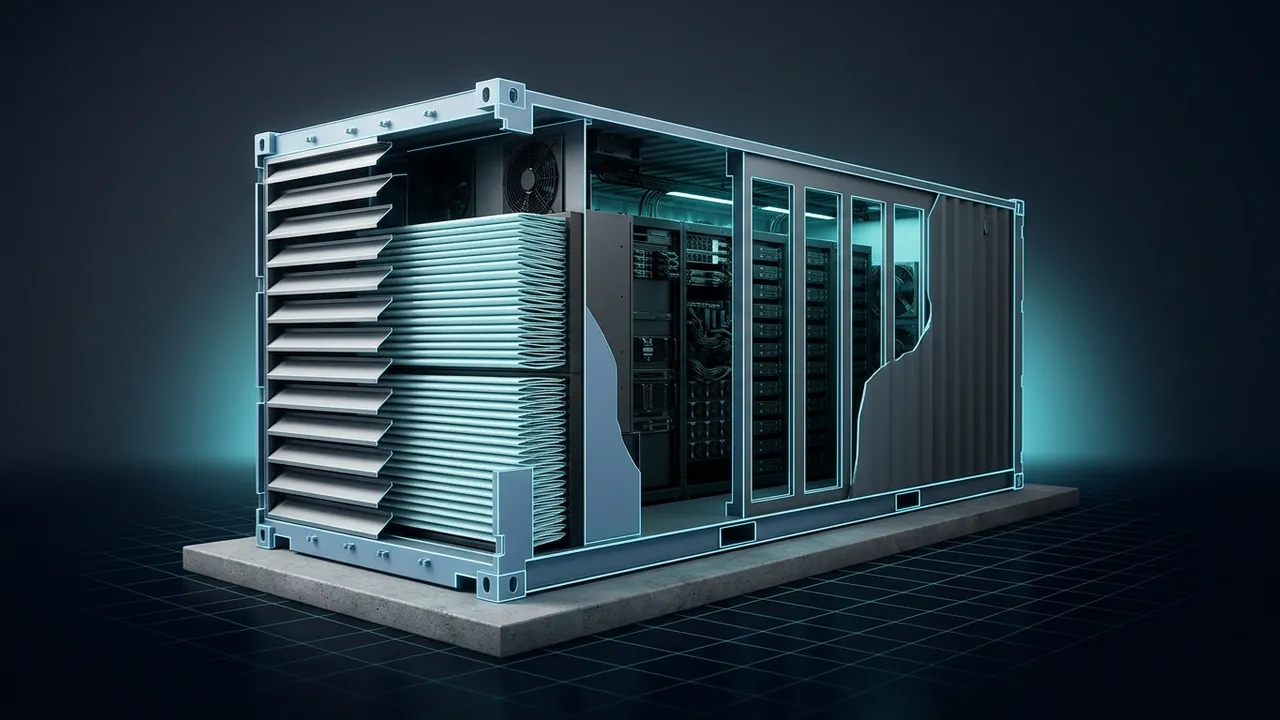
Dust gets into everything on a lease road in July: your truck's cab, your coffee, the inside of your sunglasses. It gets into electronics too, and servers pull in an astonishing amount of air every minute. A data center dropped onto a dusty pad without a plan becomes an expensive vacuum cleaner. How do you keep dust, sand and corrosive gases out of a data center at a harsh site?
Data center dust filtration at a harsh site works in layers: keep outside air out wherever you can, run what must come in through a coarse pre-filter and then a MERV 11 to 13 filter, and hold the room under slight positive pressure with every gap sealed. ASHRAE's contamination guidelines add MERV 8 on recirculated air and relative humidity below about 60%. Near sour gas, chemical filters and corrosion testing protect the copper and silver on circuit boards. A steady schedule of filter checks and storm inspections keeps it all working.
Why Is Dust Such a Problem for Servers?
Dust hurts servers in three ways. It clogs, it insulates and, in some cases, it conducts or corrodes.
- Clogging. Dust packs into server intake grilles, heat sink fins and air filters, cutting airflow. Chips run hotter and fans spin faster to compensate.
- Insulating. A coat of fine dust on components acts like a blanket, trapping heat.
- Conducting and corroding. Some dust holds salts that absorb moisture. When humidity rises, that film can become slightly conductive or corrosive, causing intermittent faults that are maddening to track down.
The trouble usually shows up slowly. Fan speeds creep up, a few servers throw thermal warnings, failure rates edge higher. By the time someone opens a chassis and finds it caked, the damage is spread across the fleet.
What Does ASHRAE Recommend for Data Center Air Quality?
ASHRAE's technical committee for data centers published gaseous and particulate contamination guidelines for data centers that remain the standard reference. The key targets are:
- Keep the data hall to ISO 14644-1 Class 8 cleanliness.
- Use MERV 8 filters on recirculated room air.
- Use MERV 11 to 13 filters on any outside air brought in.
- Keep relative humidity below about 60% so settled dust does not turn sticky or conductive.
- Keep copper corrosion below 300 angstroms per month, which matches the mildest corrosion class, G1.
What Do MERV Ratings Mean?
MERV stands for minimum efficiency reporting value, a 1 to 16 scale from ASHRAE Standard 52.2 that measures how well a filter catches particles of different sizes. Higher numbers catch finer particles. A MERV 13 filter, for example, must capture at least 50% of particles from 0.3 to 1 micron, 85% from 1 to 3 microns and 90% from 3 to 10 microns. Blowing sand is much larger than that and drops out easily. Fine silt and smoke are the hard part.
How Do You Keep Dust Out in the First Place?
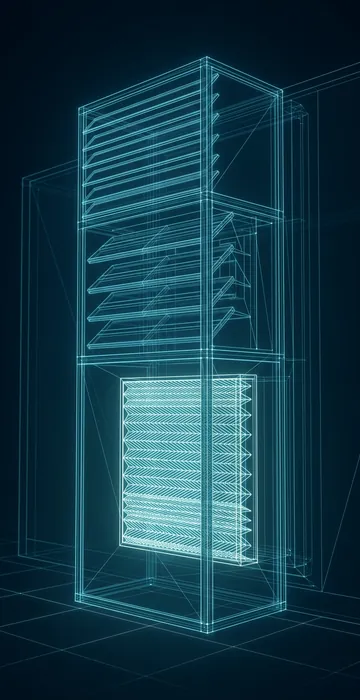
The best filter is the one you never need, so start by limiting how much outside air comes in. A closed system that recirculates the same room air through cooling coils needs only enough fresh air for pressurization and people.
- Pressurize. Keep the data hall or container at a slight positive pressure, so air leaks out through gaps rather than dust leaking in.
- Seal. Close cable penetrations, door gaps and unused openings. A container with gaps around its doors is a dust collector.
- Use vestibules. A small entry room with two doors stops a gust from blowing straight into the hall every time someone walks in.
- Stage the filters. Put a coarse or inertial pre-filter on intakes to knock out sand and heavy grit before air reaches the MERV 11 to 13 bank.
- Locate intakes wisely. Place them high and away from roads, pads and generator exhaust.
Outside-air economizers deserve a hard look at dusty sites. They save energy by pulling in cool outdoor air, but they also pull in whatever the wind is carrying. Many harsh-site designs use closed loops instead, or lock out the economizer during dust events.
What About Sour Gas and Corrosive Air?
Dust is the visible enemy. Corrosive gases are the quiet one. Near oil and gas operations, hydrogen sulfide (H2S) from sour gas can drift through a site, and it attacks the copper and silver on circuit boards. Sulfur compounds turn silver traces into silver sulfide, which can eventually cause failures. H2S is also a serious hazard to people at higher concentrations, so gas detection and personnel safety belong to the site's H2S safety program and trained staff, not to the IT team's filter plan.
The defenses are chemical filters, usually activated carbon or treated media that adsorb gases, on any air coming into the space, along with corrosion coupons. These are small copper and silver strips left in the room for a set period, then lab-tested to measure how fast they corroded. If the result falls outside the G1 class, you have a gas problem that particle filters will never solve.
How Often Should Filters Be Changed at a Dusty Site?
Change filters based on pressure drop, not the calendar. A differential pressure gauge across each filter bank shows how hard air has to push to get through. When it reaches the manufacturer's recommended final pressure drop, the filter is done, whether that took three months or three weeks.
Waiting too long costs energy. Fan power rises with the pressure the fan has to overcome. Here is a worked example with labelled assumptions: a 50,000 cubic feet per minute (CFM) air system with a fan efficiency of 60% sees filter resistance rise by 0.5 inches of water column.
- Extra fan power = CFM × added pressure ÷ (6,356 × efficiency)
- = 50,000 × 0.5 ÷ (6,356 × 0.6) ≈ 6.6 horsepower
- ≈ 4.9 kW, running around the clock
That does not sound like much until you add it up across every air handler on a site. After any dust storm, check filters, coils and evaporative pads the next day. Keep spare filter sets on site, because the nearest supplier may be a long drive away.
What Works for Containers and Edge Sites?
Small edge and containerized data centers at wellsites and compressor stations face the worst conditions with the least staff. Sealed enclosures with closed-loop cooling are the usual answer, often rated against dust ingress under the IP code, where IP5X means dust protected and IP6X means dust tight. Manufacturers have offered micro data centers built for this, such as the wall-mounted micro data centers with dust filters Schneider Electric introduced, including a rugged series.
Dust also shapes cooling choices beyond the filters. Sites that avoid outside air and evaporative pads tend to rely on closed loops and dry coolers, which shifts the balance between energy and water. That balance shows up in water usage effectiveness, the metric for how much water a site uses per unit of IT energy.
Good Data Center Dust Filtration Is Mostly Discipline
None of the equipment in this article is exotic. Filters, gaskets, gauges and copper coupons are cheap. What separates a clean site from a caked one is whether somebody actually checks them every time the wind blows.
Three moves belong on any dusty-pad design from day one: closed-loop cooling, a pressure gauge on every filter bank and a stack of spare filters on site before the first storm. Good data center dust filtration rarely gets noticed when it works, and that is exactly the point.