What Is SCADA? – How Remote Sites Report Back
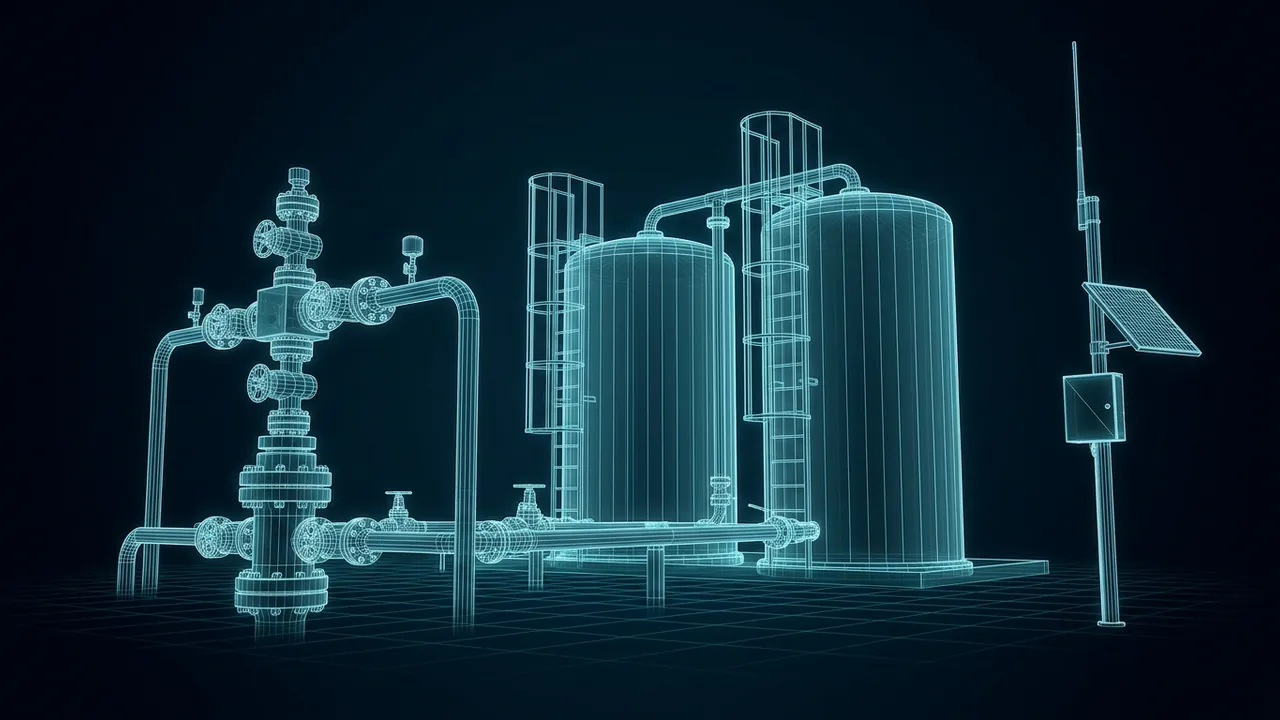
Somewhere in a pasture, a pressure transmitter just jumped 12 psi. Within seconds, an operator forty miles away sees it on a screen, checks the trend and decides whether to send a truck. Nobody drove out to read a gauge, and nobody had to. What is a SCADA system, and how does a remote site actually report back?
A SCADA system (Supervisory Control and Data Acquisition) is the combination of field instruments, site controllers, communication links and central software that lets operators monitor and control equipment spread across a wide area. Sensors measure things like pressure, level and flow.
A remote terminal unit (RTU) or programmable logic controller (PLC) at each site reads those sensors and runs local logic. A radio, cellular or satellite link carries the data to a host server, which polls the sites, stores history and shows everything on a human-machine interface (HMI). "Supervisory" is the key word: local controllers handle the fast work, while people set targets, acknowledge alarms and step in when something goes wrong.
What Are the Parts of a SCADA System?
Every SCADA system has the same five layers, whether it watches ten wells or ten thousand. Think of it as a chain where each link hands data to the next.
| Layer | Examples | Job |
|---|---|---|
| Field instruments | Pressure transmitters, level radars, flow meters, gas detectors | Turn physical conditions into signals |
| Site controller | RTU, PLC, flow computer | Read signals, run local logic, store data |
| Communications | Licensed radio, cellular, satellite, private LTE | Move data between site and host |
| Host (master station) | SCADA server, polling engine, historian | Collect, store and process data from all sites |
| HMI | Control room screens, web dashboards, phone alerts | Show people what is happening and let them act |
The site controller is where most of the real work happens. It keeps running if the communication link drops, holds data in memory until the host asks for it, and can shut a well in on high pressure without waiting for anyone. That local independence is what makes SCADA safe to run over slow or unreliable links.
How Does Data Get From the Field to the Control Room?
Mostly by polling. The host asks each site, one after another, "What are your values?" The site answers, and the host moves on. On a shared radio channel, only one site can talk at a time, so the number of sites sets how fresh the data is.
Here is a quick worked example of a polling cycle on one radio channel:
- Sites on the channel: 150
- Time per poll, including radio key-up and reply: 1.5 seconds
- Full scan: 150 × 1.5 = 225 seconds, or almost four minutes
Four minutes between updates is fine for tank levels and too slow for an urgent alarm. That is why many systems use report by exception, where a site speaks up on its own when a value crosses a limit, instead of waiting its turn.
The Protocols That Carry It
A protocol is the agreed format for those questions and answers. The common ones in North American oil, gas and power are:
- Modbus: introduced by Modicon in 1979 and still everywhere. Simple and widely supported, but it has no built-in timestamps or security.
- DNP3 (Distributed Network Protocol): common in utilities and pipelines. It supports timestamped events, buffering during outages and unsolicited reports from the field.
- IEC 60870-5-104: the international counterpart to DNP3, more common outside North America.
- MQTT: a lightweight publish-and-subscribe protocol that newer systems use to push data only when it changes.
What Does a SCADA System Monitor at Remote Sites?
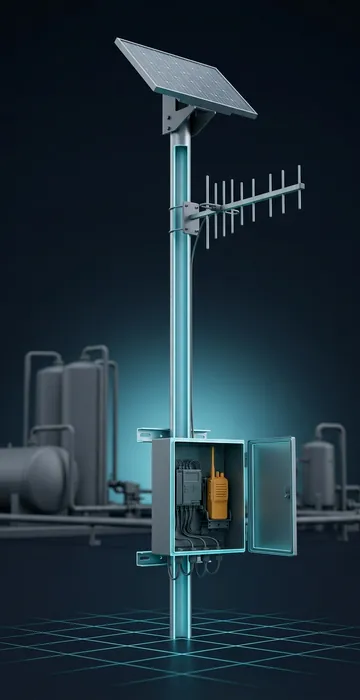
Anything that costs money, creates risk or needs a truck when it changes. A typical list for an oil and gas pad looks like this:
- Tank levels, so haulers come before tanks overflow and not before they are worth a trip.
- Tubing and casing pressures, line pressures and separator conditions.
- Gas flow from a flow computer, which calculates volumes for sales and royalty accounting.
- Compressor and pump status, run hours and shutdown causes.
- Gas detector readings and emergency shutdown status.
- Battery voltage and solar charging, because a dead battery silences everything else.
On a power site, the list shifts to generator status, breaker positions, fuel levels and alarms. The idea is the same: measure what matters, send it home, and act on exceptions.
All of those values land in a historian, a database built to store time-stamped readings for years. Production engineers use it to spot a well that is slowly loading up with liquids. Measurement staff use it to check volumes. Maintenance teams use run hours and shutdown counts to plan work before something breaks. The live screen gets the attention, but the history is often where SCADA pays for itself.
Wireless field instruments have pushed this further. Emerson has described wireless pressure, temperature and valve sensors on more than 200 wells with data relayed by satellite, which shows how far a SCADA network can stretch with the right links.
What Happens When the Link Goes Down?
A well-designed site keeps working and catches up later. The RTU or PLC continues to run its logic, so a high-pressure shutdown still trips and a pump still stops on low level. Meanwhile, the controller stores readings in local memory with timestamps.
When the link returns, the host collects the stored data and fills in the gaps in its history. DNP3 handles this well because it was built to buffer timestamped events. Plain Modbus polling does not, so engineers often add a local data logger or edge gateway to cover outages.
The host also needs to know that a site has gone quiet. A "communications failed" alarm after a few missed polls is standard. Without it, an operator may stare at a screen of frozen values and assume everything is fine. Frozen data that looks normal is one of the most dangerous failure modes in remote operations, so treat communication alarms as seriously as process alarms.
SCADA vs DCS vs PLC: What's the Difference?
They overlap, but they solve different problems. A PLC is a controller, a box that reads inputs and drives outputs. SCADA is the whole system that ties many controllers across a wide area into one view. A DCS (distributed control system) is a tightly integrated control system built for a single large plant, such as a refinery or power station, where everything sits on a fast local network.
The short version: a DCS runs a plant, SCADA watches a territory, and PLCs and RTUs do the local work for both. The line between an RTU and a PLC has blurred over the years, and our guide to RTU vs PLC at a remote site covers how to choose.
Where Does the Computing Happen at a Remote Site?
More and more of it happens on site. A simple wellsite needs only an RTU and a radio. A compressor station, gas plant or remote power site may run a local HMI, a data historian that buffers during link outages, video recording and gateway software that converts old protocols into new ones.
That work needs a computer that can live in a hot, dusty building or a roadside enclosure. A rugged edge server built for heat, dust and vibration handles the job far better than an office PC on a shelf. Keeping data local also means the site keeps a full record even when the link back to the control room goes quiet.
How Secure Is a SCADA System?
Only as secure as it was designed to be. Older protocols like Modbus were built for closed serial networks and assume anyone who can send a message is allowed to. Once SCADA traffic crosses cellular networks or the internet, that assumption fails.
Good practice includes separating SCADA networks from business networks, using encrypted VPN tunnels for every remote link, changing default passwords, limiting remote access to named users with multi-factor login, and logging who changed what. The ISA/IEC 62443 series of standards is the main reference that asset owners and suppliers use to set these requirements.
What Does It Take to Put a New Site on SCADA?
Less than people fear, if the planning comes first. A typical sequence looks like this:
- Write the point list: every value, alarm and control the site needs, with ranges and limits.
- Pick the controller and communications, and confirm signal or line of sight at the actual mounting spot.
- Size the power. Most remote SCADA sites run on solar and batteries, so the radio and RTU load sets the panel and battery size.
- Build and test the panel in the shop before it goes to the field.
- Install, wire and run point-to-point checks with the control room on the phone.
- Set alarm limits with operations, then tune them after a few weeks so real alarms are not buried in noise.
The step that slips most often is the point list. If it is vague, the panel gets rebuilt in the field, and the control room inherits a screen full of mislabeled tags.
A SCADA System Gives Every Remote Site a Voice
A SCADA system is how hundreds of scattered sites report back to one control room. Instruments measure, RTUs and PLCs act locally, communication links carry the data, and host software turns it into trends, alarms and decisions.
The design choices that matter most are local control that keeps working when the link drops, a polling and alarm scheme that keeps urgent data fresh, and security that assumes the network is not private just because it feels remote.
The cheapest hour on any SCADA project is the one spent writing the point list for a single site. Do that first, and every later choice, from the radio to the solar panel, has something solid to stand on.