How Much Land Does a Data Center Need? – Acres per MW
Developers used to shop for data center land the way they shopped for warehouse land: flat, near a highway, zoned industrial, done. Then the projects got bigger. A site that looked roomy for a 20 MW building now has to fit a substation, a generator yard, cooling equipment, stormwater ponds and a buffer the county insists on, with room left for phase two. Get the acreage wrong and you either overpay for dirt or run out of it. How much land does a data center need per megawatt?
A common rule of thumb for data center land requirements is about 0.5 to 1 acre per megawatt of capacity, so a 100 MW campus typically needs roughly 50 to 100 acres. Large hyperscale campuses often cover 200 acres or more.
The actual figure depends on rack density, whether buildings are single or multi-story, how much space the substation and cooling equipment take, local setback rules, and whether on-site power generation shares the parcel. Buyers also pay for room to grow, so the acreage purchased usually exceeds what phase one needs.
Where Does the Acres-per-MW Rule of Thumb Come From?
It comes from looking at what campuses actually use once everything is laid out. A TechTarget report on data center land buying (October 2026) cites the 0.5 to 1 acre per MW rule of thumb. A Wayne County, Michigan, guide for local governments, published in 2026, notes that hyperscale campuses commonly run 200 acres or more.
Treat the rule as a screening tool, not a design. It helps you rule parcels in or out on day one. The real number comes from a test fit, a layout drawn by an engineer that places every building, yard and road on the actual parcel.
What Takes Up Land on a Data Center Campus?
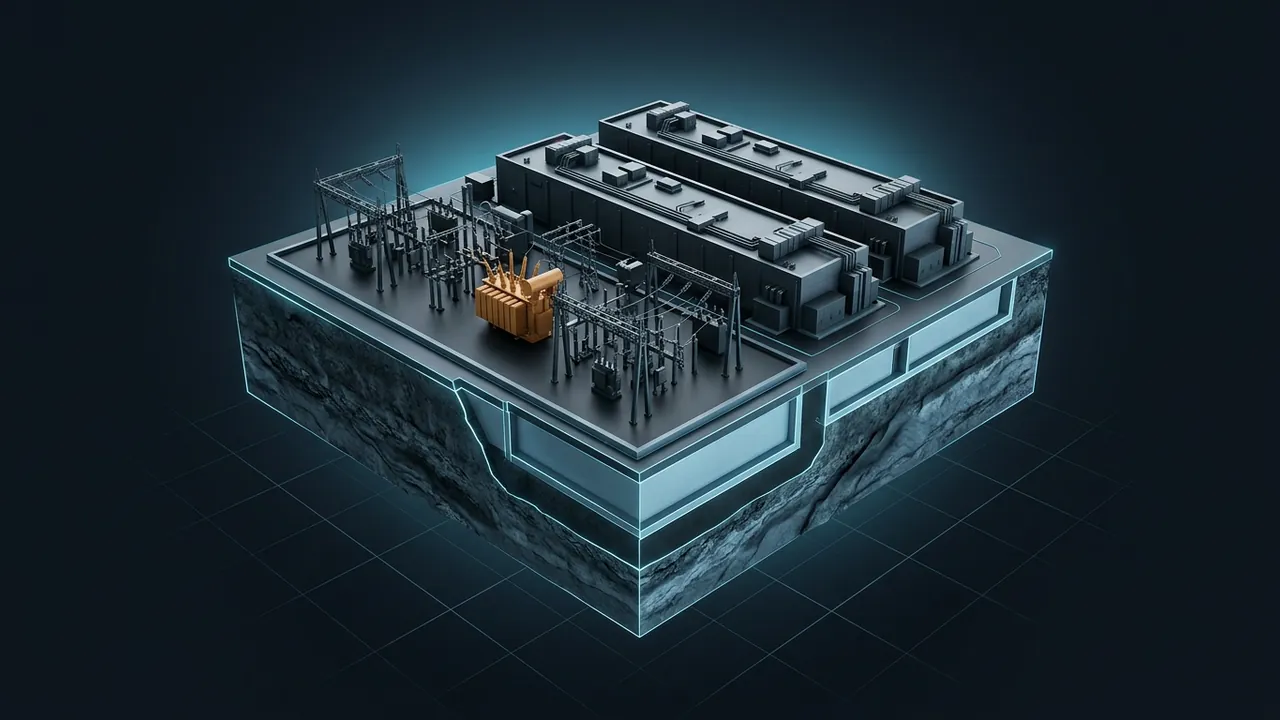
The data halls get the attention, but they are only part of the footprint. A typical campus needs space for:
- Data center buildings, including electrical and mechanical rooms
- A high-voltage substation, often several acres on its own
- Generator yards with fuel storage, or an on-site power plant
- Cooling equipment such as chillers, dry coolers or cooling towers
- Stormwater detention ponds, which can be surprisingly large
- Roads, truck access, parking and a security perimeter
- Setbacks and landscaped buffers required by zoning
- Land held for future phases
Setbacks deserve special attention. Fairfax County, Virginia, for example, requires data center buildings to sit 200 feet from residential lot lines and generators 300 feet away. On a small parcel, buffers like that can swallow a big share of the land.
How Do You Estimate Land for a 100 MW Data Center?
Work from the buildings out. Here is a labelled example with round numbers. Your designer's figures will differ.
- Target: 100 MW of IT capacity, built as three single-story buildings of about 33 MW each.
- Assume each building is about 300,000 square feet, including its electrical and mechanical rooms. Three buildings = 900,000 sq ft.
- Convert to acres: 900,000 ÷ 43,560 sq ft per acre ≈ 20.7 acres of building footprint.
- Assume buildings cover about 30% of the usable site once yards, roads, ponds and the substation are added: 20.7 ÷ 0.30 ≈ 69 acres.
- Add buffers. On a square 100-acre parcel (about 2,087 feet per side), a 200-foot setback all the way around takes 100 − (1,687 × 1,687 ÷ 43,560) ≈ 35 acres.
So roughly 69 acres of working site plus 35 acres of buffer, about 104 acres total, or close to 1 acre per MW. Use a two-story design or a narrower buffer and the same capacity fits in well under 70 acres, near the low end of the rule.
Do Denser Racks Mean Less Land?
Partly. Higher rack density puts more megawatts into each square foot of data hall, so the buildings shrink for the same capacity. That has been the trend with liquid-cooled, high-density AI deployments.
But the rest of the site doesn't shrink as fast. Every megawatt still needs transformers, switchgear, backup power and heat rejection equipment, and all of that heat still has to leave the site. Dense campuses often trade data hall floor space for bigger electrical and cooling yards. The acres per MW may drop, but less than the rack numbers alone suggest.
Single-Story or Multi-Story: How Height Changes the Math
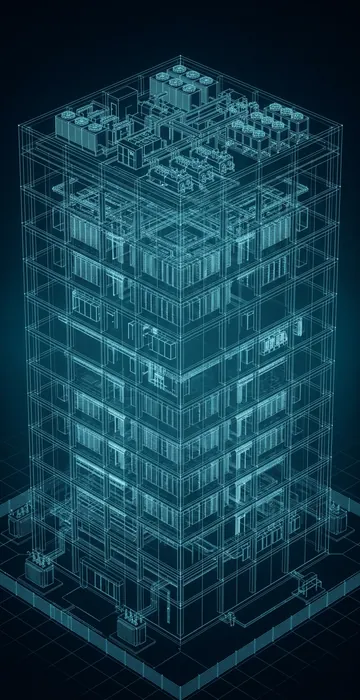
Going up is the main way to fit more megawatts on less land. Single-story buildings are cheaper and faster to build, and they make it easy to move heavy equipment. That is why they dominate in places where land is cheap. In tight markets, developers build two, three or more stories, stacking data halls and putting cooling equipment on the roof.
Using the example above, a two-story version of the same three buildings would cut the footprint from about 20.7 acres to about 10.4 acres. At the same 30% coverage, the working site drops from 69 acres to roughly 35. The trade-offs are higher construction cost, structural limits on floor loading for heavy racks, and more complex logistics for getting equipment in and out.
How Much Land Does a Gigawatt Campus Need?
Scale the 0.5 to 1 acre ratio and you get roughly 500 to 1,000 acres for 1,000 MW, before any on-site generation. The largest campuses are usually built in phases across several connected parcels, sometimes with the substation and power plant on land of their own.
At this scale, land is rarely the binding limit. Power delivery, water, transmission routes and local approvals usually decide whether a gigawatt site works long before acreage does.
How Much Extra Land Does On-Site Power Need?
It depends on the technology. Gas engines and turbines are compact, typically taking much less land per megawatt than the data center they serve, plus space for gas metering, controls and setbacks. Battery systems take more room but still fit within a campus.
Solar is the outlier. The National Renewable Energy Laboratory found in 2013 that large US solar plants used about 7.9 total acres per MW (AC). A 100 MW solar farm is therefore about 790 acres, roughly eight to fifteen times the land of the data center itself, and it still only produces power when the sun is up. That is why campuses with a solar component usually place the panels on separate land.
Why Do Developers Buy More Land Than They Need?
Because the hardest part of a data center site to replace is the power, not the dirt. Once a utility agrees to deliver capacity to a parcel, adding a phase on adjacent land is far easier than starting over somewhere else. Extra acres also give room for larger buffers, which help with neighbors and approvals.
The cost of that extra land is rising fast where power is available. TechTarget's report cites powered land in Northern Virginia above $6 million an acre, and parcels near high-voltage lines trading at a premium to those served by lower-voltage lines. Paying for land of that value is a capital decision as much as a real estate one, and it shapes the data center financing plan from the start.
What Should You Check Before Buying a Site?
Run this list before you sign anything binding:
- Is the usable area big enough after wetlands, floodplain, easements and slopes are removed?
- What setbacks, height limits and screening does zoning require?
- Where would the substation go, and does the utility need its own parcel?
- How much stormwater detention will the county require?
- Is there room for generators or an on-site plant, with their own setbacks?
- Can the parcel, or an adjacent one, hold a second and third phase?
Data Center Land Requirements Start at Half an Acre per MW and Grow From There
Data center land requirements usually land between 0.5 and 1 acre per megawatt, which means 50 to 100 acres for a 100 MW campus and 200 acres or more for large hyperscale sites. The buildings are only part of it. Substations, yards, ponds, buffers and future phases take up the rest.
Use the acres-per-MW ratio to screen parcels, then pay for a proper test fit before you close. It costs little compared with discovering, after closing, that the substation and the setbacks don't fit on the same piece of ground.