Are Hydrogen Generators Ready for Data Centers? – Cost, Supply, Pilots
Walk the perimeter of almost any large data center and you'll pass a long row of diesel generators. They sit idle nearly all year, burn fuel during monthly tests and carry the facility through the rare utility outage. They also emit carbon dioxide, soot and nitrogen oxides, and they need air permits that are getting harder to win. So operators keep asking about the cleanest-sounding swap on the table. Are hydrogen generators actually ready to take over at data centers?
Hydrogen generators work, using fuel cells or modified engines, but cost and fuel supply keep them from replacing diesel backup at data centers for now. The technology itself is proven: fuel cells and modified engines can run on hydrogen, and data center pilots have carried real server loads for up to 48 hours.
The barriers are cost, supply and storage. Clean hydrogen is still expensive, delivery infrastructure is thin, and storing enough fuel for a two-day outage takes far more space than diesel. Expect hydrogen to grow first as backup power at sites with strong climate goals, not as everyday prime power.
What Is a Hydrogen Generator?
A hydrogen generator is any on-site power unit that makes electricity from hydrogen fuel. The term covers two different machines, and the difference matters.
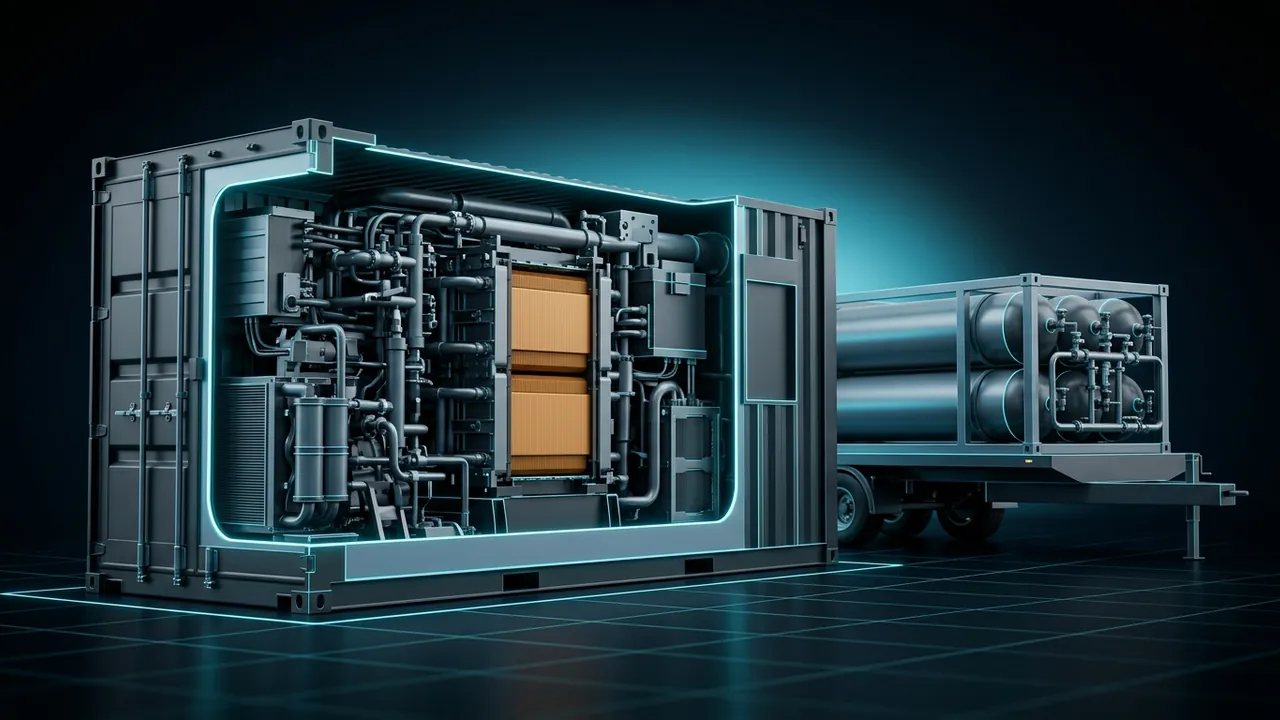
- Hydrogen fuel cells: These combine hydrogen and oxygen electrochemically, with no combustion, producing electricity, heat and water. Proton exchange membrane (PEM) fuel cells start quickly and suit backup duty.
- Hydrogen-fueled engines and turbines: These burn hydrogen, either pure or blended with natural gas, to spin a generator. Combustion produces no carbon dioxide from the hydrogen itself, but the hot flame can still form nitrogen oxides (NOx).
One naming trap: "hydrogen generator" is also used for electrolyzers, which make hydrogen from water and electricity. That's the opposite job. In a data center conversation, people almost always mean a power generator that consumes hydrogen.
Have Data Centers Actually Tested Hydrogen Backup?
Yes. The best documented work comes from Microsoft. In 2020 the company ran a row of servers for 48 hours on a 250 kW hydrogen fuel cell system. In 2022 it reported a 3 MW hydrogen fuel cell backup test, sized to power roughly 10,000 servers, which it described as a step toward replacing diesel generators.
Those pilots proved the electrical side. Fuel cells can pick up data center load and hold it. What pilots don't settle is whether a campus can store and resupply enough hydrogen, at a reasonable price, for a long regional outage. That's the harder question.
How Much Hydrogen Would a Data Center Need?
A lot, measured by volume. Let's size backup fuel for a 3 MW load running 48 hours, the same kind of duration operators plan for with diesel. This is an illustrative example using textbook values.
- Energy needed: 3 MW × 48 hours = 144 MWh of electricity.
- Hydrogen's lower heating value is about 33.3 kWh per kilogram. A PEM fuel cell system converting roughly 50% of that yields about 16.7 kWh of electricity per kg.
- Hydrogen required: 144,000 kWh ÷ 16.7 kWh/kg ≈ 8,600 kg, or about 8.6 metric tons.
- Stored as liquid hydrogen at about 71 kg per cubic meter, that's roughly 121 cubic meters, or around 32,000 gallons of cryogenic liquid at minus 253 °C.
- For comparison, a diesel generator using about 0.07 gallons per kWh would burn 144,000 × 0.07 ≈ 10,100 gallons for the same job.
So the hydrogen tank is roughly three times bigger by volume than the diesel tank, and it has to be either a cryogenic vessel or a bank of high-pressure tubes. Compressed gas tube trailers hold somewhere between a few hundred kilograms and around a thousand kilograms each depending on design, which means many trailers for even this modest example. Scale it to a 100 MW campus and the storage yard becomes a serious engineering and permitting project.
What Does Hydrogen Power Cost?

Hydrogen power costs far more than natural gas power today, mostly because clean hydrogen is expensive to make. The U.S. Department of Energy launched its Hydrogen Shot in 2021 with the goal of cutting the cost of clean hydrogen to $1 per kilogram, and as Utility Dive reported in 2024, DOE still frames that target around 2031. DOE has described clean hydrogen as costing around $5 per kilogram when the program began.
Here's what those prices mean per MWh of electricity, using the same 16.7 kWh per kg:
- At $5/kg: $5 ÷ 16.7 kWh ≈ $0.30 per kWh, or about $300 per MWh for fuel alone.
- At $1/kg: $1 ÷ 16.7 kWh ≈ $0.06 per kWh, or about $60 per MWh.
- Natural gas example: at $3.50 per million British thermal units (MMBtu) and a heat rate of 9,000 Btu/kWh, fuel costs 9,000 × $3.50 ÷ 1,000,000 ≈ $0.0315 per kWh, or about $32 per MWh.
Here's the twist for backup duty. Diesel at $4 per gallon and 0.07 gallons per kWh works out to about $0.28 per kWh, so expensive hydrogen isn't wildly worse than diesel per hour of running. Backup units only run a few hours a year, so fuel price matters less than equipment cost, storage cost and the price of keeping fuel on hand. For prime power running 8,760 hours a year, though, $300 per MWh fuel is a deal breaker.
Why Is Hydrogen Supply the Hardest Part?
Supply is the hardest part because the United States makes plenty of hydrogen but very little of it is clean, and almost none of it is delivered to data center sites. DOE estimates the country produces about 10 million metric tons a year, and roughly 95% of it comes from steam methane reforming of natural gas, which releases carbon dioxide unless it's captured.
Clean options include electrolysis powered by renewables or nuclear, and reforming with carbon capture. Both are growing slowly. The 2022 federal clean hydrogen production tax credit was meant to speed that up, but Congress shortened its window in 2025, so check current rules with tax counsel before counting on it.
Delivery is its own problem. There's no hydrogen pipeline network near most data center markets, so fuel arrives by tube trailer or liquid tanker. That works for a pilot. For a campus that must survive a multiday storm when roads may be closed, it needs serious planning.
Is Hydrogen Safe to Store at a Data Center?
Hydrogen can be stored safely, but it behaves differently from diesel and needs its own design rules. It's the smallest molecule, so it leaks through fittings that would hold natural gas. It ignites across a wide range of concentrations in air, roughly 4% to 75%, with very little ignition energy. Its flame is nearly invisible in daylight. It can also make some steels brittle over time.
Professionals handle this with codes such as NFPA 2 (the Hydrogen Technologies Code) and NFPA 55 for compressed gases, which set separation distances, ventilation, leak detection and venting requirements. Local fire officials will want to see all of it. Plan for longer permitting than a diesel tank farm, and involve the fire marshal early.
Where Does a Hydrogen Generator Make Sense Today?
Today a hydrogen generator makes the most sense as backup or peak power at a site where emissions goals justify a premium and where fuel can be delivered reliably. The checklist looks like this:
- Strong corporate or local pressure to eliminate diesel.
- Room on site for storage and the required setbacks.
- A supplier that can commit to delivery and refills after an outage.
- Backup run time requirements that are hours, not weeks.
Turbines and engines that burn hydrogen blends offer another path. Several manufacturers sell machines that run on natural gas mixed with some hydrogen, with plans to raise the share over time. That lets an owner buy gas-fired equipment now and blend in cleaner fuel later. Owners weighing that route should also compare carbon capture for gas power, which tackles the same emissions problem from the other end.
Hydrogen Generators: Ready for Pilots, Not for Every Data Center
Are hydrogen generators ready for data centers? For backup pilots and climate-driven projects, yes. Fuel cells have carried real server loads, and the electrical engineering is sound. For the industry at large, not yet.
The math explains why. Backup for a modest 3 MW load for 48 hours needs about 8.6 tons of hydrogen, and clean hydrogen still costs several times more than the federal $1 per kilogram goal. Storage takes more room than diesel, delivery networks are thin, and codes require careful design.
The practical move for a new campus is to design the generator yard so it can adapt. Leave space, specify equipment with a hydrogen upgrade path where it's offered, and revisit the economics as clean hydrogen prices and supply chains change. Hydrogen may well earn its place. It just has to win on fuel logistics first.