How Much Power Does a Server Rack Use? – Rack Density Explained

Ask ten data center people how much power a rack uses and you will get ten answers, all of them correct for some room somewhere. A rack of network gear in a closet might sip 2 kilowatts. A cabinet full of GPU servers in a new AI hall might pull 60 times that. The spread has never been wider, and it changes everything from the breakers to the cooling plant. How much power does a server rack use, and what does rack power density really mean for a site?
A typical enterprise or colocation rack uses about 5 to 10 kilowatts (kW), while racks full of AI accelerators run from 40 kW to well beyond 100 kW. That load per rack is called rack power density. The average is climbing fast: AFCOM's 2026 survey reported 27 kW per rack, up from 16 kW a year earlier and about 7 kW in 2021. Density decides whether a rack can be air cooled, how big its feeds must be and how many racks a megawatt supports.
What Is Rack Power Density?
Rack power density is how much electrical power the equipment in one rack draws, usually stated in kW per rack. A standard rack is about 2 feet wide, 3.5 to 4 feet deep and roughly 7 feet tall, with 42 to 48 units (U) of mounting space. What you put in that space decides the load.
Planners used to talk in watts per square foot of floor. That still shows up in leases and older specs, but it hides the problem. A room can look moderate on average while a few racks run far hotter than the cooling was designed for. Kilowatts per rack, along with the highest-density rack you must support, is the more honest number.
How Much Power Does a Typical Server Rack Use?
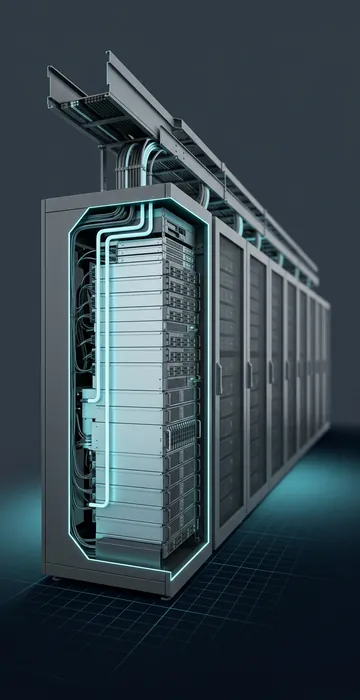
It depends entirely on the servers. Here is a rough ladder, with simple math so you can check it.
- Light enterprise rack: 20 general-purpose servers at about 300 W each = 6 kW.
- Dense compute rack: 40 one-unit servers at about 500 W each = 20 kW.
- GPU rack: four 8-GPU servers at around 10 kW each = about 40 kW. NVIDIA's DGX H100 is rated at about 10.2 kW maximum, so four of them come to roughly 41 kW.
- Rack-scale AI systems: liquid-cooled designs such as NVIDIA's GB200 NVL72 are widely reported at roughly 120 kW per rack.
Surveys show where the middle of the market sits. Uptime Institute's Global Data Center Survey 2025 found rack density rising slowly, with more racks in the 10 to 30 kW range. So while headlines focus on 100 kW racks, plenty of rooms still run racks in the single digits.
Nameplate vs Measured Load
One trap catches a lot of planners. The power rating printed on a server's power supply, its nameplate, is usually well above what the machine draws in real work. Add up nameplates and you overbuild. Add up idle readings and you underbuild. The right number comes from measured draw at the rack power distribution unit under realistic workloads, plus a margin.
AI servers narrow that gap. Training jobs tend to run GPUs hard for long stretches, so real draw sits much closer to the rated maximum than it does for a typical web or database server. If you are hosting GPU racks, plan on them running near their rated power for most of the day.
How Fast Is Rack Density Rising?
Fast, at least among the operators building for AI. The chart below shows average rack density reported in AFCOM's industry research, as covered by Data Center Knowledge in its report on rack density surging as AI overhauls data center design. The same report found 36% of respondents had liquid cooling deployed.
Average kW per rack
AFCOM survey figures as reported by Data Center Knowledge, March 5, 2026 (about 7 kW in 2021, 16 kW a year before the 2026 report, 27 kW in 2026).
View the data
| Average kW per rack | |
|---|---|
| 2021 | 7 kW |
| 2025 | 16 kW |
| 2026 | 27 kW |
Keep in mind that an average blends very different rooms. A survey respondent with a few 100 kW AI rows and many 8 kW legacy racks lands somewhere in between. The useful takeaway is the direction: what counted as high density a few years ago is now ordinary for new builds.
Why Do AI Racks Use So Much Power?
Because AI accelerators are power-hungry chips packed tightly to talk to each other quickly. A single high-end GPU can draw 700 W to over 1,000 W. Training large models works best when many GPUs sit close together on very fast links, which pushes designers to cram as many as possible into each rack instead of spreading them out.
Spreading them out would cut the density per rack, but it would lengthen the cables and slow the interconnect. So the industry chose density and accepted the cooling and power challenges that come with it. That is why direct-to-chip liquid cooling went from niche to standard for these racks.
What Does High Rack Density Mean for Power Circuits?
It means much bigger feeds to every rack. Here is the math for three-phase power, using the common practice of loading circuits to 80% of their rating:
- 208 V, 30 A, three-phase: 208 × 30 × 1.732 × 0.8 ≈ 8.6 kW usable
- 415 V, 60 A, three-phase: 415 × 60 × 1.732 × 0.8 ≈ 34.5 kW usable
A classic 208 V, 30 A pair of feeds is fine for a 6 kW enterprise rack. A 120 kW rack needs several high-amperage 415 V feeds or a dedicated busway tap. Higher voltage helps because it carries more power with less current and thinner conductors. Redundant A and B feeds double the count again.
Load Swings Matter Too
Dense GPU racks do not just draw a lot of power. Their load can rise and fall quickly as training jobs move between computing and communication phases. Multiplied across thousands of racks, those swings stress uninterruptible power supply (UPS) systems, generators and the grid. Some operators now add batteries to smooth the swings, and our guide to battery storage at the data center explains how that works alongside backup power.
How Does Rack Density Change Cooling?
Every kilowatt in the rack becomes about 3,412 Btu per hour of heat. A 40 kW rack throws off about 136,500 Btu/h, or roughly 11 tons of cooling in a footprint smaller than a refrigerator. Air can do this only with enormous airflow.
| Rack load | Heat (Btu/h) | Cooling (tons) | Airflow at 20°F rise (cubic feet per minute) | Typical approach |
|---|---|---|---|---|
| 8 kW | 27,300 | 2.3 | 1,260 | Room air with hot and cold aisles |
| 20 kW | 68,200 | 5.7 | 3,160 | Containment, in-row or rear-door coolers |
| 40 kW | 136,500 | 11.4 | 6,320 | Rear-door coolers or liquid |
| 120 kW | 409,400 | 34.1 | 18,960 | Direct liquid cooling |
The airflow column, in cubic feet per minute (CFM), uses CFM = Btu/h ÷ (1.08 × temperature rise). Past roughly 30 to 40 kW, fans and floor tiles simply cannot move that much air through a single cabinet in a practical way.
What Else Limits Rack Density?
Power and cooling get the attention, but weight, cabling and service access matter too. A fully loaded liquid-cooled AI rack can weigh well over a ton, which can exceed what an older raised floor was built to carry. Many new halls put dense racks directly on a concrete slab for that reason.
Cabling grows with density as well. Each GPU server can need several high-speed network links, and those cables add weight, block airflow at the back of the rack and have strict length limits. Then there is maintenance. Technicians need room to pull a heavy tray safely and to disconnect coolant lines without rushing. Packing racks tighter than people can work on them is a false economy.
What Does Rack Density Mean for a Site's Power Plan?
Higher density packs the same megawatts into fewer racks and less floor space, but it does not reduce the megawatts. A 10 MW IT hall holds about 1,250 racks at 8 kW, or about 83 racks at 120 kW. The building gets smaller. The substation, generators and cooling plant do not.
For behind-the-meter and off-grid projects, that shift is welcome. Smaller buildings mean shorter cable runs and simpler construction, and liquid cooling at high density usually brings a lower power usage effectiveness (PUE), which means fewer megawatts of generation per megawatt of IT. The catch is that the power plant must handle sharper load swings from tightly packed GPU racks.
Rack Power Density Sets the Rules for Everything Downstream
The number that matters most is not the average rack in your hall. It is the densest rack you will ever be asked to host, because that one sets the size of every feed, pipe and cooling unit around it.
Design a new hall for a range rather than a single number. Pick power and cooling paths that can serve today's 15 kW racks and tomorrow's 120 kW racks, with liquid cooling piping and high-voltage feeds planned from the start. It is far cheaper to leave room for density than to rip out a floor that was built too small.