What Is Stranded Gas? – Why Some Gas Has Nowhere to Go
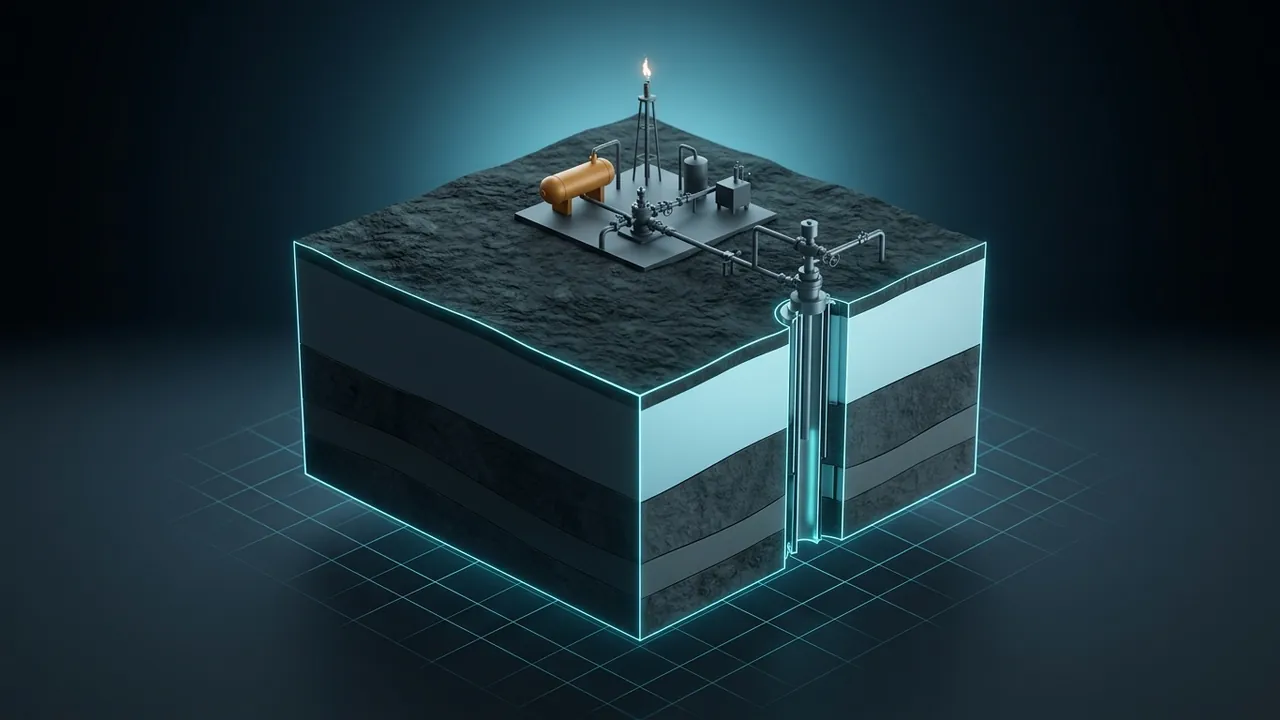
Natural gas only has value if you can get it to someone who wants it. That sounds obvious, but it explains a strange fact of the oil patch: there is gas in the ground and coming out of wells right now that nobody can sell. Some of it gets reinjected. Some gets flared. Some never gets produced at all. The industry has a name for it, stranded gas, and it is the starting point for a lot of creative energy projects. So what is stranded gas, and why does some gas have nowhere to go?
Stranded gas is natural gas that has been discovered or is already being produced but cannot be brought to market at a profit, usually because it is too far from pipelines and buyers, too small in volume to justify infrastructure, or too contaminated to sell without costly treatment. The gas itself is real and often high quality. What is missing is an economic path from the wellhead to a customer. It can be a huge Arctic field or a single oil well with no gathering line. The usual fixes are building infrastructure, converting the gas into something easier to move, or bringing the customer to the gas.
What Makes Gas Stranded?
Economics, more than geology. The Society of Petroleum Engineers' PetroWiki describes stranded gas as reserves that cannot be developed economically because they are too small, too remote or too far from markets. The U.S. Department of Energy's National Energy Technology Laboratory (NETL) adds contaminants, costs and regulations to that list in its Stranded Natural Gas Roadmap.
In practice, gas usually gets stranded for one or more of these reasons:
- Distance. The nearest pipeline or buyer is hundreds of miles away, or across an ocean.
- Small volume. The gas flow is too small to pay back a pipeline, a compressor and a meter station.
- Timing. Wells come online faster than gathering lines and processing plants can be built.
- Quality. High levels of carbon dioxide, hydrogen sulfide (H2S) or nitrogen make the gas expensive to clean up.
- Price. Pipelines out of a region are full, so local prices fall so low that selling is barely worth it.
Notice that most of these can change. A new pipeline, a higher gas price or a nearby buyer can un-strand gas overnight. That is why the term describes a situation, not a permanent condition.
What Are the Main Types of Stranded Gas?

It helps to sort stranded gas into two very different groups.
Big, Remote Gas Fields
These are large discoveries far from any market. The classic U.S. example is Alaska's North Slope, where huge volumes of gas produced alongside oil have long been reinjected to help maintain reservoir pressure because there is no pipeline to carry it to the Lower 48. Around the world, many offshore fields sat undeveloped for years until liquefied natural gas (LNG) projects made them worth tapping.
For fields this size, the answers are big ones too: long-distance pipelines, LNG export plants or gas-to-liquids plants that turn gas into diesel and other fuels. These cost billions and take years.
Small, Scattered Wellsite Gas
This is the kind most people in the oilfield deal with. An oil well in a fast-growing play produces associated gas, but the gathering line has not arrived yet, or the line is full, or the well is too far out to connect. The volume might be a few hundred thousand cubic feet a day. It is valuable in total, but on a single lease it is too small for the big solutions.
Much of this gas ends up flared. NETL's roadmap estimated U.S. flaring and venting at about 1.25 billion cubic feet per day in 2018. Every flare you see on the horizon at night is, in a sense, a small stranded gas problem burning in plain sight.
Why Not Just Build a Pipeline?
Because a pipeline has to pay for itself, and small or short-lived gas flows often cannot. A quick example shows why:
- A well produces 300 thousand cubic feet per day (Mcf/d) of gas.
- At an illustrative net price of $2.00 per Mcf, that is $600 a day, or about $219,000 a year.
- Shale wells decline quickly, so the second and third years bring in much less.
- If connecting the well needs miles of new line, a compressor and a meter station costing several million dollars (an illustrative figure), the gas may never pay it back.
Gathering companies run this kind of math every day. They build when a group of wells, or an acreage dedication from a producer, promises enough volume over enough years. A single isolated well rarely qualifies. Gas from a cluster of new wells usually does, eventually, which is why a lot of wellsite gas is stranded only temporarily.
What Can You Do With Stranded Gas?
You have three broad choices: move it, convert it or use it where it is.
| Approach | Examples | Best fit |
|---|---|---|
| Move it by pipe | New gathering lines, laterals, export pipelines | Large or long-lived volumes |
| Move it by truck or ship | Compressed natural gas (CNG), LNG | Moderate volumes, medium distances |
| Convert it | Gas-to-liquids, methanol, fertilizer | Very large fields |
| Strip the liquids | Recover propane and butane, flare or burn the rest | Rich gas with valuable liquids |
| Reinject it | Push gas back into the reservoir | Fields where pressure support helps oil output |
| Use it on site | Generators for lease power, grid export or computing | Small, remote or short-lived volumes |
Trucking compressed or liquefied gas, sometimes called a virtual pipeline, works when a buyer is within a reasonable drive and the volumes justify compressors and trailers. For the smallest and most remote sites, using the gas right on the pad is often the only option that pencils out.
Why Are Computing Loads Showing Up at Stranded Gas Sites?
Because data travels over a fiber or satellite link far more cheaply than gas travels by pipe. If you cannot bring the gas to the customer, you can bring the customer to the gas. Containerized computing equipment can be set on a pad, powered by gas generators and moved when the well declines.
Bitcoin mining has been the most common fit so far. Miners can run anywhere with power and a data connection, and they can shut down or ramp up as gas volumes change. That flexibility matches wellsite gas almost perfectly, which is why flare gas bitcoin mining became the best-known example of the idea. Other flexible loads that can tolerate interruptions are possible too, though few are as portable.
Who Decides What Happens to Stranded Gas?
Usually the well operator, but never alone. The operator controls the lease equipment and makes the call on flaring, connecting or selling. The mineral owners have a stake because royalties are typically owed on gas that is sold, and lease terms decide how gas used for other purposes is treated. State regulators set the limits on flaring and venting and require reporting.
Anyone proposing to use stranded gas, whether for power, trucking or a computing load, needs the operator as a partner first. Then the deal has to respect the lease, the royalty owners and the state rules. Getting those three lined up often takes longer than installing the equipment. It is worth reading your lease and talking to counsel or the state regulator before assuming any gas is free for the taking.
Is Stranded Gas a Problem or an Opportunity?
Both. When stranded gas is flared, it wastes a resource and releases carbon dioxide plus some unburned methane. When it is vented, the methane goes straight to the atmosphere, which is worse. Regulators in several states limit how long operators can flare, and that pressure pushes producers to find uses for gas they once burned.
On the opportunity side, stranded gas is cheap fuel in places where little else is available. That makes it attractive for remote power, for small industrial uses and for flexible computing. The catch is that many of these sites are temporary. A good stranded gas project plans for the day a pipeline arrives or the well runs down, and keeps its equipment mobile.
Stranded Gas, and Getting It Somewhere Useful
Stranded gas is gas that exists and could be produced but has no economic route to market, whether because of distance, small volume, poor quality or full pipelines. It ranges from giant Arctic fields to a single oil well's associated gas, and the right answer depends on which end of that range you are dealing with.
If you are looking at a stranded gas opportunity, start by asking why it is stranded and whether that reason is likely to change soon. Then match the solution to the volume and the time frame: pipe or trucking for gas with a future, on-site use for gas that is small, remote or short-lived. Gas that has nowhere to go can still do useful work, as long as you are honest about how long it will last.