How Does an Automatic Transfer Switch Work at a Data Center?
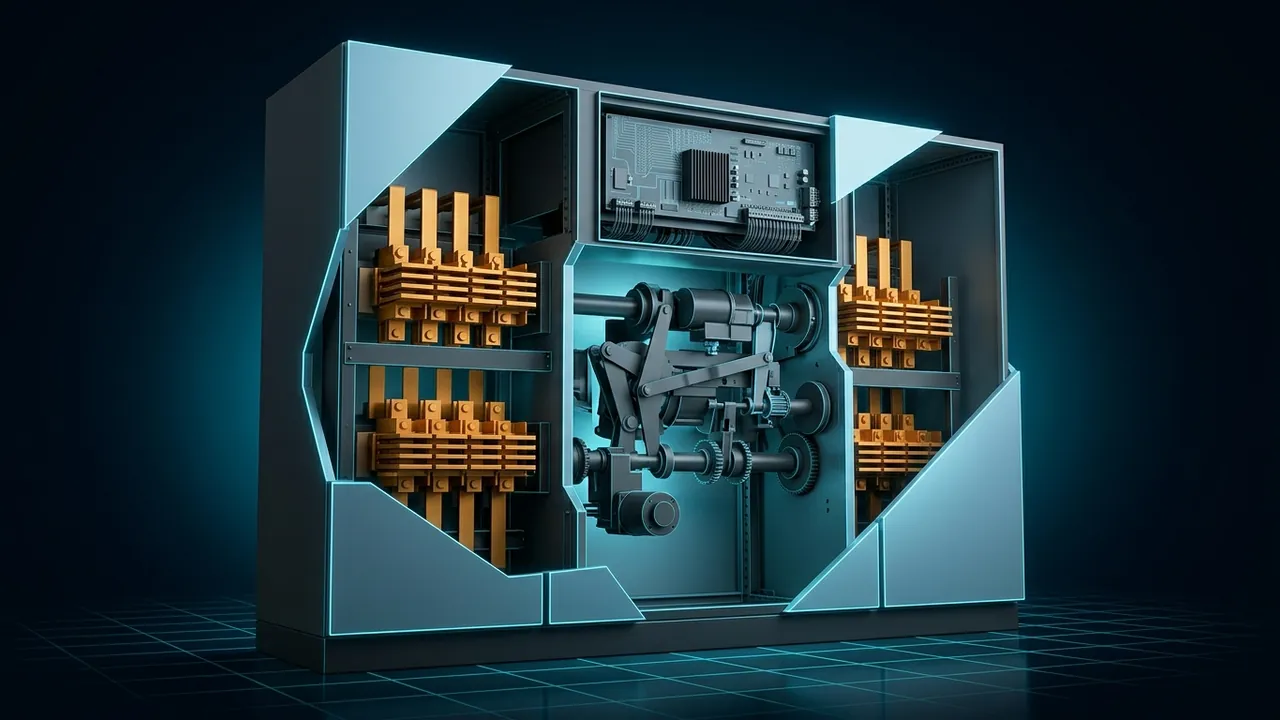
Think of a railroad switch at a junction. A train can come down one track or the other, and the switch decides which one connects to the line ahead. An automatic transfer switch does the same thing with electricity, choosing between the utility and a generator, except it has to make the call by itself, in the dark, during the worst minute of somebody's week. How does an automatic transfer switch work at a data center, and why does the timing matter so much?
An automatic transfer switch (ATS) watches the normal power source, and when it fails, the ATS signals the generator to start, waits until the generator's voltage and frequency are acceptable, then moves the load from the utility to the generator. When utility power returns and stays stable for a set time, the ATS transfers the load back and lets the generator cool down before it stops.
Most transfers briefly disconnect the load, so data centers rely on UPS systems to carry IT equipment through the gap. Emergency systems are typically designed to restore power within about 10 seconds.
How Does an Automatic Transfer Switch Work, Step by Step?
It runs the same sequence every time. The timings below are illustrative; most are adjustable settings in the ATS controller.
| Step | What happens | Typical timing |
|---|---|---|
| 1. Sense | Controller sees utility voltage or frequency outside limits | Instant detection |
| 2. Confirm | A short delay rules out a momentary blip | About 1 to 3 seconds |
| 3. Start | ATS closes the generator's start contacts | Generator reaches speed in several seconds |
| 4. Transfer | Once generator voltage and frequency are acceptable, the switch moves the load | Power restored within about 10 seconds of the outage |
| 5. Retransfer | Utility returns and must stay stable before the load moves back | Often several minutes or more |
| 6. Cool down | Generator runs unloaded before stopping | Often around 5 minutes |
The retransfer delay surprises people. Why wait? Because utility power often flickers on and off during storms or after a fault is cleared, and bouncing the load back and forth is worse than waiting for the grid to settle.
How Fast Does an Automatic Transfer Switch Transfer?
The switch itself moves quickly, in a fraction of a second. The wait is the generator. NFPA 110, the standard for emergency and standby power systems, classifies systems by how fast they restore power. As Consulting-Specifying Engineer explains, a Type 10 system restores power within 10 seconds.
Worked example of why that is too long for servers: on a 60 hertz (Hz) system, one cycle lasts 1 ÷ 60 ≈ 0.017 seconds. Ten seconds is 10 × 60 = 600 cycles. IT equipment typically rides through roughly one cycle of total dropout. That is why the ATS never feeds servers directly without a UPS in between.
Open, Delayed and Closed Transition
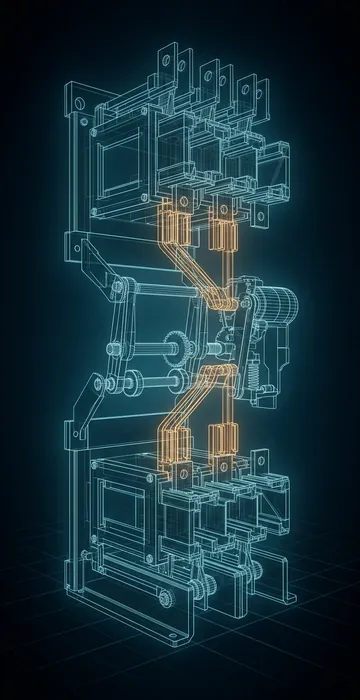
Transfer switches differ in how they handle the moment of transfer. ASCO's technical brief on transition modes describes three approaches:
- Open transition (break-before-make): the switch disconnects one source, then connects the other, with an interruption of tens of milliseconds. Simple and common.
- Delayed transition: the switch pauses in a neutral, disconnected position for a moment, letting motors and transformers lose residual voltage before reconnecting. This prevents damaging out-of-phase reclosing on inductive loads.
- Closed transition (make-before-break): the switch briefly parallels the two sources, usually for a fraction of a second, so the load never sees an interruption. It requires the sources to be synchronized and often needs utility coordination.
Closed transition is popular for retransfer and testing, because the load can move from generator back to utility without a second blip. During an actual outage there is nothing live to parallel with, so the first transfer is always open.
Where Do Transfer Switches Sit in a Data Center?
It depends on size. Small data centers and server rooms may use one ATS between the utility service, a generator and the main distribution. Larger facilities often handle transfer in switchgear, with pairs of motorized breakers interlocked by a controller. That approach scales better to thousands of amps and fits main-tie-main layouts.
Even at large sites, ATS units are common on mechanical loads such as chillers, pumps and fans, on life-safety circuits, and on smaller buildings. The way all these pieces connect, from the utility through transformers, switchgear, UPS and down to the rack, is covered in our guide to data center power distribution.
ATS vs Static Transfer Switch
A static transfer switch (STS) uses solid-state switches, not mechanical contacts, and transfers in a fraction of a cycle. It works between two live sources, typically two UPS systems, so single-corded equipment can survive the loss of one UPS. The two devices solve different problems.
| Feature | Automatic transfer switch | Static transfer switch |
|---|---|---|
| Switching device | Mechanical contacts | Thyristors (solid state) |
| Typical sources | Utility and generator | Two UPS outputs |
| Transfer time | Fraction of a second, plus generator start | A fraction of a cycle |
| Position in the chain | Upstream of the UPS | Downstream of the UPS |
Can an ATS Switch Between Two Utility Feeds?
Yes. Some sites have two utility services, ideally from different substations, and use a transfer switch or breaker pair to move between them. The logic is the same as utility-to-generator transfer, minus the engine start, so the transfer can finish in well under a second. Many facilities combine both: two utility feeds plus generators, with the controls choosing the best available source in a set order.
How Is an Automatic Transfer Switch Tested?
The best test is a real transfer under real load. Codes such as NFPA 110 call for regular exercise of the emergency power system, and many operators run monthly generator tests that include an actual transfer. Annual or periodic tests often go further: opening the utility breaker to simulate an outage and watching the whole sequence, from sensing to retransfer, with the UPS, generators and cooling all responding together. Keep records of the timings each time. A transfer that slowly gets slower is telling you something.
What Can Go Wrong With an ATS?
A few things show up again and again:
- Wrong settings: delays that are too short cause nuisance transfers; delays that are too long stretch the UPS battery.
- Neutral and grounding problems: some systems need a switched neutral (four-pole ATS) so ground fault protection works correctly on both sources.
- Mechanical wear: contacts and mechanisms need inspection and testing like any switching device.
- No maintenance path: a bypass-isolation ATS lets technicians service the switch while the load stays powered through a bypass.
Regular testing under real load, not just a no-load generator run, is the best way to find these problems before an outage does.
The Automatic Transfer Switch Makes the Call So Nobody Has To
An automatic transfer switch senses a utility failure, starts the generator, waits for stable power, transfers the load, and later brings it back to the utility and lets the generator cool down. The switching is quick; the generator start is what takes roughly 10 seconds, which is why the UPS carries the IT load in between.
On your next facility walk-through, check the ATS settings against the UPS runtime, confirm a bypass path for maintenance, and test transfers under load. A transfer switch only gets one chance to work when it counts.