What Happens During Data Center Commissioning? – Levels 1 to 5
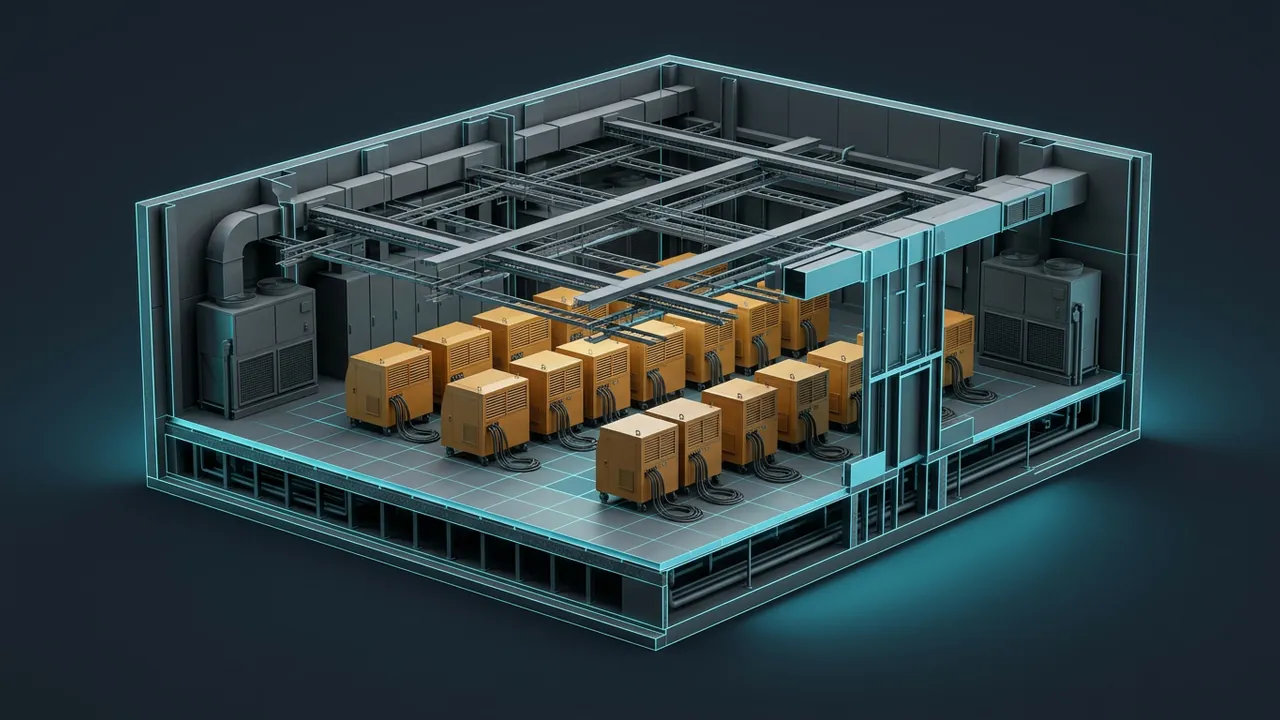
Near the end of every serious data center build, someone pulls the plug on purpose. The utility feed opens, the lights in the electrical room flicker, generators crank, cooling restarts and a room full of test equipment keeps humming as if nothing happened. Or it doesn't, and the team learns something important while the building is still empty. That moment is the last step of a long process. What happens during data center commissioning, from the factory floor to that final test?
Data center commissioning is a structured process that proves every piece of power, cooling and control equipment works, alone and together, before live servers move in. The industry usually breaks it into five levels.
Level 1 tests equipment at the factory. Level 2 checks that it arrived undamaged and was installed correctly. Level 3 starts up each piece of equipment. Level 4 tests each system through all its operating modes. Level 5, the integrated systems test, runs the whole facility under simulated load and simulates failures such as a utility outage. An independent commissioning team usually leads the process and documents every result.
Who Is in Charge of Data Center Commissioning?
Usually a commissioning authority (CxA) or commissioning agent, ideally independent of the contractor who built the systems. The CxA writes test scripts, witnesses tests, tracks problems in an issues log and reports to the owner. Contractors, equipment vendors and electrical testing firms do much of the hands-on work.
Good commissioning starts in design, not at the end. The process laid out in ASHRAE's Guideline 0, which aligns with ASHRAE/IES Standard 202, begins with the owner's project requirements (OPR), a document stating what the facility must do, and a basis of design (BOD) explaining how the engineers intend to do it. Every later test traces back to those two documents.
What Are the 5 Levels of Data Center Commissioning?
The five levels follow the equipment's journey from factory to fully loaded building. Many teams also use colored tags, a convention that makes status visible on the floor. Hioki's overview of data center commissioning levels summarizes the sequence well.
| Level | Common tag | What happens |
|---|---|---|
| 1 | Red | Factory acceptance testing |
| 2 | Yellow | Delivery and installation checks |
| 3 | Green | Individual equipment start-up |
| 4 | Blue | Functional performance tests of each system |
| 5 | White | Integrated systems test of the whole facility |
Level 1: Factory Acceptance Testing
Major equipment is tested before it ships. The owner's team or CxA often travels to the factory to witness generator load tests, UPS performance tests and switchgear checks. Finding a problem at the factory is far cheaper than finding it on site, where a crane, a crew and a schedule are waiting.
Level 2: Delivery and Installation Checks
When equipment arrives, the team inspects it for shipping damage, confirms the nameplate matches the order and checks that it was set and connected according to the drawings. Electrical testing firms run pre-energization tests on cables, breakers and transformers, such as insulation resistance and torque checks, often following the InterNational Electrical Testing Association (NETA) acceptance testing specifications.
Level 3: Start-Up
Each piece of equipment is energized and started for the first time, usually by the vendor's technicians. Protective relay settings are applied, generators are run, chillers and air handlers are started and controls are checked one device at a time. The question at Level 3 is simple: does this machine work by itself?
Level 4: Functional Performance Testing
Now each system is tested through every mode it will see in service. Automatic transfer switches transfer. Generators synchronize and share load. UPS systems switch to battery and to bypass. Cooling units fail over to their backups. Every alarm and monitoring point is checked from the device to the building management screen. Each test follows a written script with pass or fail criteria.
Level 5: Integrated Systems Testing
The integrated systems test (IST) runs everything together under simulated IT load. Portable load banks stand in for servers, drawing power and producing heat. The team then simulates the events the facility was designed to survive: a utility failure, a generator that won't start, a chiller trip, maintenance on one power path. They watch whether power stays clean, temperatures stay in range and the controls do what the sequence of operations says they should.
Why Use Load Banks Instead of Real Servers?
Because nobody wants to test a failure on equipment that holds customer data. Load banks are big, controllable resistive (and sometimes reactive) loads that turn electricity into heat. They let the team step the load up in stages and hold it there for hours, which tests both the electrical system and the cooling system at once.
Running at load also exposes problems that never appear at idle. Technicians scan connections with infrared cameras while load is applied, looking for hot spots from loose or undersized connections. A bolt that looked fine at zero amps can glow on a thermal image at full load.
What Problems Does Commissioning Usually Find?
The same kinds keep showing up, which is exactly why the process exists:
- Breaker and relay settings that don't match the coordination study
- Control sequences that work alone but conflict when systems interact
- Sensors that are miscalibrated, mislabeled or wired to the wrong point
- Transfer timing that is slower than the design assumed
- Airflow problems such as hot spots, recirculation or leaky containment
- Generator, UPS and switchgear controls that don't communicate as expected
None of these are exotic. They are what happens when hundreds of devices from dozens of vendors meet for the first time.
How Long Does Commissioning Take?
It depends on size, complexity and how ready the site is. Levels 1 through 3 overlap with construction and stretch across months as equipment arrives. Levels 4 and 5 happen near the end and are where schedules get squeezed. A large IST can take days or longer, and each failed test means a fix and a retest.
Here is a warning worth repeating: commissioning time is the first thing to get cut when construction runs late, and it is the worst place to cut. Protect it in the schedule from day one, and make sure the contract says what "done" means.
How Is Commissioning Different With On-Site Power?

It gets longer and tougher, because the generators are no longer just backup. When a site runs on its own engines or turbines, or switches between utility and on-site power, the tests have to prove the plant can carry the data center on its own.
That usually adds tests such as:
- Block load acceptance: dropping large steps of load onto running units to see how far voltage and frequency dip and how fast they recover.
- Load sharing between many units, including what happens when one trips at full output.
- Island mode operation with no utility at all, and the transfer into and out of it.
- Black start, if the plant must restart from a complete shutdown without outside power.
- Fuel system checks, from gas pressure regulation to any backup fuel.
These tests need careful planning with the utility, the engine or turbine vendor and the controls integrator. They also need a lot of load bank capacity, which can be hard to rent on short notice. Book it early.
Does Commissioning Look the Same for Every Facility?
The five levels apply broadly, but the scope scales with the building. A single prefabricated module or a small edge room may pack most of Levels 1 through 4 into factory testing, with a short site test at the end. A large campus with multiple halls, a medium-voltage system and on-site generation may run separate ISTs for each phase.
The types of data centers differ a lot in how much testing they need. Facilities pursuing a Tier certification of their constructed facility also need to demonstrate the redundancy their data center tier promises, live and under load.
What Gets Handed Over at the End?
A commissioned building comes with paperwork that operations staff will rely on for years: the completed test scripts, the closed issues log, as-built drawings, equipment manuals, final settings and a commissioning report. Operators should also get hands-on training on the systems they will run, ideally during Level 4 and 5 testing, when they can watch equipment respond to real failures.
Data Center Commissioning Is Where You Find Out the Truth
Data center commissioning walks every system through five levels: factory tests, installation checks, start-up, functional tests and an integrated systems test under load. Each level catches a different kind of problem, and the final test proves the building can survive the failures it was designed for.
Three moves protect you. Hire the commissioning authority early, write the owner's project requirements before design is finished and guard the testing window in the schedule. It is far better to find a bad setting with a load bank than with a live customer.