Flaring vs Venting – Which Is Worse for Methane Emissions?
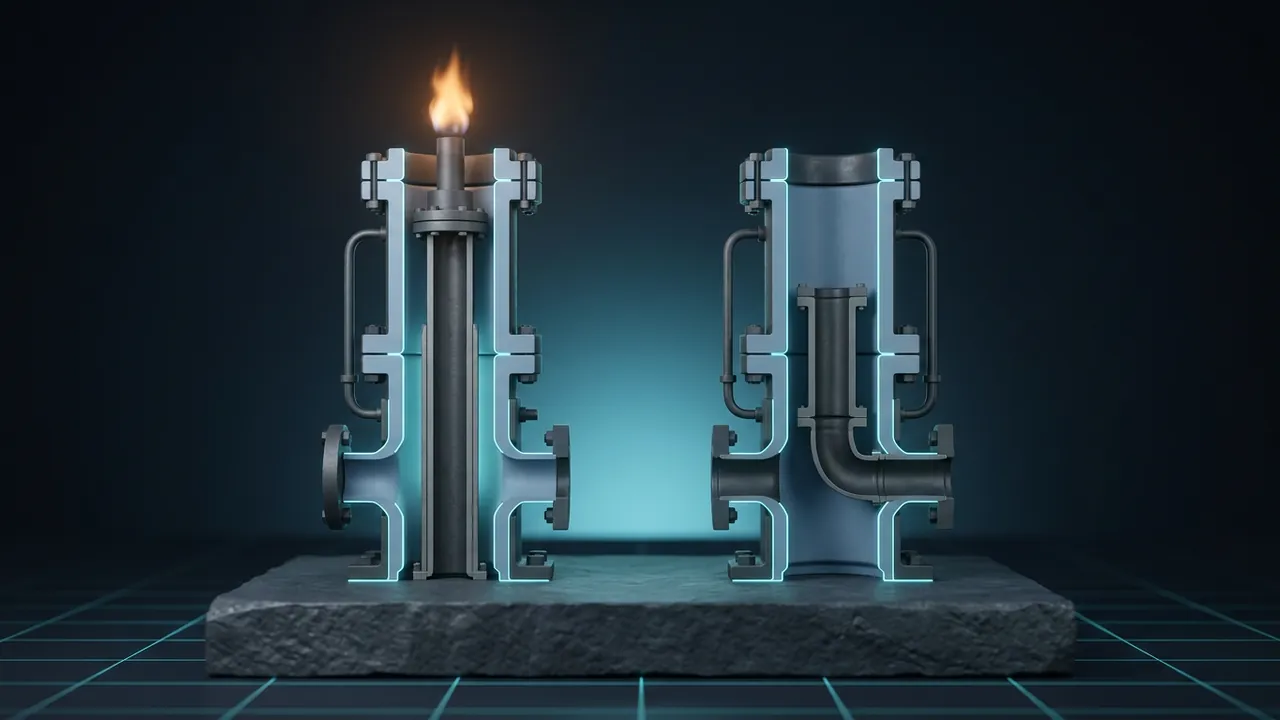
Both flaring and venting get a bad name, and both deserve some of it. One burns gas in the open. The other lets it go straight into the air. If you have spent time around production sites, you know operators lean hard toward flaring when gas cannot be sold, and regulators usually push the same way. But a lot of people outside the industry assume a visible flame must be the worse of the two. Flaring vs venting is a fair question, and the answer comes down to one molecule. So which is worse for methane emissions, flaring or venting?
Venting is much worse than flaring for the climate, because venting releases methane directly, while a working flare burns most of it into carbon dioxide, which traps far less heat. Using a 100-year comparison, venting a given amount of methane has roughly 5 to 9 times the warming impact of flaring it, depending on how well the flare burns. Over 20 years, the gap grows much wider. Flares are not clean, though: real-world studies show many burn less completely than assumed, and an unlit flare is simply a vent. The best option is to capture and use the gas.
What Is the Difference Between Flaring and Venting?
Flaring is the controlled burning of gas through a stack with a pilot flame. Venting is releasing gas into the atmosphere without burning it. Both happen at well sites, tank batteries, compressor stations, processing plants and refineries when gas cannot be sent to a pipeline or used on site.
Venting can be deliberate, like blowing down a line before maintenance, or it can be built into equipment, like gas-driven pneumatic controllers and some storage tanks. Leaks from valves and fittings are usually called fugitive emissions rather than venting, though they release the same methane.
Why Does Methane Matter So Much?
Because methane traps much more heat than carbon dioxide (CO2), especially in its first couple of decades in the atmosphere. Scientists compare gases using global warming potential (GWP), which measures how much heat a ton of gas traps relative to a ton of CO2 over a set time.
- Over 100 years, methane is commonly rated at roughly 28 to 30 times CO2, based on figures from the Intergovernmental Panel on Climate Change (IPCC).
- Over 20 years, it is rated above 80 times CO2.
Methane breaks down in the atmosphere in about a decade, which is why the short-term number is so much higher. It also means cutting methane slows warming relatively quickly. When you burn methane, each molecule becomes one molecule of CO2 plus water. That CO2 still warms the planet, just far less per ton than the methane it came from.
Flaring vs Venting: How Do the Numbers Compare?
Let's run the math on one million cubic feet (1 MMcf) of gas. To keep it simple, treat the gas as pure methane and use a 100-year GWP of 28. Real associated gas contains heavier hydrocarbons, which change the numbers somewhat but not the conclusion.
- Mass of methane: at standard conditions, methane weighs about 0.0423 pounds per cubic foot. 1,000,000 × 0.0423 ≈ 42,300 pounds, or about 19.2 metric tons.
- Venting: 19.2 tons × 28 ≈ 537 tons of CO2-equivalent (CO2e).
- Flaring at 98% destruction: 18.8 tons of methane burned × 2.75 (the CO2-to-methane mass ratio, 44 ÷ 16) ≈ 51.7 tons of CO2. The 0.38 tons left unburned × 28 ≈ 10.7 tons CO2e. Total ≈ 62 tons CO2e.
- Flaring at 91% destruction: 17.5 tons burned × 2.75 ≈ 48.0 tons of CO2. The 1.73 tons unburned × 28 ≈ 48.4 tons CO2e. Total ≈ 96 tons CO2e.
| Case (1 MMcf of methane) | Approximate CO2e, 100-year | Compared with venting |
|---|---|---|
| Vented | 537 tons | Baseline |
| Flared, 98% destruction | 62 tons | About 1/9 as much |
| Flared, 91% destruction | 96 tons | About 1/6 as much |
| Unlit flare | 537 tons | Same as venting |
Using a 20-year GWP above 80 makes venting look even worse. In the 98% case, venting would come out roughly 19 times worse than flaring instead of about 9.
Do Flares Really Burn 98% of the Gas?
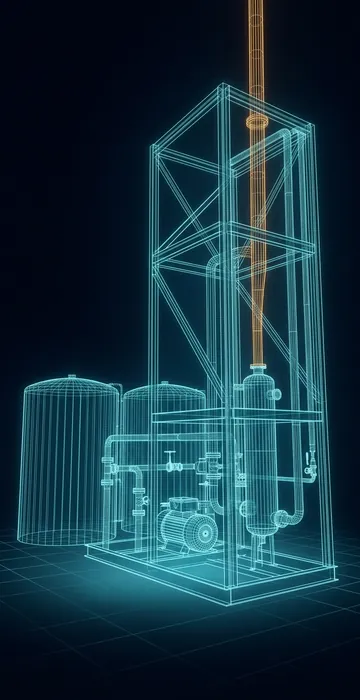
Well-run ones can, but many in the field do not. The U.S. Environmental Protection Agency's flare fact sheet says properly operated flares can reach at least 98% destruction when the gas has enough heating value, more than about 300 British thermal units per standard cubic foot (Btu/scf). Wind, low gas flow, poor design and wet or diluted gas all drag performance down.
A 2022 study published in Science, summarized by the University of Michigan, measured flares in major U.S. basins and found they averaged about 91% effective. Part of the problem was flares that were unlit 3% to 5% of the time, which turns them into vents. The researchers estimated that flaring released about five times more methane than assumed.
That finding does not flip the comparison. Even a 91% flare beats venting by a wide margin. But it does mean that reported numbers can understate real emissions, and that keeping pilots lit and flares well maintained makes a measurable difference. Much of that comes down to how a flare stack is designed and looked after.
When Is Venting Still Allowed?
Usually only in limited, short situations. Most states allow brief venting for things like maintenance blowdowns, emergencies or small releases where lighting a flare is not practical or safe. Longer releases are expected to go to a flare or, better, to a sales line. The Railroad Commission of Texas, for example, has explained that under its Statewide Rule 32, gas releases lasting more than 24 hours must be flared rather than vented.
Rules differ from state to state and change over time, and federal rules can apply as well. If you are planning a project that will handle gas at a well site, ask the state regulator and your environmental consultant what is allowed before you design around it.
How Are Flaring and Venting Measured?
Flaring is easier to track because the gas usually passes through a pipe on its way to the stack. Many sites meter flare volumes, while others estimate them from production and sales data. Operators report those volumes to state regulators.
Venting is harder. Methane is invisible, and small vents, leaking tank hatches and controllers can go unnoticed. Crews use optical gas imaging cameras, which make hydrocarbon plumes visible on screen, along with handheld detectors. Aerial and satellite surveys have also revealed large releases that ground inventories missed. That gap between reported and measured emissions is one reason the methane debate stays heated.
Is Flaring Bad for Anything Besides Climate?
Yes. Flares produce nitrogen oxides, carbon monoxide, soot and other pollutants that affect local air quality, especially when they burn poorly. Large flares are also loud and bright, which neighbors notice at night. Venting has its own local problems, including smells, volatile organic compounds that help form ground-level ozone, and, in sour gas fields, hydrogen sulfide that is deadly at high concentrations.
So "flaring is better than venting" is true for methane and climate, and generally true for safety. It is not the same as saying flaring is harmless.
What Is Better Than Either One?
Using the gas. Every alternative that gets methane into a pipeline or into an engine that makes useful energy beats both flaring and venting:
- Connecting to a gathering line and selling the gas.
- Running on-site generators for lease power, grid export or portable computing loads.
- Recovering vapors from tanks with vapor recovery units.
- Replacing gas-driven pneumatic controllers with electric or air-driven ones.
- Reinjecting gas where geology allows.
Rules increasingly push in that direction. Federal rules are moving the same way, and the EPA methane rule is the one to watch for how flaring is treated. State rules matter too, so check with your state regulator for what applies to a given site.
Flaring vs Venting, Settled by the Math
When the question is flaring vs venting for methane, flaring wins clearly. Burning methane turns it into CO2, and on a 100-year basis that cuts the warming impact to roughly a sixth to a ninth of venting, depending on how well the flare works. Over 20 years the advantage is bigger still.
The catch is that real flares often underperform, and an unlit flare is just a vent with a tall pipe. If you operate sites with flares, keep the pilots lit, monitor them, and treat every flare as a sign that there is gas worth capturing. The best flare is the one you no longer need.