Why Does North Dakota Flare So Much Gas? – The Bakken Story
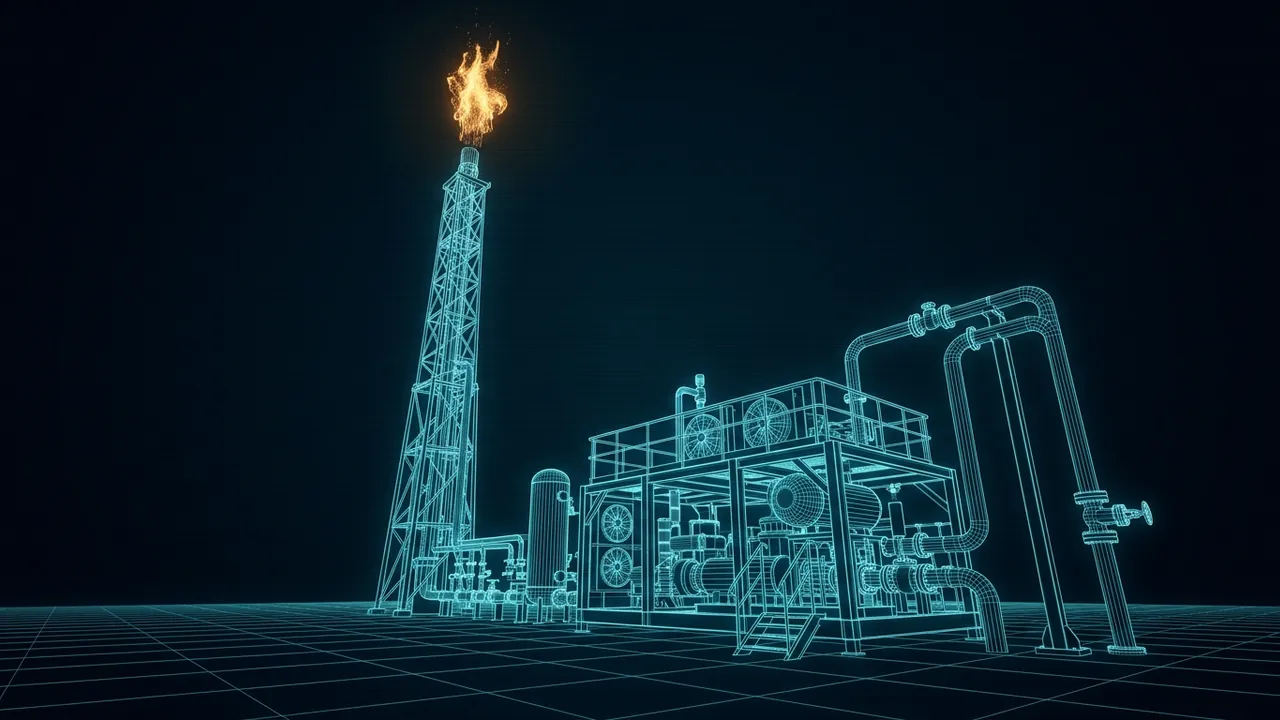
A few years into the Bakken boom, people flying over western North Dakota at night started comparing it to a city. There was no city. Those lights were flares, hundreds of them, burning gas from oil wells across the prairie. The pictures made the news, and the questions followed. Why did North Dakota flare so much gas, and what did the state do about it?
North Dakota flaring got so high because the Bakken oil boom arrived faster than the pipelines and processing plants needed to handle the gas that comes up with the oil. Bakken wells are drilled for crude, and nearly all the gas in the region is associated gas, so production surged whether or not there was anywhere to send it. At the peak, about a third of the state's gas was flared. In 2014 the North Dakota Industrial Commission (NDIC) set gas capture targets backed by limits on oil production, and the industry built gathering lines and plants to meet them. By 2021 the state was capturing more than 90% of its gas.
What Made the Bakken Different?
The Bakken is an oil play first. Horizontal drilling and multistage fracturing opened it up in the late 2000s, and operators chased the crude. The gas came along for the ride. The U.S. Energy Information Administration (EIA) reported that associated gas made up 92% of all gas produced in the Bakken region in 2018, the highest share of any major U.S. oil region.
Three other things stacked up against gas capture:
- Little existing gas infrastructure. Western North Dakota was not a big gas region before the boom, so there was no web of gathering lines waiting.
- Speed. Rigs could drill and complete wells much faster than midstream companies could secure rights-of-way and lay pipe.
- Rich gas. Bakken gas carries a lot of natural gas liquids, which need processing plants and liquids pipelines, not just a gas line.
Add short construction seasons on the northern plains and right-of-way work across private, tribal and federal land, and the gap between drilling and gathering grew wide.
How Bad Did North Dakota Flaring Get?

Bad enough to stand out nationally. EIA reported that more than 30% of North Dakota's gas was flared in 2013, that the share was about 36% in January 2014, and that the state flared about 0.35 billion cubic feet per day (Bcf/d) in 2014, almost half of the U.S. total.
For perspective, here is a rough energy check using an assumed heating value of 1,300 Btu per cubic foot for rich Bakken gas: 350 million cubic feet per day × 1,300 Btu = about 455 billion Btu per day. Run through generators at 10,000 Btu per kWh, that much gas could have supported roughly 1,900 MW of average load. The point is not that anyone could have built that, but that a lot of energy was going up in smoke.
Why Not Just Shut the Wells In?
People asked that a lot. The short answer is that an oil well is not a faucet. Shutting in a new Bakken well means giving up its most productive months, delaying royalty checks to mineral owners and tax revenue to the state, and sometimes risking problems in the wellbore or reservoir. The gas and oil come out together, so you cannot keep one and stop the other.
That is why the state's eventual approach squeezed oil output instead of banning production. It made flaring expensive without shutting the boom down, and it gave operators a clear target to build toward.
What Were North Dakota's Gas Capture Targets?
The NDIC's answer was Order 24665, adopted in 2014. Instead of banning flaring outright, it set capture goals that stepped up over time. The Commission's Order 24665 policy and guidance lists the schedule, shown in the chart below.
Required share of produced gas captured, by effective date
North Dakota Industrial Commission, Order 24665 Policy/Guidance (gas capture goals)
View the data
| Capture target | |
|---|---|
| Oct 2014 | 74% |
| Jan 2015 | 77% |
| Apr 2016 | 80% |
| Nov 2016 | 85% |
| Nov 2018 | 88% |
| Nov 2020 | 91% |
The targets had teeth. Under the guidance, an operator that misses the goals faces limits on oil production: wells capturing at least 60% of their gas are capped at 200 barrels of oil per day, and wells below 60% at 100 barrels per day. Operators also have to file a Gas Capture Plan with each drilling permit, showing where the gas will go.
That is what made the policy work. Oil is the money. Tie oil output to gas capture and suddenly the gathering line becomes a priority instead of an afterthought.
Other Rules in the Mix
- Flaring is allowed for a well's first year of production. After that, operators must connect to a gathering line, use the gas on site or get an exemption.
- Venting is prohibited by state law. Gas that is not captured has to be burned.
- Taxes and royalties are owed on gas flared beyond the first year, according to EIA, which gives operators another reason to capture it.
- Temporary exemptions are possible for things like right-of-way delays, midstream outages or safety concerns.
Did the Targets Work?
Mostly, yes, though not in a straight line. EIA reported that the flared share fell from that 36% in January 2014 to 10% in March 2016. Then production kept growing, and flaring crept back up: EIA found North Dakota flared about 19% of its gas withdrawals in 2019, and North Dakota and Texas together accounted for 85% of U.S. venting and flaring that year.
The bigger turnaround came with more infrastructure. EIA reported that North Dakota's producers met the state's natural gas capture target in 2021, flaring an average of 7.5% through September. Gas processing capacity rose from about 1 Bcf/d in 2013 to 3.4 Bcf/d in 2020, and pipeline capacity for natural gas liquids grew from 60,000 barrels per day to more than 580,000. Producers met the target every month from April 2020 through September 2021 except July 2021.
The 2020 oil price crash helped too, by slowing new drilling and giving gathering systems a chance to catch up. But the lasting change was steel in the ground.
What Does the Bakken Story Teach Us?
A few lessons carry over to any oil basin:
- Flaring is mostly an infrastructure timing problem. The gas has value; it just needs a way out.
- Targets work better with consequences tied to oil, because that is what operators care about most.
- Rich gas needs more than a pipe. Processing plants and liquids lines are part of the fix.
- Some gas will always be stranded at the edges, on new or remote pads, which is where on-site uses like generators and portable computing come in.
Even in a well-run basin, some flaring remains, and how it burns matters. A properly designed and operated flare stack destroys most of the methane, while a poorly lit or overloaded one lets more slip through.
North Dakota Flaring Fell When the Pipes Caught Up
North Dakota flared so much gas because a fast-moving oil boom outran the pipelines and plants needed to carry associated gas to market. At its worst, about a third of the state's gas went up in flares.
The fix was not a ban. It was a schedule of capture targets with oil production limits behind them, plus years of building gathering lines and processing plants. If you are working a newer basin with the same problem, study the Bakken. Measure the gas, plan the gathering before the rig shows up, and treat on-site use as a bridge for the wells the pipe cannot reach yet.