Can Fuel Cells Power Data Centers? – Solid Oxide Explained
A power plant with no turbine, no pistons and no flame sounds like a riddle. Gas goes in, electricity comes out, and the exhaust is mostly hot air, water vapor and carbon dioxide. That's a fuel cell, a technology that flew on early space missions. What's new is the scale. Utilities and developers are now ordering fuel cells by the hundreds of megawatts, and the fuel cell data center has become a serious option for sites that can't wait years for the grid. Can fuel cells really power data centers, and what makes solid oxide fuel cells different?
Yes, fuel cells can power data centers, and a fuel cell data center built on solid oxide fuel cells (SOFCs) can run on pipeline natural gas around the clock without combustion, at electrical efficiencies that often beat engines and simple-cycle turbines. SOFCs work at high temperatures, which lets them pull hydrogen out of natural gas inside the cell.
They're modular, quiet and very low in NOx emissions, and they can be installed faster than many grid upgrades. The trade-offs are higher capital cost, cell stacks that wear and need periodic replacement, slow startup and limited ability to follow fast load swings, so most designs pair them with batteries.
How Does a Fuel Cell Make Electricity?
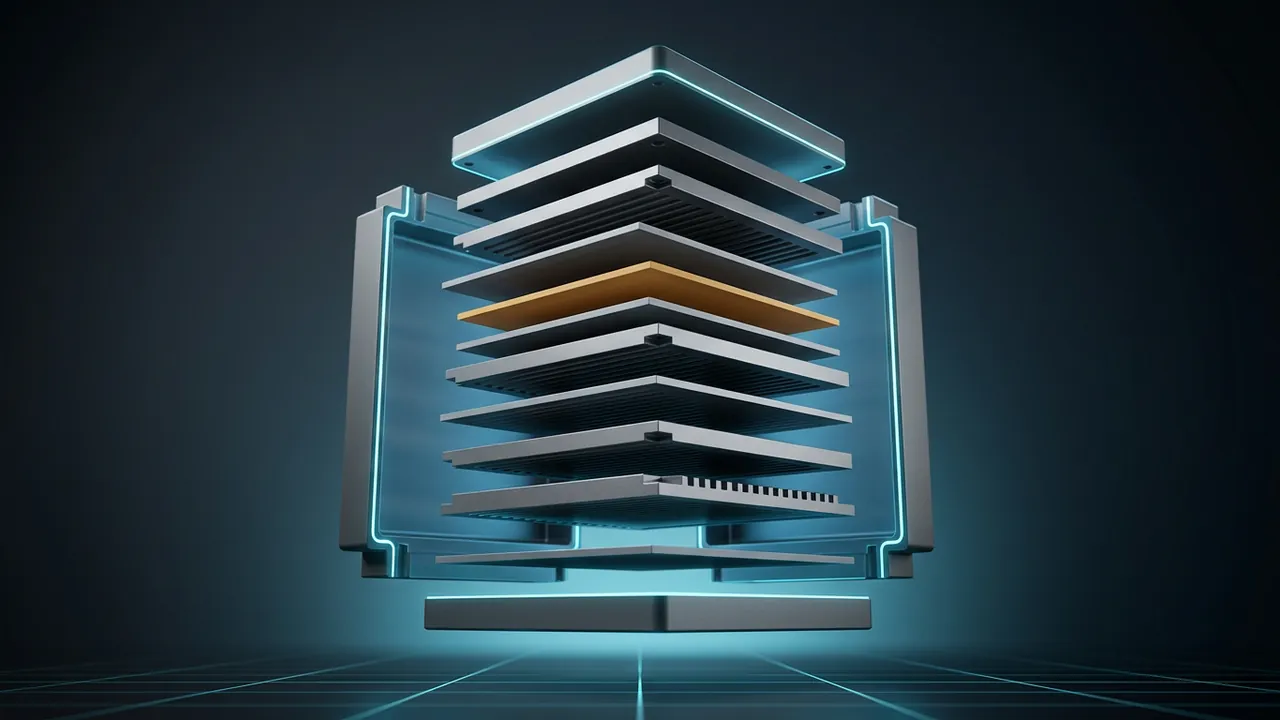
A fuel cell makes electricity through an electrochemical reaction instead of combustion. It has three main layers: an anode, a cathode and an electrolyte between them. Fuel goes to the anode, air goes to the cathode, and ions move through the electrolyte. Electrons can't pass through the electrolyte, so they travel through an external circuit, and that flow is the electric current.
A single cell produces less than about one volt, so manufacturers stack many cells together. Stacks are grouped into modules, and modules into power blocks. That's why fuel cell plants scale in small increments, more like servers in a rack than a single big turbine.
What Makes Solid Oxide Fuel Cells Different?
Solid oxide fuel cells use a solid ceramic electrolyte and run hot, typically well above 600 °C. That heat is what makes them suited to natural gas.
- Internal reforming: at high temperature, the cell can convert methane and steam into hydrogen and carbon monoxide inside the stack, so it doesn't need pure hydrogen.
- Fuel flexibility: SOFCs can run on natural gas, biogas or hydrogen.
- High efficiency: the US Department of Energy's SOFC program targets electrical efficiencies above 60%, and the technology suits both modular and large-scale power.
Other fuel cell types exist. Proton exchange membrane (PEM) fuel cells run much cooler and start quickly, but they need clean hydrogen. Microsoft tested PEM-style hydrogen fuel cells as a replacement for diesel backup in 2022, running a 3 MW system. That's a different use case: backup on hydrogen, not prime power on gas.
Why Are Data Centers Interested in Fuel Cells Now?
Data centers are interested in fuel cells mainly because of speed. In many regions, a new large grid connection can take years. A fuel cell plant connected to an existing gas line can sometimes be installed much faster, and it can run as prime power while the site waits for the grid, or permanently.
The deals are getting large. In November 2024, Bloom Energy announced an agreement with utility AEP to procure up to 1 GW of solid oxide fuel cells, with an initial order of 100 MW, aimed at powering AI data centers. Bloom also claims a power density of about 100 MW per acre, a vendor figure, which would make fuel cells very compact compared with solar or even many engine plants.
Air permitting is the other draw. With no flame, SOFCs produce very little NOx, which can make permits simpler in areas with ozone problems.
How Much Gas Does a Fuel Cell Data Center Use?
A fuel cell data center uses less gas per MWh than an engine plant because of its higher efficiency. Compare the two for a hypothetical steady 50 MW load. Efficiencies are assumptions; real numbers come from vendor data and degrade over time.
Fuel Cells at an Assumed 55% Efficiency
- Heat rate: 3,412 Btu/kWh ÷ 0.55 = about 6,204 Btu/kWh
- Hourly fuel: 50,000 kW × 6,204 = about 310 MMBtu/hr
- Daily fuel: 310 × 24 = about 7,445 MMBtu/day
- Gas volume at 1,037 Btu per cubic foot: about 7.2 million cubic feet per day (MMcf/d)
Gas Engines at an Assumed 40% Efficiency
- Heat rate: 3,412 ÷ 0.40 = 8,530 Btu/kWh
- Daily fuel: 50,000 × 8,530 × 24 ÷ 1,000,000 = about 10,236 MMBtu/day
- Gas volume: about 9.9 MMcf/d
The fuel cells save about 2,790 MMBtu a day. At an assumed $3.00 per MMBtu, that's roughly $8,400 a day or about $3 million a year. Carbon dioxide drops in the same proportion, about 27% less, because CO2 depends on how much gas you burn.
How Do Fuel Cells Compare With Engines and Turbines?
Fuel cells compare well on efficiency and emissions and less well on cost and flexibility. The table below is a simplified, qualitative comparison for on-site prime power; real numbers depend on the model and site.
| Feature | Solid oxide fuel cells | Gas reciprocating engines | Simple-cycle gas turbines |
|---|---|---|---|
| How power is made | Electrochemical, no flame | Combustion in pistons | Combustion in a turbine |
| Electrical efficiency | High | Medium to high | Medium |
| NOx without aftertreatment | Very low | Moderate, usually needs controls | Moderate, usually needs controls |
| Startup from cold | Hours | Minutes | Minutes |
| Handling fast load swings | Weak, needs batteries | Fair | Fair to good |
| Unit size | Small modules | Hundreds of kW to about 20 MW | A few MW to hundreds of MW |
Engines and turbines win on upfront cost, field experience and fast starts. Fuel cells win on fuel use, air emissions and noise. That's why the choice usually comes down to which constraints matter most at a given site.
Can Fuel Cell Waste Heat Be Used?
Yes, fuel cell waste heat can be used, and it's higher quality than the heat from many other sources. Because SOFCs run so hot, their exhaust can feed a heat recovery system to make hot water or steam, or drive absorption chillers that produce chilled water for cooling.
For a data center, that's an interesting pairing. The facility needs cooling all year, and an absorption chiller running on fuel cell exhaust heat can offset some of the electric chiller load. The engineering is more complex, and few sites have done it at scale, but it can push total fuel efficiency well beyond the electrical efficiency alone.
What Are the Downsides of Fuel Cells?

The downsides are cost, stack life, startup time and load following. None are deal-breakers, but each shapes the design.
- Capital cost: fuel cells generally cost more per kW installed than reciprocating engines, so the fuel savings have to pay back the premium.
- Stack degradation: cells slowly lose performance and are replaced on a multi-year schedule, which belongs in the operating budget.
- Slow startup: SOFCs must heat up to operating temperature, which can take hours. They're meant to run continuously, not to start in an emergency.
- Load following: SOFCs prefer steady output. Sudden swings stress the cells, so batteries usually handle fast changes.
- Carbon: on natural gas, they still emit CO2, just less per MWh than less efficient generators.
The way I see it, the economics hinge on how much you value speed and clean air permits. If a site can get grid power on time at a fair price, fuel cells face a tough comparison. If the alternative is waiting years, the premium can look small.
How Do Fuel Cells Handle Data Center Reliability?
Fuel cells handle reliability through modularity. A plant is made of many small units, so losing one module takes out a small slice of capacity, not the whole plant. Designers add spare modules, an N+1 or N+2 approach at the module level, so the site keeps full output when one unit is down for service.
The gas supply becomes the single point of failure. A fuel cell plant needs firm gas delivery and, ideally, a second source or on-site storage of some kind. Many designs also keep a grid connection or batteries for ride-through.
Do Fuel Cells Still Need Batteries and Backup?
Most fuel cell data center designs still use batteries, and many keep some form of backup. Batteries absorb fast load steps and cover the gap if a module trips. Uninterruptible power supply (UPS) systems still protect the servers from any interruption at all.
Whether diesel generators stay depends on the owner's risk appetite and local rules. Some operators see a modular, always-on fuel cell plant with batteries as resilient enough. Others keep generators as a last line of defense.
Where Do Fuel Cells Fit Among Other Clean Options?
Fuel cells fit as a near-term, available option between conventional gas generation and future firm clean power. They can be deployed today on gas, with a path to hydrogen or biogas later.
Nuclear is the longer-term contender for firm, carbon-free power. A small modular reactor data center is still years away for most developers, while fuel cells can be ordered now. Some owners treat fuel cells as a bridge, others as the permanent answer.
A Fuel Cell Data Center Fits Where Speed Beats Sticker Price
Fuel cells can power a data center, and solid oxide fuel cells are the type best suited to running on natural gas around the clock. They're efficient, quiet, low in NOx and modular, and they can arrive faster than many grid upgrades.
The fair way to judge a fuel cell data center is on total cost: capital, fuel, stack replacements and the value of speed. Pair the fuel cells with batteries for fast response, secure firm gas supply and decide early whether you're building a bridge or a permanent plant.