Gas Turbines vs Reciprocating Engines – Which Fits On-Site Power?
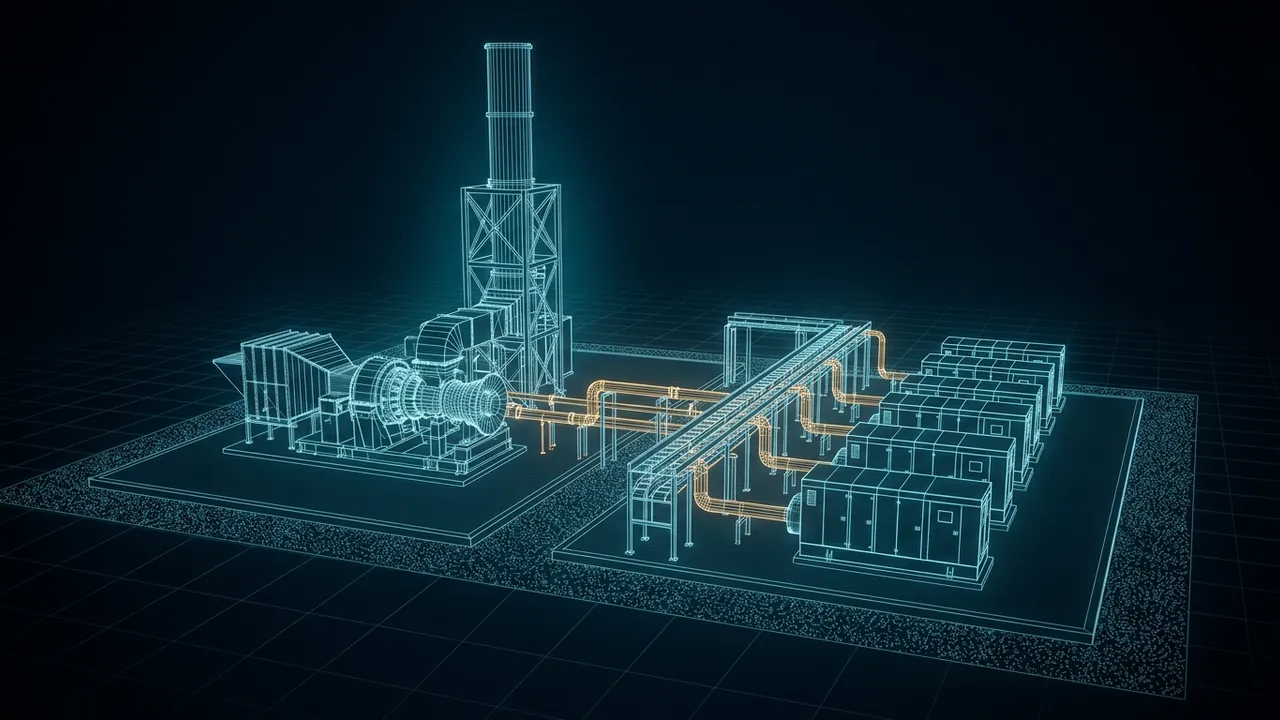
Put a natural gas turbine and a natural gas engine on the same pad, feed them the same fuel, and they will both make electricity. That is about where the similarity ends. One spins continuously at thousands of rpm; the other thumps along with pistons the size of buckets. Anyone choosing between a gas turbine vs reciprocating engine for an on-site power plant is really choosing between two sets of trade-offs. So which one fits your project?
Reciprocating engines usually fit on-site plants where efficiency across changing loads, low gas pressure, hot or high sites, and fine-grained redundancy matter most, which describes many projects from a few megawatts up to a couple hundred. Gas turbines fit larger and steadier loads, tight footprints, projects that want lower uncontrolled emissions or longer maintenance intervals, and plants that will use exhaust heat for steam or combined-cycle operation.
Engines generally win on simple-cycle efficiency at small and mid sizes and on part-load performance. Turbines win on power per square foot and on scale. The right answer comes from your load profile, site conditions and fuel, not from a brochure.
How Do Turbines and Engines Make Power Differently?
A reciprocating engine burns fuel in bursts. Gas and air enter a cylinder, a spark ignites the mix, and the expanding gas pushes a piston down. A crankshaft turns that up-and-down motion into rotation, which drives a generator. It is the same basic idea as a car engine, scaled up enormously and built to run for tens of thousands of hours.
A gas turbine burns fuel continuously. A compressor at the front squeezes incoming air, fuel burns in a combustor, and the hot, high-pressure gas expands through turbine blades that spin a shaft. Part of that shaft power drives the compressor; the rest turns the generator. Engineers call this the Brayton cycle.
That difference explains most of what follows. Pistons hold their efficiency when you run fewer of them or run them partly loaded. Turbines are happiest running steadily near full output, and they depend heavily on the density of the air they breathe.
Which Is More Efficient, a Turbine or an Engine?
At small and medium sizes in simple cycle, reciprocating engines are usually more efficient. The U.S. EPA's Catalog of CHP Technologies lists electric efficiencies of about 27% to 41% for reciprocating engines and about 24% to 36% for gas turbines in its size ranges, both on a higher heating value (HHV) basis. The chart below shows those ranges alongside the availability figures from the same catalog.
Electric efficiency (HHV) and availability ranges for CHP-scale units
- Reciprocating engine
- Gas turbine
U.S. EPA Combined Heat and Power Partnership, Catalog of CHP Technologies (2017)
View the data
| Reciprocating engine | Gas turbine | |
|---|---|---|
| Efficiency, low end | 27% | 24% |
| Efficiency, high end | 41% | 36% |
| Availability, low end | 96% | 93% |
| Availability, high end | 98% | 96% |
The largest modern gas engines go higher. Wärtsilä lists its 34SG gas engine at about 10.4 MW per unit and 47.5% electrical efficiency at 60 Hz, a figure on the lower heating value (LHV) basis that engine makers normally quote. Large aeroderivative turbines can reach around 40% in simple cycle on the same LHV basis.
Turbines take the efficiency crown in one important case: combined cycle. A turbine's exhaust is a single hot stream, often well over 800°F, which is ideal for raising steam in a heat recovery steam generator and running a steam turbine. A large combined-cycle plant beats any engine plant on efficiency. But combined cycle adds cost, water or air-cooled condensers, complexity and time, so it is rare at on-site scale.
Part-Load Efficiency
This is where engines really pull ahead. A turbine running at half load loses a large share of its efficiency, because the compressor still has to work hard while firing temperature drops. An engine plant can simply shut off some units and keep the rest near full load, where they are most efficient. If your load swings or grows in phases, that flexibility shows up directly in the fuel bill.
How Do Heat and Altitude Change the Answer?
Hot weather and high elevation hurt turbines more than engines. Turbine ratings are set at ISO conditions: 59°F, sea level and 60% relative humidity. Hotter air is less dense, so the compressor moves less mass and the turbine makes less power. On a 100°F afternoon a turbine can lose a meaningful slice of its rated output, and the loss grows with altitude.
Engines derate too, but usually less, and often only above certain temperature and altitude thresholds set by the manufacturer. Turbine plants sometimes add inlet air cooling (evaporative coolers or chillers) to recover hot-day output, which brings back some capacity at the cost of water or extra equipment.
Illustrative example: say a project needs 60 MW on its hottest day and considers turbines rated 30 MW at ISO. If the site's design-day conditions knock each unit down to 25 MW, two units now make 50 MW, not 60. The plant needs a third running unit before you even count a spare. That is why every on-site power quote must state output at your design conditions, not just ISO.
Which Handles Load Steps Better?
Both can handle load steps, but they behave differently, and the details depend heavily on the model. A load step is a sudden block of load, such as a cooling plant starting or a data hall transferring from the grid. The generator slows slightly, frequency dips, and the governor adds fuel to recover.
Lean-burn gas engines, the efficient type most common in power plants, can be sensitive to large instant steps because their air-fuel ratio must stay in a narrow band. Many accept load in stages. Rich-burn engines and diesel engines take big steps more easily. Turbines have a lot of rotating inertia and respond smoothly to moderate steps, though large ones still need careful control.
Start time matters too. Wärtsilä says the 34SG reaches full load in under two minutes from a fast start. Aeroderivative turbines can reach full power in roughly five to ten minutes. Large frame turbines take much longer. Many modern on-site plants pair either technology with a battery or UPS system that covers the first few seconds of any step, which takes pressure off the generators.
Size, Footprint and Unit Count
Engine gensets run from a few hundred kilowatts to roughly 20 MW per unit. Gas turbines run from a few megawatts to several hundred. The EPA catalog lists 0.005 to 10 MW for CHP engines and 0.5 to 300 MW for gas turbines, and larger units of both exist.
Unit size changes how redundancy works. Here is a worked comparison for a 60 MW load with N+1 redundancy:
- With 2.5 MW engines: 60 ÷ 2.5 = 24 running units, plus 1 spare = 25 units. Installed capacity is 62.5 MW, about 4% above the load.
- With 30 MW turbines: 60 ÷ 30 = 2 running units, plus 1 spare = 3 units. Installed capacity is 90 MW, 50% above the load.
The engine plant buys redundancy cheaply in megawatts, but it has 25 machines to maintain. The turbine plant has only three, but each spare is a big chunk of capital. Turbines win on footprint: they pack far more megawatts per acre, which matters on tight sites.
Maintenance and Availability
Engines need more frequent attention. Oil changes, spark plugs, valve adjustments and inspections come around every few thousand hours, with major overhauls commonly scheduled around 60,000 to 80,000 operating hours. The work is routine and can often be done on one unit at a time while the others carry the load.
Turbines go longer between major inspections, but each inspection is a bigger job, and hot-section work requires specialists. Aeroderivative units have an advantage here: the engine core can often be swapped for a spare and sent away for overhaul, cutting downtime to days.
The EPA catalog puts availability at 96% to 98% for engines and 93% to 96% for turbines. Plant availability also depends on spares, parts supply, crew skill and how much redundancy you build in, so treat those ranges as starting points.
Gas Pressure, Fuel Quality and Emissions
Turbines need high fuel pressure. Many require gas at hundreds of pounds per square inch, so a site on a low-pressure line may need a fuel gas compressor, which adds cost, power use and one more machine to fail. Most engines run on much lower supply pressure.
Fuel quality cuts the other way. Engines care about methane number, a measure of knock resistance. Rich field gas with lots of ethane, propane and heavier compounds lowers the methane number and can force a derate or gas conditioning. Turbines are generally more tolerant of varied gas, though they have their own limits on contaminants and heating value swings.
On emissions, turbines start ahead. Dry low-NOx combustors keep uncontrolled nitrogen oxide (NOx) emissions low, and some sites add selective catalytic reduction (SCR) for more. Lean-burn engines emit more NOx and carbon monoxide per MWh before controls, so they usually need SCR and an oxidation catalyst to meet strict permits. Both technologies can meet tough limits with the right equipment, but control systems affect cost and footprint.
What About Noise, Water and Waste Heat?

Neither machine is quiet, but they are loud in different ways. Engines produce strong low-frequency sound and vibration, the kind that travels through walls and ground and is hard to block. Turbines produce more high-frequency noise from the inlet and exhaust, which enclosures and silencers handle well. If neighbors are close, ask each vendor for a sound study at your property line, not just a decibel rating at a few feet.
In simple cycle, both use very little water. Engines reject heat through closed-loop radiators, much like a truck. Turbines in simple cycle need almost no cooling water at all, unless they use evaporative inlet cooling or water injection for NOx control.
Waste heat is where the split gets interesting. About half or more of the fuel energy in either machine leaves as heat. In an engine, that heat is divided between the exhaust and the jacket water that cools the block, so it suits hot water, building heat and absorption chillers. In a turbine, nearly all of it leaves in one hot exhaust stream, which suits high-pressure steam. If your site has a use for heat, the type of heat you need may decide the machine for you.
What About Cost?
Installed cost per kW depends on unit size, market conditions, emissions controls, site work and how much redundancy you carry, so be wary of anyone who quotes a single number without seeing your project. As a rule of thumb, compare total cost per delivered MWh over the life of the plant, including fuel, maintenance and the spare units, rather than the sticker price per kW of one machine. A slightly cheaper machine that burns 10% more gas usually loses that contest within a few years.
Gas Turbine vs Reciprocating Engine: Side by Side
| Factor | Reciprocating engine | Gas turbine |
|---|---|---|
| Typical unit size | Under 1 MW to about 20 MW | A few MW to several hundred MW |
| Simple-cycle efficiency | Higher at small and mid sizes | Lower, except large aeroderivatives |
| Part-load efficiency | Strong, since units can be shut off | Drops noticeably |
| Hot-day and altitude loss | Smaller | Larger |
| Fuel gas pressure | Low | High, may need a compressor |
| Uncontrolled NOx | Higher | Lower with dry low-NOx |
| Maintenance | Frequent and routine | Less frequent, more specialized |
| Power per acre | Lower | Higher |
| Best heat recovery | Hot water and low-pressure steam | High-pressure steam, combined cycle |
Which Fits Your On-Site Power Project?
Lean toward engines when the plant is under roughly 100 to 200 MW, the load varies or grows in phases, the site is hot or high, gas pressure is low, or you want many small units for redundancy. Remote and oilfield sites often fit this description.
Lean toward turbines when the load is large and steady, space is tight, you want fewer machines, you plan to recover exhaust heat at high temperature, or local NOx limits are strict. If speed and mobility matter, a trailer-mounted unit or an aeroderivative gas turbine may fit better than a heavy frame machine.
Plenty of plants use both: engines for flexible load following and turbines for the steady base. That kind of mix also spreads supply chain risk, since engines and turbines come from different factories with different lead times.
Pistons or Blades: Picking the Right Gas Turbine vs Reciprocating Engine
There is no universal winner in the gas turbine vs reciprocating engine debate. Engines lead on simple-cycle efficiency at modest sizes, part-load performance, hot-site output and low gas pressure. Turbines lead on scale, footprint, uncontrolled emissions and high-temperature heat recovery.
Before talking to vendors, write down four things: your load profile over a day and over the project's phases, your design hot day and elevation, your gas pressure and composition, and your redundancy target. Run both technologies through those numbers. The physics will usually make the choice clearer than any sales pitch.