What Is Black Start Capability? – Restarting Power From Zero

Here is a puzzle that keeps power engineers honest. A large power plant makes hundreds of megawatts, yet it cannot start itself. Its pumps, fans, fuel systems and controls all need electricity before the first unit can turn. Normally that power comes from the grid. So what happens when the grid is gone and every plant in the region is sitting dark? Someone has to strike the first match. What is black start capability, and how does a power system restart from zero?
Black start capability is the ability of a generating unit or plant to start up without any outside electricity and then energize a dead electrical system so other units can start. Most large power plants do not have it, because their auxiliary equipment needs power from the grid to run.
Black start units are usually smaller machines, such as hydro units, diesel generators, batteries or gas turbines with starter engines. On the grid, operators plan restoration around a few designated black start resources. On a microgrid or off-grid site, black start capability is part of the design from day one, because nobody else will restart it.
Why Can't Most Power Plants Start Themselves?
Because a power plant is also a big electrical customer. Before a large unit can make power, it has to run cooling water pumps, boiler feed pumps, fans, fuel handling, lubrication systems and controls. Engineers call this station service or auxiliary load.
Run rough numbers on a big unit. An illustrative 600 MW steam unit that uses about 5% of its output for auxiliaries needs roughly 0.05 × 600 = 30 MW just to start and run. That is far more than a backup generator in the parking lot can supply. With the grid down, the plant is stuck.
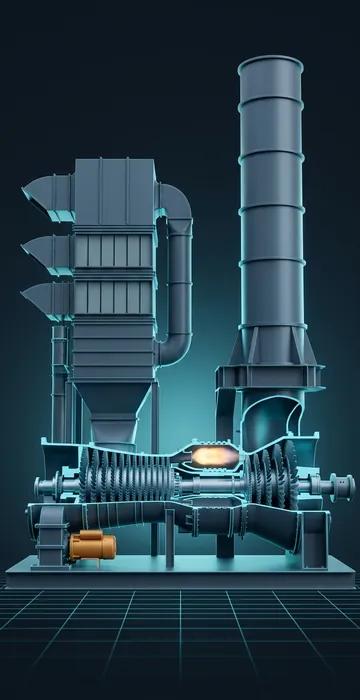
Smaller and simpler machines are different. A hydro unit needs little more than battery power for controls and gate operation. A gas turbine needs a starter, which can be a diesel engine or an electric motor fed from a small generator. A reciprocating engine may start from batteries or compressed air, much like a truck engine.
How Does Black Start Work on the Power Grid?
Grid operators keep written restoration plans built around designated black start resources. In North America, reliability standards from the North American Electric Reliability Corporation (NERC), including its system restoration standard known as EOP-005, require transmission operators to maintain those plans and test the resources.
The broad sequence is:
- A black start unit starts on its own power.
- It energizes a short, planned path of transmission lines, called a cranking path, to a larger power plant.
- That plant uses the power to start its auxiliaries and bring its own units online.
- Operators connect blocks of customer load gradually, keeping frequency and voltage stable.
- Islands of restored power grow and are synchronized together until the system is whole again.
Is there enough black start capability on the grid? A joint Federal Energy Regulatory Commission (FERC) and NERC staff study released in 2018 reviewed nine utilities and found they had sufficient black start resources. It also recommended attention to units that depend on a single fuel and to more thorough restoration testing.
What Equipment Provides Black Start Capability?
At grid scale and at site scale, the same few technologies show up:
- Hydroelectric units, which need very little auxiliary power
- Gas turbines with diesel starting engines or dedicated black start generators
- Diesel generators, which start from their own batteries
- Battery energy storage systems (BESS) with grid-forming inverters that can create voltage and frequency on a dead bus
- Reciprocating gas engines with battery or compressed air starters
Batteries have become a popular black start source for microgrids because they respond instantly and can energize a bus smoothly. But they hold limited energy, so they must get the main generators running before they run down.
How Does a Microgrid or Off-Grid Site Black Start?
On a self-contained site, the sequence is a smaller version of the grid's. A typical restart looks like this:
- Confirm the cause of the blackout is cleared and the system is safe to re-energize.
- Open breakers to most loads, so the first source only sees what it must carry.
- Start the black start source, often a diesel generator or a battery system.
- Energize the station bus and the auxiliaries of the main generators, such as cooling, lube oil and controls.
- Start the first main unit and synchronize it to the bus.
- Bring additional units online, then restore loads in planned blocks.
Two details catch people off guard. First, energizing a transformer draws a large magnetizing inrush current, often several times its rated current for a short time, and a small black start source may not handle that. Second, loads that have been off for a while can come back all at once and pull more than their normal demand. Planning the restoration order carefully avoids both surprises.
What Does Fuel Have to Do With Black Start?
Everything. A black start unit is only useful if its fuel is available when the grid is down. Diesel stored in tanks on site is the classic answer. Natural gas is less certain, since pipeline compressor stations, and any on-site gas compressors, may themselves need electricity.
That is why the 2018 FERC and NERC study flagged single-fuel risk. For an off-grid or behind-the-meter site, ask a pointed question: if every machine here is dark, where does the first unit's fuel come from, at the pressure it needs? If the answer involves an electric compressor, the black start plan needs a power source for that compressor too.
How Is Black Start Capability Tested?
By doing it for real, under controlled conditions. A paper plan is not enough. Testing usually includes:
- Starting the black start unit with all outside power isolated
- Energizing a dead bus and verifying voltage and frequency stay within limits
- Starting the auxiliaries of a main unit from the black start source
- Picking up load blocks and confirming protection settings behave as expected
Testing finds the small things that ruin a real restart: a dead starting battery, a breaker that needs station power to close, a control panel fed from the wrong source. Good operators repeat the test on a schedule and after any major change.
Why Does Black Start Matter for Data Centers?
For a grid-connected data center with standby generators, black start is handled locally by the generators themselves, which start from batteries and pick up the load automatically. The bigger question is for behind-the-meter and off-grid campuses, where the on-site plant is the only source. If that plant trips completely, the uninterruptible power supply (UPS) buys minutes, not hours. The plant has to restart from zero, quickly and in the right order.
Restarting is also only half the job. The power that comes back must be clean and stable enough for sensitive electronics. Frequency, voltage and harmonics during restoration all affect data center power quality, and a rough restart can trip equipment that just came back online.
Somebody Has to Strike the First Match
Black start capability is the ability to bring a power system back from total darkness without outside help. Large plants usually cannot do it; small, self-starting units such as hydro, diesel, gas turbines with starter engines and batteries provide it. The grid restores itself through planned cranking paths, and microgrids follow the same logic at a smaller scale.
A simple test for any site that makes its own power: can the person on shift tonight name the first source, its fuel, its starting method and its restart sequence, and say when all four were last tested? If not, that is the next job on the list.